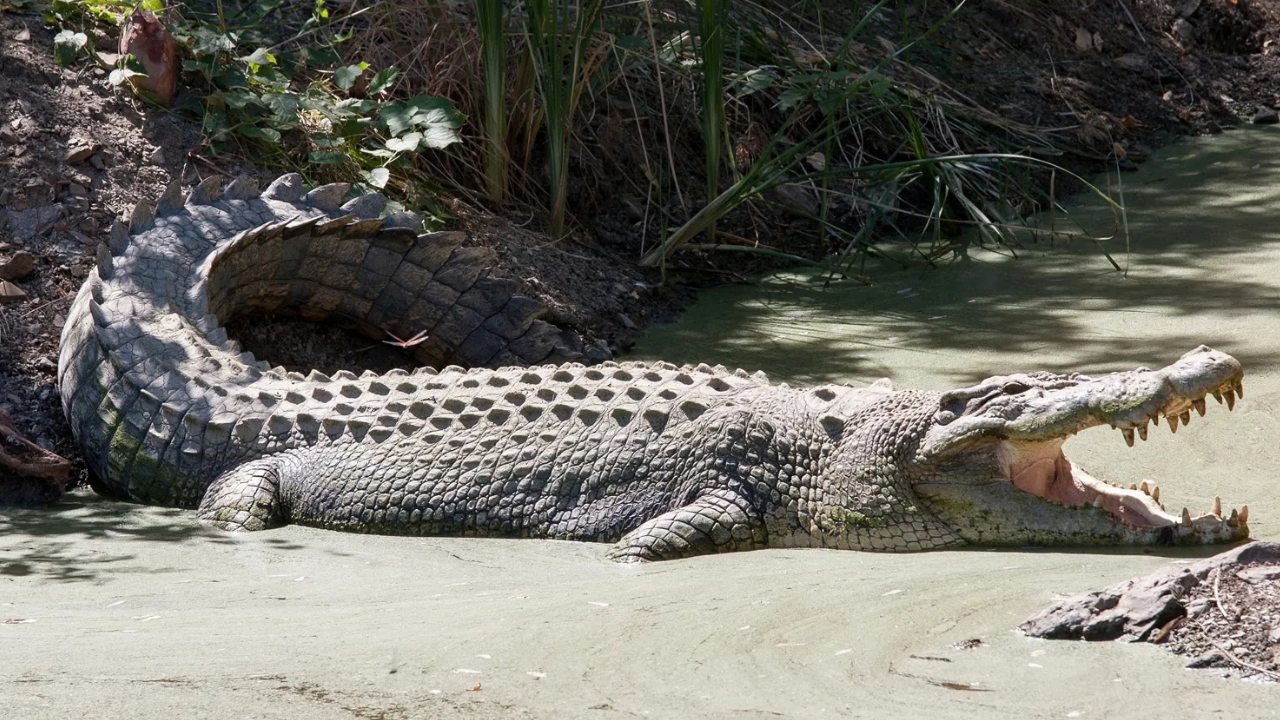
Water does not forgive a shadow.
When something breaks the surface of Lower Peirce Reservoir in Singapore, the reaction is not casual. The water is thick, dark, and heavy with the history of a tropical catchment area where monitor lizards slip quietly through the reeds and freshwater life thrives in the humid stillness. So when a photograph surfaced online showing what appeared to be a massive, prehistoric-scaled crocodile gliding near the banks, the water stopped being just water. It became a theater of collective anxiety.
For forty-eight hours, the local landscape shifted. Rangers walked the muddy perimeters with boots sinking into red earth. Drones hummed against the heavy morning haze, their optical sensors scanning every reed bed and ripple for the distinctive profile of an apex predator. Wildlife officers deployed cameras, checked traps, and questioned park-goers who suddenly looked at the placid shoreline with entirely different eyes. People canceled morning runs. Parents pulled children back from the water's edge.
The animal looked real. Its armored plates caught the tropical glare. Its tail curved with the terrifying, effortless geometry of a creature built before humanity invented concrete or code.
Except it never breathed. It never blinked. It never left a footprint in the mud.
A fifty-four-year-old man had generated the image using artificial intelligence, uploading it into the digital bloodstream where context dissolves faster than sugar in hot tea. He had wanted to see what would happen. He found out. What started as a casual experiment in digital creation metastasized into a physical emergency, mobilizing municipal resources, terrifying a neighborhood, and forcing emergency responders to spend two precious days chasing a ghost crafted entirely of pixels and probability matrices.
We live now in a peculiar friction point between what we see and what we know. For decades, visual media carried an implicit social contract. A photograph was a witness. A video was an affidavit. If you saw it with your own eyes—mediated through a screen or printed on paper—your brain accepted it as a proxy for physical reality. That contract is broken.
Consider what happens when the digital realm bleeds into the physical world with such violent speed. A generation ago, a hoax required physical labor. Someone had to carve a fake footprint, paint a papier-mâché fin, or doctor a negative with chemicals in a darkroom. That friction acted as a natural brake on absurdity. Today, the generation of hyper-realistic imagery takes seconds. A prompt typed into a server farm in another hemisphere can conjure a photorealistic disaster, an extinct animal, or a localized catastrophe with terrifying fidelity.
The man in Singapore discovered what happens when the barrier between fantasy and public safety collapses. When the police finally tracked him down, the realization set in that the consequences of our digital keystrokes are no longer contained within the glowing rectangle of a smartphone. They spill over into the mud. They cost taxpayer money. They consume the hours of men and women whose job is to protect real human lives from genuine hazards.
Fear is an ancient currency. Long before we had algorithms, we had rumors of monsters in the dark. We are hardwired to respond to the threat of teeth and claw. The human amygdala does not pause to evaluate the provenance of a JPEG when an apex predator appears to be lurking in local waters. Our physiological response—the adrenaline spike, the tightening of the chest, the sudden hyper-awareness of our surroundings—is entirely real, even when the stimulus is entirely synthetic.
This is the hidden cost of our current technological pivot. We have democratized the ability to manufacture collective panic.
Look closer at the reservoir during those two days. The search effort was not just a logistical response; it was a symptom of a deeper societal vertigo. When authorities finally confirmed the image was a fabrication, the public relief was immediately shadowed by a cold, nagging realization. If a crocodile was fake today, what is real tomorrow?
The erosion of trust is silent. It does not announce itself with a crash. It arrives in whispers, in the second-guessing of a news alert, in the hesitant glance toward a neighbor's post, in the weary sigh of an official who has to spend public funds debunking a digital hallucination. Every false alarm taxes our collective resilience. We only have so much vigilance to give before exhaustion sets in, and a tired society is dangerously vulnerable.
Technology companies often speak of innovation in terms of frictionless power. They promise tools that let us create anything, faster, cheaper, and with unprecedented scale. But frictionless creation guarantees frictionless deception. When there is no cost to manufacturing convincing lies, the truth becomes an expensive luxury that requires specialized labor to excavate.
The man sitting at his computer screen typing out descriptors for a reptile that never existed probably did not intend to launch a two-day municipal hunt. He likely viewed it as a prank, a harmless exercise in digital flexing, a way to test the limits of generative tools. But intent matters very little when the machinery of mass communication is amplified to industrial levels. A match struck in an empty room is just a spark until it lands on dry tinder.
We are forced to ask ourselves how we navigate a world where seeing is no longer believing. The answer does not lie in retreating from technology, nor does it lie in throwing our hands up at the impossibility of verification. It lies in building a new kind of cultural literacy—one that recognizes the weight of our outputs.
The water in Lower Peirce Reservoir is quiet again. The rangers have packed away their tracking gear. The joggers have returned to the perimeter paths, their eyes occasionally dropping to the surface, looking for ripples that shouldn't be there. The digital ghost is gone, dissolved back into the servers where it was born, but the ripple it left in the public consciousness continues to widen, touching the edges of how we trust what we know.