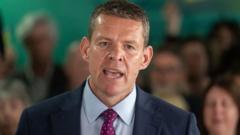
The century of Labour dominance in Wales did not end with a bang, but with the steady, practiced cadence of a former BBC journalist. As the 2026 Senedd election results settled into the history books, Rhun ap Iorwerth did more than just lead Plaid Cymru to a plurality of 43 seats. He effectively dismantled the "Red Wall" of the west, proving that the Welsh electorate’s exhaustion with Cardiff Bay was stronger than its traditional tribal loyalties. For the first time since the dawn of devolution in 1999, the keys to the kingdom have been handed to a party whose primary allegiance is not to a UK-wide machine, but to the specific, often messy realities of Welsh autonomy.
The victory is historic, but the mechanics of how we got here are less about a sudden surge in nationalist fervor and more about a calculated pivot toward pragmatism. Ap Iorwerth inherited a party in 2023 that was reeling from internal scandals and a sense of directionless idealism. His predecessor, Adam Price, spoke the language of grand constitutional theory; ap Iorwerth speaks the language of surgical hubs and school attainment. By sidelining the immediate demand for an independence referendum—pushing the conversation toward 2030 at the earliest—he neutralized the most potent weapon in his opponents' arsenal. He didn't make the election about leaving the UK; he made it about the fact that after 27 years of Labour rule, the Welsh NHS is at a breaking point.
The Mathematics of Survival
Leading a minority government in a 96-seat Senedd is a precarious balancing act. While Plaid Cymru is the largest party, it sits six seats short of a majority. The collapse of the Welsh Conservatives and the seismic rise of Reform UK, who secured 34 seats, has created a chamber that is more polarized than at any point in the devolved era. Ap Iorwerth has already ruled out any deal with Nigel Farage’s party, calling them a "politics of division" that cannot be trusted with Welsh institutions. This leaves him in a forced marriage of convenience with a hollowed-out Labour Party that has seen its vote share crater to 12 percent.
The "One Welsh Public Service" model ap Iorwerth has proposed is a direct response to the fragmentation of the last two decades. He is betting that by consolidating health boards and centralizing the delivery of services, he can find the efficiency that eluded the Gething and Morgan administrations. It is a gamble. Minority governments are notoriously vulnerable to "budget blackmail," where smaller parties like the Greens or the remains of the Liberal Democrats can demand localized concessions that threaten the coherence of a national strategy.
Key Challenges for the Minority Administration:
- NHS Reform: Moving from seven health boards to a more centralized or localized "surgical hub" model without causing administrative paralysis.
- The Reform Threat: Managing a Senedd where the second-largest party is ideologically committed to undermining the very institution they sit in.
- Fiscal Restraint: Fulfilling promises not to raise income tax while demanding "fair funding" from a UK Labour government that is equally strapped for cash.
The Journalist in the First Minister’s Office
There is a specific irony in ap Iorwerth’s ascent. As a former chief political correspondent for BBC Wales, he spent years asking the questions that now haunt him from the other side of the podium. His media training is visible in every public appearance—he rarely makes the kind of unforced errors that plagued the final months of the Labour-Plaid cooperation agreement. When Vaughan Gething was mired in donation scandals, ap Iorwerth didn't just criticize; he walked away, ending the partnership and signaling that his party would no longer be the junior partner in a failing firm.
That decision was the turning point. It allowed Plaid Cymru to position itself as the "hopeful" alternative to Reform’s "anger." While Reform campaigned on a platform of punishing the "establishment," ap Iorwerth convinced voters that Plaid was the anti-establishment choice, despite having been a de facto part of the governing structure for years. He successfully framed the 2026 election as a choice between a Wales that works for itself and a Wales that remains an afterthought in Westminster.
The Independence Long Game
The elephant in the room remains the constitutional question. Critics on the hard-line wing of his own party are already murmuring that the price of power was the soul of the independence movement. By delaying a referendum, ap Iorwerth has traded a dream for a delivery plan. However, his strategy is more sophisticated than a simple retreat. He understands that a failed referendum in the mid-2020s would bury the movement for a generation.
Instead, he is attempting to build "independence in all but name." By focusing on economic development agencies and taking control of natural resources, he is building the infrastructure of a state before asking for the title. If his government can prove that a Plaid-led Wales is more efficient and more prosperous than a Labour-led one, the argument for full sovereignty becomes a matter of logic rather than just emotion.
The next 100 days will be the test. The "First 100 Days" plan he launched in Newport is ambitious, promising immediate action on child poverty and health waiting lists. But the Senedd is a different beast now. The old consensus is dead. Ap Iorwerth is no longer the man asking the questions; he is the man who has to make the numbers add up in a room full of people who want him to fail.
Plaid Cymru leader Rhun ap Iorwerth on Senedd election victory
This video provides direct insight into Rhun ap Iorwerth's campaign promises and his confrontational stance against Westminster during the 2026 election cycle.