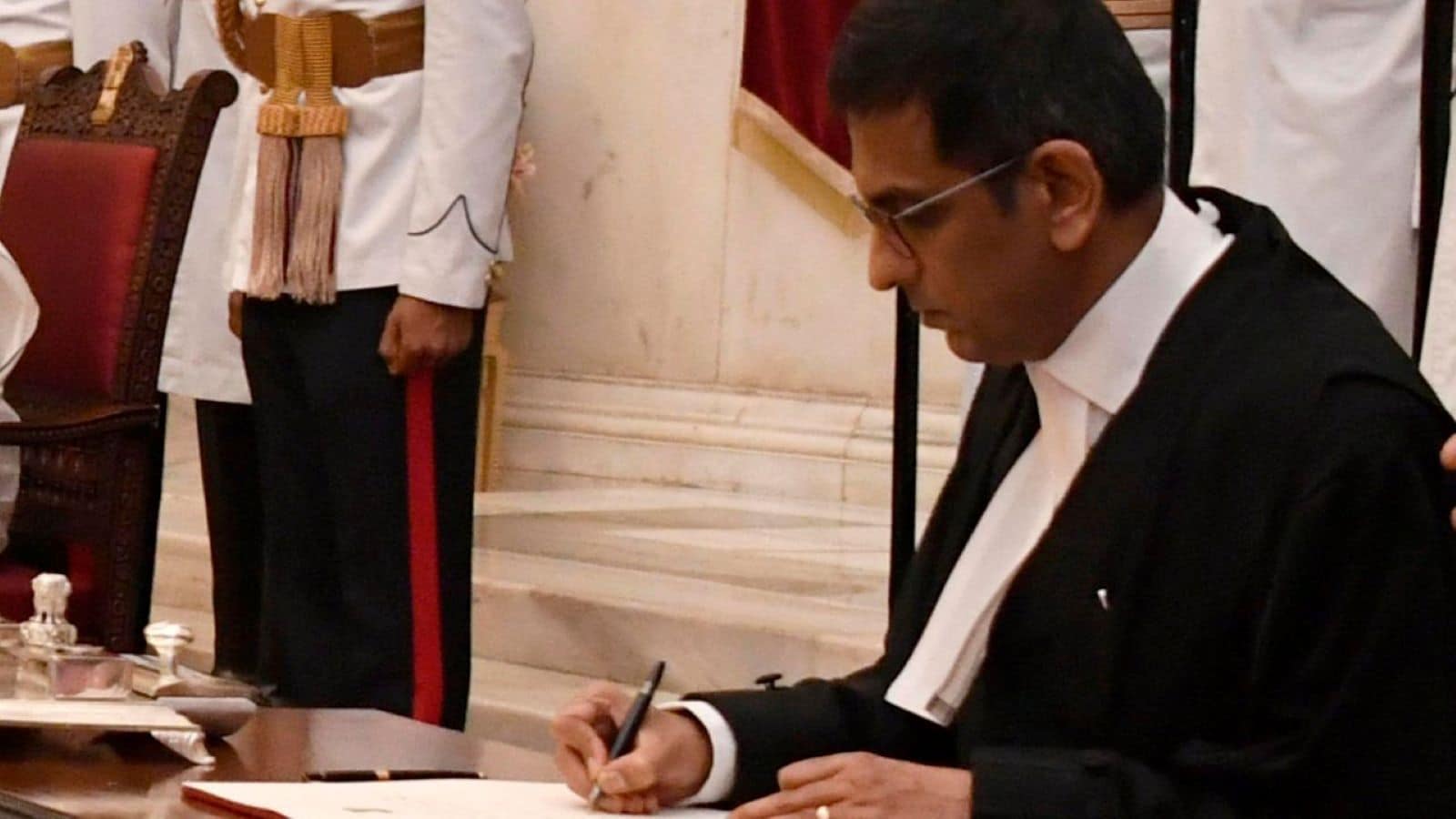
Ink dries slowly in official chambers. Usually, it takes years for a legal signature to harden into history. But sometimes, a single stroke of a pen carries the weight of a continent's unresolved grief.
Picture a quiet study. Piles of briefs rise like fortress walls. Dust motes dance in slanting afternoon light. A man who spent decades sitting on the highest bench of a sprawling democracy now stares at a new kind of docket. His name is Dhananjaya Yashwant Chandrachud. Not long ago, he wore the heavy robes of India’s Chief Justice, listening to the heartbeat of a billion people through petitions, arguments, and constitutional crises. Today, thousands of miles away from the dust and clamor of New Delhi, his signature is summoned for a very different theater of conflict.
Russia has chosen him. As an arbitrator.
To understand why this matters, you have to step away from the sterile jargon of international law and look at the wreckage.
War is loud. Cannons roar, sirens wail, and buildings crumble into gray dust. Yet, beneath the noise of artillery, a quieter, equally brutal war wages in ledgers, bank vaults, and corporate boardrooms. Billions of dollars freeze in accounts. Contracts shatter overnight. When nations collide, the money trail breaks, and someone has to pick up the pieces of the financial puzzle.
Enter the former Chief Justice.
Arbitration sounds dry. It sounds like men in gray suits arguing over commas in a conference room. But behind closed doors, arbitration is where empires settle their bills when they cannot afford total financial ruin. It is the shadow court of global commerce.
Consider what happens when a major bank becomes a casualty of geopolitical crossfire. A Ukrainian bank, caught in the suffocating grip of a war that has rewritten the map of Eastern Europe, finds itself locked in a bitter financial dispute with Russian entities. Trust is a luxury of the past. Neither side will ever step foot in the other's domestic courts. They need a neutral referee. They need someone whose reputation stands above the immediate fray.
They need a legal titan who knows how to read between the lines of global treaties.
When the news broke, it hit legal circles with the sudden force of a dropped anchor. Why Chandrachud? Because trust is the scarcest commodity on earth right now. India has maintained a delicate, diplomatic tightrope walk throughout the conflict, refusing to condemn Moscow outright while calling for peace and respecting sovereign borders. That strategic neutrality makes an esteemed Indian jurist uniquely acceptable to opposing sides who would violently reject a Western or Russian judge.
Law is supposed to be blind. We learn this cliché in school, imagining a statue holding scales with a cloth tied over her eyes. In reality, the statue frequently peeks. Judges are human. They carry the weight of their origins, their cultures, and their political climates.
I remember sitting in a packed courtroom years ago, watching a senior magistrate weigh a messy commercial dispute. The air smelled of old paper and nervous sweat. The stakes were microscopic compared to a sovereign state dispute, yet the human dynamic was identical. People desperate for a stranger to tell them who was right. People hoping against hope that fairness still existed in a room full of expensive lawyers.
Now scale that up. Replace two squabbling corporations with a scarred nation and a nuclear superpower. Replace the tired magistrate with a man who until recently shaped the constitutional destiny of the world's largest democracy.
The appointment raises fierce, uncomfortable questions. Can a former head of a nation’s judiciary step onto the global stage as a mercenary of peace, selling his intellect to resolve the financial fallout of a war? Or is this the ultimate act of legal diplomacy, a way to keep communication channels alive when politicians have stopped talking?
The truth is messier than a neat ideological label.
Arbitrators are not politicians. They are mechanics of dispute. They look at contracts, international conventions, and precedents. They ask whether a clause was violated, whether an asset was wrongfully seized, and how much compensation is owed. They do not stop missiles. They do not liberate occupied towns. What they do is tally the cost of the catastrophe.
And that cost is staggering.
As the arbitration proceedings grind forward, shielded by layers of confidentiality and diplomatic discretion, the world will mostly look away. Headlines chase explosions, not arbitration clauses. But the outcome of this specific legal battle will ripple through international finance for decades. It will set a precedent for how frozen assets are handled, how cross-border banking disputes survive active warfare, and whether global institutions can still find neutral ground when the world is splitting apart at the seams.
Think about the sheer surrealism of the scene.
In a quiet room, insulated from the sirens of Kyiv and the Kremlin's war rooms, an Indian jurist reads arguments written in English, Russian, and Ukrainian. He sips his tea. He turns a page. He considers the fate of millions of dollars tied up in a war zone.
History is written by victors, but it is audited by arbitrators.
The pen moves across the paper. Another line is drawn. The war outside continues its vicious cycle, but inside the chamber, a different kind of boundary is being marked out, one quiet ruling at a time.