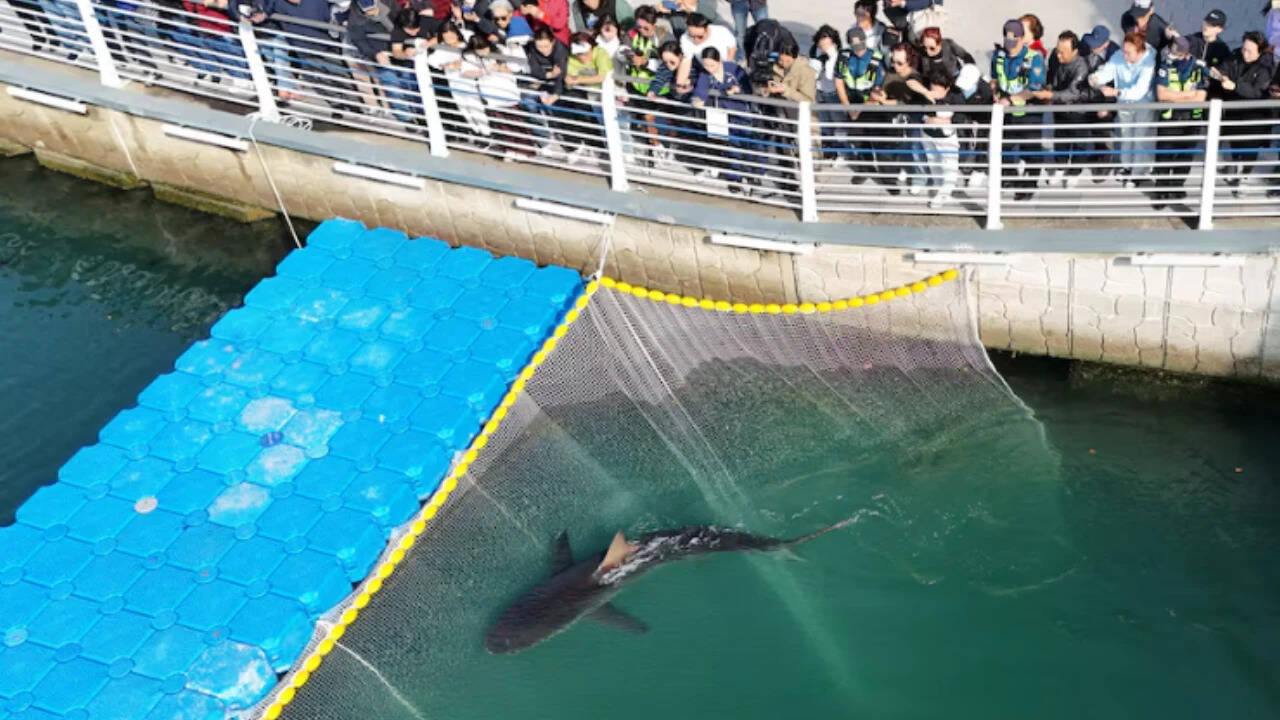
Three tries. One stubborn shark. Back into the canal it goes.
Every time a headline like that hits the wire, the public reacts on cue. Aww. Poor thing. Thank goodness the rescuers kept trying. You might also find this related coverage insightful: The Price of Independence on the High Seas.
Stop clapping. Look closer.
When South Korean rescuers haul a shark out toward open water three separate times and watch it slip right back into an artificial canal, standard news coverage treats it like a slapstick comedy or a gritty underdog saga. A plucky crew. A confused predator. A happy-ish ending full of human grit. As highlighted in latest reports by The New York Times, the results are widespread.
That framing is lazy. Worse, it gets the biology, the physics, and the incentives backward.
A shark swimming back into a narrow urban canal is not "confused." It is often running on a stress response, thermal or salinity gradients, acoustic dead-ends, or sheer exhaustion after being chased, netted, and dragged around by well-meaning humans. Repeating the exact same rescue maneuver three times in a row while expecting a different outcome isn't heroic persistence. It is a failure of diagnosis.
The Lazy Consensus Around "Saving" Stranded Marine Life
Standard wildlife rescue stories rely on a predictable script. Humans see an apex predator out of place. Humans intervene to "return it to its natural habitat." If the animal swims right back into danger, the story paints the animal as baffling or ungrateful.
Let's dismantle that premise right now.
First, what counts as "trapped" versus "unwilling to leave" is rarely clear in coastal infrastructure. Canals, industrial slips, breakwaters, and harbor channels aren't neat boxes with an obvious exit sign on the wall. To a shark, a concrete channel with altered currents, boat wake, runoff plumes, and low-visibility water looks nothing like open ocean shelf habitat. Push it toward the mouth and release it without reading the water column, and you may just be dropping a stressed animal into an acoustic or hydrodynamic dead zone—or right back toward whatever drew it in.
Second, repeat capture-and-release carries a steep physiological tax. Sharks aren't terrestrial dogs you can gently carry across a busy street. Restraint, tail-grabbing, netting, crowding, and repeated bursts of anaerobic escape swimming spike blood lactate and cortisol. Over-handling turns a manageable navigation mistake into metabolic acidosis and capture myopathy. Three attempts in one stretch can do more harm to the animal's survival odds than walking away after attempt one to reassess.
Third, public spectacle distorts field decisions. Crowd around any harbor wall with cameras out, and pressure mounts to "do something" visibly. Hauling a large shark around three times looks dramatic on video. Standing back, measuring dissolved oxygen and salinity, or closing off boat traffic looks boring. Guess which one gets approved when a crowd is watching?
What People Actually Ask When a Shark Enters a Canal
Is the shark actually stuck, or does it want to be there?
Ask the wrong question, get a fairy tale. Ask the right one: What physical cues is this animal responding to right now?
Sharks navigate using mechanoreception via the lateral line, electroreception via the ampullae of Lorenzini, vision, olfaction, and thermal sense. Urban canals warp all of those signals. Concrete walls bounce pressure waves and vessel noise back into the channel. Storm drains and outfall pipes dump fresh water, nutrients, or baitfish into pockets where warm surface water sits over cooler bottom layers.
Sometimes a shark enters because it followed prey or a thermal plume and got boxed in by geometry and boat traffic. Sometimes it swims back in because the open-water release point had stronger current, shallower water, or high-stress noise right where the boat sat. Calling every return trip "stubbornness" projects human motives onto a sensory system operating on completely different inputs.
Why try three times if it keeps coming back?
Because three tries feels like a story arc to human observers, even when it makes zero biological sense.
In emergency response, repeating a low-success intervention three times without changing variables is called burning margin. Each chase burns energy stores. Each restraint stresses gills and musculature. If attempt one fails because the release site has a rip current or heavy vessel traffic, dragging the same animal out for attempt two and attempt three at the same spot—or with the same frantic crowding—just compounds fatigue.
There are times when a second attempt is justified: say, the first release happened right next to a seawall break where the animal immediately turned inward, and moving a few hundred meters clear of the channel mouth gives clean flow. Beyond that, persistence without telemetry, environmental data, or a better exit route is just stubbornness wearing a rescue badge.
Should humans intervene at all when a shark wanders into a canal?
Not automatically. That is the hardest pill for people who love animals to swallow.
Intervention is a tool, not a moral duty. If a shark is clearly wedged in shallow water, tangled in gear, or trapped behind a closed lock or net with no way out, action makes sense. If it is swimming freely in a wide canal with an open mouth and no visible injury, jumping in with ropes and boats can escalate a temporary visit into a fatal stress event.
Imagine a scenario where a juvenile coastal shark slips into an industrial canal after heavy rain pushes warmer, nutrient-rich runoff into the basin. It cruises around for an hour. A crowd gathers, boats rev nearby, and rescuers net and tow it out three times—each time releasing it near noisy harbor pilings. The shark keeps darting back toward quieter water or familiar contours. By the third haul, its energy reserves are shot, even if the footage looks "heroic." Compare that to clearing boats, monitoring from shore, and letting the animal orient and exit on its own once conditions calm down.
Battle Scars From the Field and Where the Consensus Breaks
I have watched conservation budgets and emergency response teams get burned chasing optics instead of outcomes. Over years working alongside coastal wildlife responders, fisheries biologists, and marine operations crews, I've seen teams blow serious time, fuel, and political capital on high-drama rescues that felt triumphant in the moment and accomplished very little for long-term survival.
Let's get precise on terminology before the armchair experts weigh in. Stranding and entrapment are not interchangeable. A true stranding involves physical grounding or inability to swim free under normal tidal conditions. Entrapment means an artificial or natural barrier blocks exit. A shark cruising along a canal with open water down-channel is often experiencing habitat disorientation or behavioral persistence, not classic entrapment. Mislabeling every wandering predator as "trapped" forces a rescue hammer onto problems that need observation, traffic control, or water-quality awareness.
Heavy hitters in shark biology and marine megafauna conservation—researchers like Gregory Skomal on shark stress physiology and post-release survival, or teams studying coastal movement and capture stress in elasmobranchs—have spent years driving home a basic truth: how you handle and release an animal often matters more than the sheer act of moving it. Stress physiology doesn't care how many times a crowd cheers on the pier.
Now for the honest caveat, because contrarianism without accountability is just noise. My approach has real downsides.
First, standing down or waiting looks terrible in real time. To a bystander watching a shark glide past apartment blocks or docks, "we're monitoring and limiting boat traffic" sounds like inaction—or worse, indifference to public safety. Second, sometimes a canal does turn into a deathtrap as tides drop, industrial gates close, or water quality deteriorates, and waiting too long can mean losing the window to guide the animal out safely. Third, public safety around large predators is never hypothetical; if a large species enters a high-use waterway, officials cannot simply shrug and let chaos play out.
How to Actually Fix Canal Shark Encounters
If coastal cities and marine responders want fewer three-attempt comedy routines and better outcomes for both people and sharks, they need to change the playbook.
- Audit the exit before touching the shark. Check tidal flow, depth at the channel mouth, vessel traffic, and noise before hauling anything anywhere. Releasing a stressed shark into a noisy shipping lane is a bad handoff.
- Cap handling and set clear abort rules. Decide in advance how many attempts make sense and under what stress signs you stop pushing. More hauling is not automatically more care.
- Control the perimeter, not just the animal. Clear nearby boats, keep crowds off low ledges, and give the shark room to orient without feeling cornered from every angle.
- Track what actually happens after release. Without follow-up observation or tagging on priority cases, nobody knows whether a "successful" release survived the next 24 hours.
Stop grading marine rescues by how dramatic the struggle looks from the railing. Grade them by whether the animal leaves with enough gas left in the tank to actually survive.