The air in New Delhi during late autumn carries a distinct, heavy weight. It is a mix of dust, festive smoke, and the invisible hum of 30 million people trying to move all at once. If you sit near the diplomatic enclaves of Chanakyapuri, the noise of the streets fades into a quiet, manicured stillness. But the decisions made inside these sandstone walls vibrate across continents.
A few years ago, a massive private refinery on the western coast of India stood largely quiet in the dead of night. Its towering distillation columns, designed to process the thickest, most difficult crude oil on earth, were running on a diet of lighter, more expensive fuels. The reasons were thousands of miles away, locked in the geopolitical gridlock of Washington sanctions. The heavy Venezuelan oil that the refinery loved—crude that looks less like liquid gold and more like molasses—had vanished from the market. You might also find this connected story useful: The Sound of Silence After the Sirens Stop.
Then, the political weather shifted.
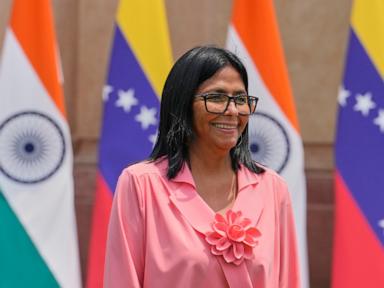
When Indian Prime Minister Narendra Modi shook hands with Venezuelan Vice President Delcy Rodriguez in New Delhi, it was not just another photo opportunity for the diplomatic press corps. It was the closing of a circuit. For the average commuter stuck in a three-mile traffic jam on the Delhi-Gurugram border, watching the fuel gauge tick downward, the meeting mattered. It mattered because India imports over 85 percent of the oil it consumes. Every fraction of a dollar saved on a barrel of crude prevents a ripple effect that can raise the price of a plate of rice on the street corner. As highlighted in latest articles by Associated Press, the effects are widespread.
Geopolitics is often discussed in abstract terms like balance of power or strategic autonomy. In reality, it is about plumbing. It is about matching the specific chemical needs of a multi-billion-dollar refinery with the specific geological output of a hole dug in the Orinoco Belt.
The Chemistry of a Deal
To understand why this meeting caused ripples through global energy markets, consider how a modern oil refinery actually works. Think of it not as a passive factory, but as a highly specialized kitchen. Some kitchens are built to bake delicate pastries; others are designed to roast tough, gamey meats.
India possesses some of the most complex, technologically advanced oil refineries in the world, particularly those owned by Reliance Industries and Nayara Energy. These facilities are the heavy-duty kitchens. They thrive on "sour" and "heavy" crude—the varieties that are cheap because they are packed with impurities like sulfur and metal. While simpler refineries in other nations shy away from this sludge, Indian engineers have perfected the art of cracking these stubborn molecules into ultra-pure petrol and diesel.
Venezuela sits on the world’s largest proven oil reserves, and the vast majority of it is exactly this kind of heavy sludge. They are a lock and a key.
But for years, the key was rusted over. Washington’s tightening of sanctions on Caracas meant that Indian buyers had to walk away from their South American supplier. The refineries had to adapt, buying more expensive alternatives from the Middle East or West Africa. The math was simple but brutal: higher raw material costs meant tighter margins, which eventually filtered down to the domestic consumer.
When the United States temporarily eased those sanctions, allowing transactions to resume, the response was immediate. Reliance quickly placed orders for Venezuelan crude, and state-run entities like Indian Oil Corporation began exploring term contracts. The meeting between Modi and Rodriguez was the public validation of a commercial scramble that had been brewing behind closed doors for months.
The Invisible Stakes at the Pump
Let us step away from the diplomatic corridors and look at a hypothetical citizen named Rajesh. He drives a small, silver hatchback for a ridesharing service in Mumbai. Rajesh does not read the economic pages, and he does not know who Delcy Rodriguez is.
What Rajesh does know is that two years ago, filling his tank consumed nearly 40 percent of his daily earnings. When fuel prices spike, he has to choose between working an extra three hours in grueling traffic or cutting back on the tuition fees for his daughter’s extra math classes.
When India buys discounted Venezuelan crude, it is not an act of ideological alignment with Caracas. It is an act of survival for Rajesh. By diversifying its oil basket, India creates a buffer. If tensions flare in the Middle East—the traditional source of India's energy—the country can pivot. That optionality keeps domestic fuel prices stable. It keeps Rajesh on the road without draining his savings.
This is the human core of energy security. It is the realization that national macroeconomics are directly tied to the micro-stress of a father trying to balance a household budget.
Consider what happens next on the global chessboard. India’s appetite for Venezuelan oil does not just impact the two nations involved. It reshapes trade routes across the globe.
Previously, much of Venezuela’s heavy oil found its way to independent refineries in China via convoluted, shadowy shipping networks designed to evade scrutiny. Now, with India back in the open market as a legitimate, high-volume buyer, Caracas has leverage. Indian refiners offer something cash-strapped nations prize above almost all else: reliable, transparent, hard-currency payments.
The tankers that used to take months navigating subterranean financial channels are now charting direct courses across the Indian Ocean.
The Friction of Autonomy
This return to Venezuela is not without friction. Navigating the shifting sands of international sanctions requires a delicate diplomatic dance. New Delhi has consistently maintained that its energy security cannot be compromised by unilateral sanctions imposed by foreign capitals.
It is an awkward position. India has deepened its strategic partnership with the United States, collaborating on technology, defense, and maritime security in the Indo-Pacific. Yet, at the very same time, Indian officials are sitting across the table from a Venezuelan leadership that Washington has spent years trying to isolate.
How does a nation manage such a contradiction? Through the cold, unblinking lens of national interest.
The Indian diplomatic strategy has become remarkably consistent: look after the immediate economic well-being of its 1.4 billion people first, and manage the geopolitical fallout second. It is the same pragmatism that saw India dramatically scale up its purchases of discounted Russian oil, despite intense pressure from Western capitals.
The meeting between Modi and Rodriguez serves as a clear signal that the Russian strategy was not a one-off anomaly. It was a template.
The Long Journey of a Single Drop
The oil flowing from the Orinoco Belt to the ports of Gujarat travels over 9,000 nautical miles. It spends weeks at sea, a silent cargo cutting through the Atlantic, around the Cape of Good Hope, and across the Arabian Sea.
When it arrives, it is pumped into giant storage tanks, heated, pressurized, and shattered into its component parts. It ceases to be Venezuelan. It becomes the diesel powering a long-haul truck delivering fresh produce to a market in Delhi. It becomes the aviation fuel lifting a domestic flight out of Bengaluru. It becomes the bitumen smoothing out a new highway in Bihar.
The dry news reports will tell you that India is expanding its oil imports to foster economic ties and leverage market opportunities. They will use the language of balance sheets and trade deficits.
But the real story is much simpler, and much older. It is the story of an ancient crossroads utilizing every tool at its disposal to keep its fires burning, its factories humming, and its people moving forward into an uncertain dawn.