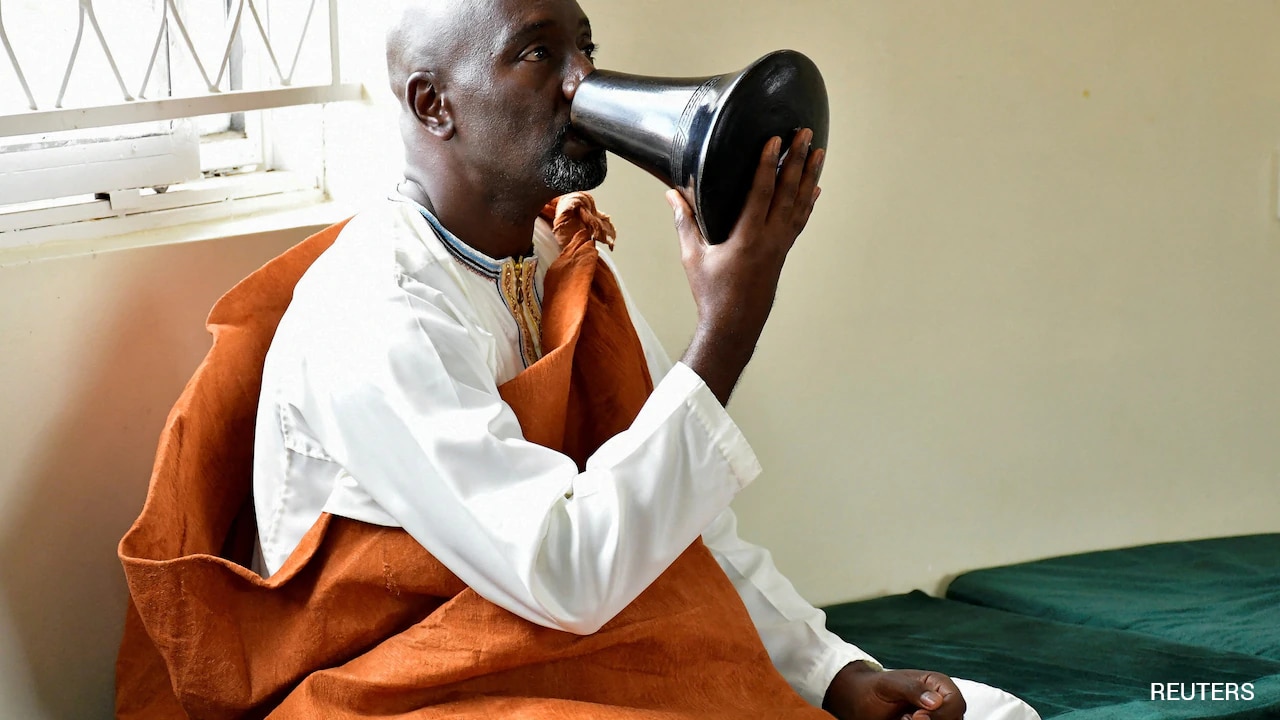
The lazy consensus loves a neat narrative. Take a man who spent his weekdays reading bulletins off a teleprompter at the state broadcaster, drop him onto an ancient African throne, and the global press corps instantly treats the transition like a quirky human-interest filler piece.
Mainstream profiles frame Edward Rukidi Nyabongo the First as an accidental monarch, a television anchor plucked from a studio desk by capricious palace elders. They reduce centuries of structural institutional governance to a fairytale career pivot.
That framing misses the entire mechanics of how traditional power actually survives inside a modern constitutional republic.
The Myth of the Accidental Royal
When King Oyo Nyimba Kabamba Iguru Rukidi the Fourth passed away at thirty-four, foreign desks scrambled for easy tropes about boy kings and sudden vacuums. When the Babiito clan's twenty-one-member succession committee selected Edward Rukidi Kijanangoma, commentators fixated entirely on his resume at the Uganda Broadcasting Corporation.
Stop treating a bloodline like an audition tape.
Monarchies embedded within centralized modern states do not operate on spontaneous whims. They survive through severe, calculated institutional friction. Kijanangoma was not chosen because he knew how to project voice resonance into a studio microphone. He was chosen because the intersection of clan elders, regional supreme councils, and state political machinery calculated that a seasoned, mature insider could stabilize an institution facing severe internal fractures.
To understand the Omukama of Tooro, you have to abandon the Western fantasy that traditional African crowns are merely ornamental relics waiting for a reality television crossover.
The Real Leverage Point Is Structural Continuity
Let us look at the actual data of institutional endurance. Uganda's traditional kingdoms were abolished by Milton Obote in 1967, restored constitutionally under Yoweri Museveni in 1993, and restricted strictly to cultural mandates. They hold no executive authority, no legislative power, and no command over the national treasury.
By conventional political science metrics, these crowns should be dead weights. Yet they persist, command intense loyalty, and arbitrate fierce social cohesion. Why? Because cultural legitimacy acts as the ultimate shock absorber for the state.
When a former news editor takes the regnal name Edward Rukidi Nyabongo the First at Karuziika Palace, he is not stepping up from a lower caste of labor; he is stepping into a formalized framework of micro-diplomacy. A media background does not make someone a novelty king—it makes someone hyper-literate in optics, public narrative control, and institutional communication. In a landscape where ethnic federalism and cultural heritage dictate regional stability, the ability to manage public perception is a formidable governance tool.
Dismantling the Succession Noise
The mainstream narrative loves to emphasize family friction, legal disputes from immediate relatives, and court challenges. This treats the succession like a corporate hostile takeover.
Imagine a scenario where a corporate board ignores internal shareholder litigation because the broader market demands operational continuity. That is precisely what happened in Fort Portal. The Tooro Supreme Council endorsed the selection not because of a vacuum, but because the institution required a mature figure capable of steering cultural preservation—such as protecting local languages and environmental stewardship of the Mpanga River basin—without triggering a constitutional crisis with Kampala.
The friction between royal family factions and clan elders is not a sign of a failing institution; it is the exact pressure valve through which legitimate traditional authority negotiates its survival.
The Uncomfortable Truth About Heritage Governance
Critics love to ask whether traditional monarchies have any functional place in a twenty-first-century republic. It is the wrong question entirely.
The question is not whether the crown possesses legislative teeth. It does not. The real question is how decentralized cultural authorities manage to outlast the centralized political regimes that attempt to contain them. Kingship in Tooro is a masterclass in soft power endurance. It binds communities together through shared rituals like Amakondere praise music and localized identity long after national political parties fracture along ethnic or economic lines.
Edward Rukidi Nyabongo the First did not inherit a stage set. He inherited a heavy administrative obligation to keep a traditional identity alive under the unyielding gaze of a modern state.
Stop looking at the crown through the lens of a television studio. The broadcast ended. The reign has begun.
A TV journalist is crowned king of a traditional monarchy in Uganda
This video provides an on-the-ground look at the historic coronation ceremonies and official proceedings in Fort Portal.