The human body is not designed to absorb what happens in the eighty-fourth minute of a Test match. By that point, the lungs are burning with the dry heat of Santiago del Estero. The jersey feels like wet cardboard. Every impact against the hard earth of the Estadio Único Madre de Ciudades reverberates straight into the jawline.
For England, the physical toll was compounded by self-inflicted math. They were playing with thirteen men.
Four different players had been sent to the sin-bin over the course of the afternoon. Jack van Poortvliet, Alex Coles, Henry Pollock, and the debutant Emmanuel Iyogun had all, at various intervals, been ordered to walk the long line to the plastic chairs. Discipline had not just broken down; it had evaporated.
Yet, there they were, clinging to a 31-24 lead with the clock deeply into the red.
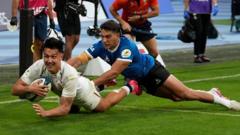
Consider the perspective of Bautista Delguy. The Argentinian winger found himself out wide, the ball finally sticking to the palms of the Pumas after a frantic, multi-phase assault. The stadium, a swirling cauldron of white and sky-blue replica jerseys honoring Diego Maradona, was screaming for a resurrection. Delguy launched his body through the air, aiming for the corner flag, desperate to ground the leather before the whitewash ran out.
Henry Slade threw himself into a desperate, cover-defending slide.
It was a collision of pure will. On the field, referee Angus Gardner signaled what everyone in the stadium believed to be the truth: a try. A chance for Argentina to kick the conversion, level the scores, and complete a staggering second-half comeback.
Then the world stopped for five minutes.
The Television Match Official and the Erasure of Joy
Modern rugby is no longer just governed by the whistle. It is governed by the replay booth. As Gardner hesitated and referred the grounding to the Television Match Official, the collective breathing of forty thousand people halted.
The stadium screens became a courtroom.
Frame by frame, the high-definition footage was rocked backward and forward. To look at sports through a lens so magnified is to strip them of their poetry. You see the grass bend. You see the white chalk of the touch-in-goal line compress under a fragment of a boot.
The footage showed Delguy’s left hand. It showed the ball. It showed the microscopic margin between a heroic draw and an agonizing defeat.
Gardner looked at the monitors. The TMO pointed to the line. Delguy had grounded the ball on the touch-in-goal line by millimeters. The try was overturned.
Furious protests erupted instantly. Fly-half Tomás Albornoz approached Gardner, his face masked in the disbelief that only an athlete denied by technology can feel. Support staff had to physically separate the seething Argentinian squad from the officiating team. It felt, to the home crowd, less like a sporting conclusion and more like a bureaucratic eviction.
But the scoreboard remained frozen: 24-31.
The Chaos That Built the Fortress
The irony of England’s survival is that their rugby had been, for forty minutes, beautiful.
Early on, Tommy Freeman had gathered a delicate cross-kick from Fin Smith to silence the partisan crowd. Ben Earl, running with the sort of fury that suggests he reads every critic's column, crossed twice before the interval. When Immanuel Feyi-Waboso cut a line through the midfield that left three defenders clutching at the hot northern air, England looked entirely untouchable.
They led by sixteen at the break. They looked ready for the beach.
But rugby matches have a habit of decomposing when the pressure changes. When Fin Smith went off for a head injury assessment, the structural integrity of the English backline began to splinter.
Van Poortvliet flapped wildly at a pass. Yellow card.
Coles attempted to intercept a ball from the floor. Yellow card and a penalty try to Argentina.
Suddenly, the sixteen-point cushion was reduced to two. The Pumas roared back through Mateo Carreras, their legs lifted by the sheer noise of an arena that smelled of spilled beer and deep-seated historical rivalry. England’s young replacements looked at one another, suddenly realizing that the international game does not offer safe harbors.
It was a test of survival in the most literal sense. Ollie Chessum and Ellis Genge threw themselves into tackles that were less about technique and more about basic human geography—putting a heavy frame in front of a running man and hoping the collision favored the rose.
The Last Line on the Ledger
When the final whistle finally blew after the TMO's intervention, there were no grand celebrations. The English players sank to their knees, faces caked in sweat and dirt, looking more like survivors of a minor traffic accident than victorious athletes. They had won their second match of this inaugural Nations Championship, securing third place in the northern standings, but the victory felt heavy.
Sports analytics will look at the penalty counts. Coaches will look at the tackle completion percentages and the technical errors that led to four separate yellow cards. Steve Borthwick will undoubtedly spend the flight home wondering how a team can look so brilliant and so fragile within the span of the same eighty minutes.
But for those who watched the ball descend into Delguy’s arms in the dying seconds, the game will not be remembered for its structure. It will be remembered for that agonizing, silent interlude where twenty-six exhausted men stood in the dirt, waiting for a man in a booth miles away to tell them whether their afternoon of pain had amounted to anything at all.