The air above Museum Island smelled of damp asphalt, bruised petals, and the electric static of a city holding its breath.
Only hours earlier, the bright pulse of Berlin’s Christopher Street Day had been violently interrupted. A white van had sheared through the edges of the festivities near Tiergarten park, leaving one life extinguished and nearly thirty others broken. The sirens had wailed through the night, a metallic chorus that drowned out the music, trading the rhythmic thump of basslines for the frantic shouts of medics. By Sunday morning, candles and white lilies began to pool on the pavement like silent tears. Fear had arrived, wearing its familiar, ugly mask.
Then came the spinning skirt.
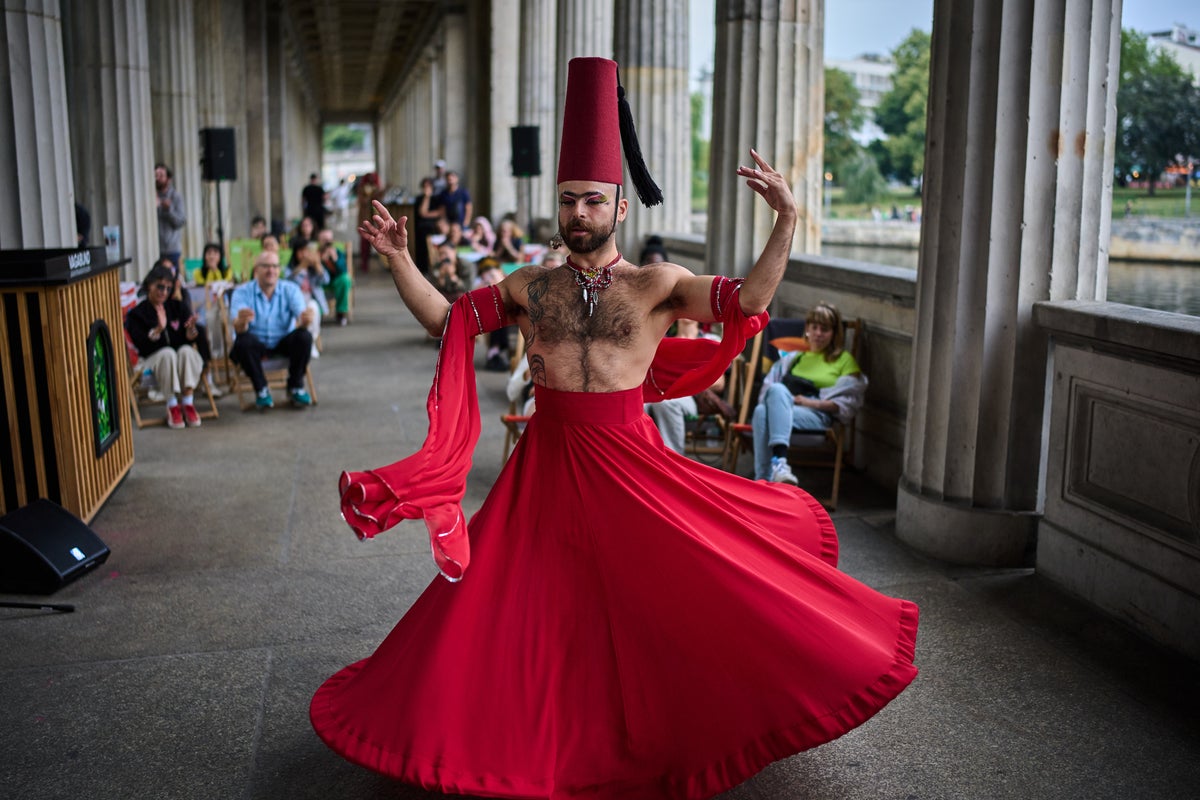
Haidar Darwish stood backstage, adjusting the crimson fabric of his traditional red fez. He is a man who knows what it means to lose a horizon. Fleeing Syria in 2016, he brought with him the heavy inheritance of displacement, landing in a Europe that often welcomed him with suspicion rather than open arms. Yet here he was, stepping into the glaring light of a makeshift stage with Queens Against Borders, an LGBTQ+ collective built for the displaced and the wandering.
He asked the crowd for a moment of silence.
The silence was absolute. You could hear the distant murmur of the Spree river cutting through the capital. You could feel the collective grief of a community whose sanctuary had just been pierced by an extremist terror attack, executed by a 21-year-old assailant with ties to militant ideologies. For a fragile moment, the world felt entirely narrow, defined only by loss and the creeping shadow of intimidation.
Then Darwish spoke the words that shifted the axis of the evening: the show must go on.
Consider what happens next.
He did not armor himself in heavy armor or retreat behind closed doors. He spun. Like an Anatolian dervish, his flamboyant hoop skirt billowed outward into a brilliant, spinning cone of red. Traditional Arabic melodies surged through the open-air speakers, accelerating, beating against the night sky. With a sharp twist, he shed the outer skirt, revealing the intricate, hypnotic hip movements of belly dance.
It was a deliberate, radical choice.
Violence demands a specific reaction. It asks for panic, for retreat, for the walls of suspicion to grow higher and the circles of community to grow smaller. The attacker, authorities later confirmed, sought precisely that fragmentation. He wanted to exploit old fault lines, turning neighbors against neighbors, refugees against locals, humanity against itself.
Darwish and his fellow performers—an Egyptian belly dancer named Aleya, a Nigerian drag artist named Countess Sasha Seduction—refused to hand over the script.
They could have stayed home. Safety whispered from the shadows of empty apartments across Berlin. Curtains could have been drawn. Phones could have been turned off. But staying home is a subtle form of surrender. It concedes territory to the darkness before the sun has even fully set on the tragedy.
Instead, they chose the alternative. They put grief into joy.
This alchemy is not easy. It requires a specific kind of internal friction, grinding the raw, jagged edges of sorrow until they catch the light. When foreign tourists and native Berliners alike watched the stage that night, they weren't just watching a dance performance. They were witnessing a reclamation of space. They were watching people who have every reason to be tired—so profoundly tired of fighting for the right to simply exist—decide that their visibility is non-negotiable.
The rhythm quickened. The crowd began to clap. Chairs scraped against the pavement as people stood up, first a few, then dozens, until the boundaries between the stage and the audience dissolved completely. Strangers linked arms, bridging the gaps of language, nationality, and trauma.
A single white van and a blade cannot rewrite the character of a city built on the hard-won lessons of history. Memorials at the Brandenburg Gate filled with cardboard signs bearing handwritten ink: The only thing more powerful than hate is love. It sounds like a cliché until you see it enacted under the glow of streetlights, carved out by dancers who refuse to let their stories end in a footnote of violence.
The music fades, but the momentum does not. In the space where fear tried to plant its flag, a red skirt spins on, defying the dark with every rotation.
Joy turns to grief after Berlin Pride attack
This video provides a visual look at the aftermath of the tragedy at Berlin's Pride celebrations, capturing how the community gathered to mourn and honor those affected.
http://googleusercontent.com/youtube_content/1