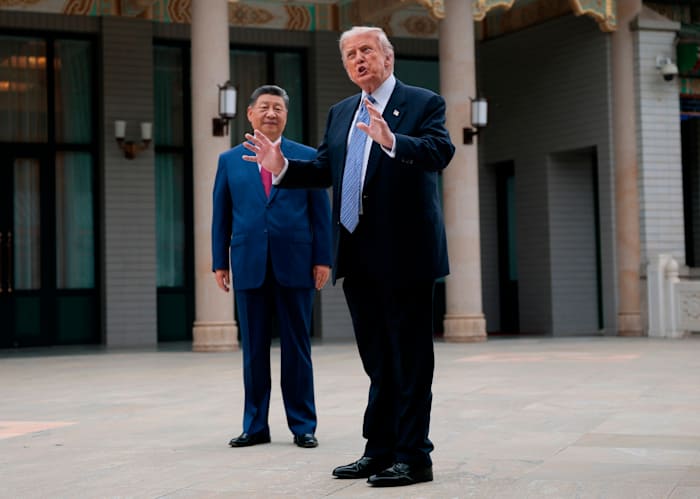
The air in Beijing has a specific weight. It is thick with history, coal dust, and the silent, crushing gravity of a billion decisions being made all at once. When the motorcade for the President of the United States hissed across the pavement toward the Great Hall of the People, that weight seemed to double.
Donald Trump didn’t just walk into a meeting with Xi Jinping. He walked into a stage play where every floorboard had been polished for months and every silence was a calculated maneuver. To the casual observer watching the news ticker, it was a "wrap-up" of a diplomatic tour. To those watching the eyes of the aides in the back of the room, it was a high-stakes poker game played with the global economy as the pot.
Silence is a weapon in Chinese diplomacy. While Western leaders often feel the need to fill every gap with words, promises, or jokes, the Great Hall operates on the principle of the pause.
The Weight of the Gilded Chair
Imagine standing in a room so large it feels like it has its own weather system. You are flanked by gold-leafed pillars and a phalanx of men in identical dark suits. Trump, a man built on the energy of the rally and the roar of the crowd, found himself in a space designed to swallow noise.
The facts of the visit were stark. There were trade deficits to discuss—hundreds of billions of dollars that represent more than just numbers on a spreadsheet. They represent steel mills in Ohio that have gone quiet and tech hubs in Shenzhen that are humming with a frantic, electric energy. There was the North Korean "problem," a term that feels dangerously inadequate when you consider the proximity of Seoul to the artillery lines.
But the human story wasn't in the trade data. It was in the body language of two men who represent the two most powerful scripts on earth. One script is about "America First," a disruptive, loud, and immediate demand for a return to a perceived golden age. The other is the "Chinese Dream," a century-long marathon that views time not in news cycles, but in dynasties.
When they sat down for their private meeting, the cameras were ushered out. The heavy doors clicked shut. In that moment, the "Latest News" ceased to matter. What mattered was the friction between a real estate mogul from Queens and a student of Marxist-Leninist history who had survived the Cultural Revolution.
The Invisible Ledger
We often talk about trade deals as if they are bloodless exchanges of goods. We say "China agreed to buy $250 billion in American products." It sounds like a grocery list.
In reality, it is a desperate attempt to balance a scale that has been tipping for decades. Consider a hypothetical small-town manufacturer in the Midwest. Let’s call him Jim. For Jim, this meeting isn't about geopolitics; it’s about whether he can afford the health insurance premiums for his twenty employees next year. If the Boeing jets and the Iowa soybeans don't move across the Pacific, Jim’s world shrinks.
Conversely, consider a young engineer in Chengdu. For her, the "private meeting" determines whether the components she needs for her startup will be blocked by a sudden shift in export licenses.
These are the invisible stakes. Every time Trump and Xi exchanged a nod or a handshake for the cameras, they were signaling to the markets—and to the Jims and the engineers—that the world wasn't going to fly off its axis today. But the underlying tension remained. You could see it in the way the officials hovered. There was a desperate, clawing need to project "stability" while both sides knew the ground was shifting beneath them.
The Theater of Power
The visit was punctuated by a "state visit-plus" treatment. It was an honor meant to flatter, to overwhelm the senses with the sheer scale of Chinese history. They toured the Forbidden City, a place where emperors once believed they held the mandate of heaven.
This wasn't just sightseeing. It was a message.
By inviting Trump into the heart of the ancient imperial palace, Xi was whispering a truth that many in the West often forget: We have been here for five thousand years. We can wait.
Trump, ever the performer, seemed to lean into the spectacle. He showed Xi videos of his granddaughter singing in Mandarin. It was a rare, human bridge in a landscape of tariffs and territorial disputes. For a fleeting second, the two most powerful men in the world weren't talking about South China Sea transit rights or intellectual property theft. They were two grandfathers looking at a screen.
Then the screen went dark, and the world came rushing back in.
The meeting didn't "solve" China. No single meeting could. The issues are too deep, the histories too scarred. The trade deficit isn't a knot that can be untied; it’s a structural reality of how we live, what we buy, and where we choose to send our capital.
The Ghost in the Room
The most haunting part of the wrap-up wasn't what was said, but what was ignored. While the leaders toasted to "win-win cooperation," the structural competition for the future of artificial intelligence and global infrastructure loomed like a ghost at the banquet.
We tend to focus on the "win" or the "loss" of a diplomatic trip. Did Trump get what he wanted? Did Xi hold his ground?
This binary thinking misses the point. Diplomacy at this level is about managing the inevitable friction of two tectonic plates grinding against each other. If they move too fast, you get an earthquake. If they don't move at all, the pressure builds until something snaps.
The private meeting was the grease for those plates. It was the human element—the look in the eye, the tone of the voice—that prevents a trade war from turning into something much colder and more permanent.
As the Air Force One wheels left the tarmac in Beijing, the red carpet was already being rolled up. The soldiers in the square reverted to their statuesque poses. The dry facts of the news reports recorded the events: a meeting was held, statements were made, the President departed.
But back in the offices of the Ministry of Commerce and the West Wing, the real work began. The spreadsheets were opened again. The "private" conversations were dissected for every inflection and hesitation.
The world looks different from thirty thousand feet. Below, the lights of Beijing and the rural expanses of the Middle Kingdom blurred into a single, glowing organism. We are locked in a dance we didn't choose, with partners we don't fully trust, on a floor that is constantly moving.
The motorcade is gone, but the weight of that room remains. It sits in the wallets of every person buying a smartphone and in the ledgers of every farm in the plains. We are all living in the shadow of that private meeting, waiting to see if the next movement of the plates will be a gentle shift or a catastrophic crack.
The sun sets over the Great Wall, and for a moment, the gold of the stone matches the gold of the pillars in the Great Hall. It is a beautiful, fragile image of order.
Underneath, the machinery of the future is grinding, indifferent to the theater, hungry for the next move.