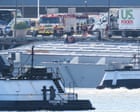
When a commercial vessel loses control on the lower Mississippi River near New Orleans, it rarely ends without tragedy. Yet when a recent New Orleans boat crash left passengers and crew scrambling on the water, every single person aboard was accounted for without a single fatality. Local officials quickly called it a "miracle on the Mississippi," a phrase that makes for a great evening news graphic.
Honestly, calling it a miracle insults the people who kept their heads when steel started bending.
If you spend enough time around maritime operations in Southeast Louisiana, you learn fast that the Mississippi River doesn't forgive mistakes. Between the Port of New Orleans and the Port of South Louisiana, you're looking at one of the busiest commercial corridors on the planet. Massive ocean-going cargo ships share narrow, twisting bends with multi-barge tows, ferry boats, and tourist paddlewheelers. When a crash happens here, survival isn't luck. It comes down to cold, practiced maritime protocol, rapid local emergency response, and strict federal safety mandates that most passengers ignore right up until the moment an alarm sounds.
Why the Mississippi River Near New Orleans Is So Unforgiving
To understand why everyone walking away from a New Orleans boat crash is such a big deal, you have to look at the water itself. Most tourists look out from the French Quarter riverwalk and see a wide, muddy, slow-moving expanse. That's an illusion.
Underneath that calm surface, the Mississippi moves with violent, unpredictable currents that routinely push past four to six knots during high-water seasons. At Algiers Point—just across from the French Quarter—the river makes a sharp, nearly 90-degree turn. Maritime pilots call it one of the most treacherous stretches of navigable water in North America. Visibility around the bend is terrible, eddies pull hulls sideways without warning, and deep-draft vessels need massive distances just to slow down.
When two vessels collide or a passenger boat strikes a stationary object in these waters, the physics are brutal:
- Downward pull: Strong currents and swirling eddies can drag a damaged hull or an unvested person underwater in seconds, leaving zero time for second guesses.
- Zero visibility: Silt-heavy water means rescue divers operate completely blind, relying entirely on touch and sonar if someone goes below the surface.
- Traffic congestion: A disabled vessel becomes an immediate hazard to 800-foot freighters that simply cannot swerve out of the way.
Because the margin for error is basically nonexistent, the U.S. Coast Guard Sector New Orleans enforces some of the strictest vessel traffic management rules in the country. Every commercial movement is tracked through the Vessel Traffic Service (VTS), a sort of air-traffic control for the river. Even with that oversight, mechanical failures, sudden squalls, and human miscalculations still happen.
The Real Reasons Every Passenger and Crew Member Survived
When news broke that all passengers and crew were accounted for after the crash, initial reports leaned heavily into the "miracle" angle. That's standard for breaking local news, where reporters are working off brief scanner traffic and early press conferences from the New Orleans Fire Department or Coast Guard spokespeople.
Once you strip away the sensational headlines, a very clear pattern emerges from successful maritime rescues on the Mississippi. People survive because of three specific factors working together in the first five minutes after impact.
Crew Training Under Pressure
Commercial passenger vessels operating out of New Orleans are required under U.S. Coast Guard Subchapter T and Subchapter K regulations to run regular emergency drills. Deckhands aren't just there to serve drinks or tie off dock lines. In an emergency, their primary job is crowd control and rapid headcounts.
Panic kills faster than cold water. If 50 or 100 passengers rush to one side of a listing boat, they can capsize a vessel that would have otherwise stayed afloat. During a real collision, trained crew members immediately divide the deck, distribute Type I offshore life jackets—which are engineered to turn an unconscious wearer face-up in rough water—and keep people away from unstable railings. Getting a clean, accurate manifest check before rescue boats even arrive is how authorities can confirm everyone is accounted for so quickly.
The Neighbor Effect on the River
The official emergency response from the Coast Guard, Harbor Police, and local fire marine units is fast, usually arriving within minutes. Still, the closest help on the Mississippi is almost always another commercial boat.
River captains monitor VHF Channel 16 and local bridge-to-bridge frequencies constantly. Unlike highway drivers who might rubberneck and keep moving, maritime law and basic river culture dictate that if a vessel calls a Mayday or takes a hard hit, every nearby tugboat, ferry, and tour boat pivots toward the scene. Good Samaritan vessels routinely pull alongside damaged boats to serve as floating platforms, transferring passengers directly across decks before the stricken boat can drift into the main shipping channel.
Hull Compartmentalization
Modern passenger vessels and commercial workboats aren't built like single open tubs. Federal marine engineering standards require watertight bulkheads—essentially sealed steel walls dividing the lower hull into separate compartments. If a collision breaches one section, the flooding stays contained. That buys the captain critical minutes to ground the vessel on a soft mudbank or hold position until rescue craft tie up alongside.
What Most News Coverage Misses About River Crashes
Breaking news articles focus on the immediate relief: nobody died, injuries were minor or manageable, and families are reunited. That's the human interest hook, and it's completely understandable.
What gets left on the cutting-edge—scratch that, what gets left on the cutting room floor—is what happens the second the last passenger steps onto dry land. A major marine casualty triggers a massive federal investigation led by the Coast Guard and often supported by the National Transportation Safety Board (NTSB).
If you're following this story or trying to understand how maritime accountability works, don't expect answers tomorrow. Federal marine investigations take months, sometimes over a year. Investigators immediately lock down the vessel's Voyage Data Recorder (the maritime version of a black box), pull VHF radio logs, test every crew member involved for drugs and alcohol under mandatory federal rules, and inspect steering and propulsion systems for mechanical failure.
Here's what investigators look at first in a New Orleans river collision:
- Right-of-way compliance: Under the Inland Navigation Rules, vessels meeting head-on or crossing paths have strict obligations to communicate passing arrangements via radio well before they get close.
- Engine and rudder response: Did a steering gear fail right as the pilot entered a bend? Loss of propulsion in a five-knot current turns a boat into a drifting projectile.
- Passenger manifest accuracy: Commercial operators must maintain exact counts of everyone aboard. Discrepancies between the ticket count and the rescue count cause massive, resource-draining search operations.
How to Actually Protect Yourself on a Commercial Boat
Most people treat the safety briefing at the start of a harbor cruise, ferry ride, or swamp tour like background noise. They're taking selfies with the Crescent City Connection bridge in the background while a deckhand points out where the life jackets are stowed.
I get it. You're on vacation, or you're just commuting across the river from Algiers to Canal Street. Nobody wants to think about steel hulls grinding together.
Still, spending ten seconds paying attention changes your odds dramatically if things go sideways. Next time you step onto any commercial vessel—whether it's a New Orleans paddlewheeler, a water taxi, or an offshore charter—do three simple things before the lines are cast off:
- Locate the life jacket locker nearest your seat. Don't just look at the ceiling storage; check if the latches are accessible and see how the straps clip. Putting on a bulky commercial Type I life vest for the first time while a boat is tilting is harder than you think.
- Note two ways off your deck. Stairwells on older riverboats can become bottlenecks fast. Know where the secondary exterior ladder or side gate is located.
- Keep your phone in your pocket during an actual emergency. Trying to film a collision for social media delays your movement and blocks narrow walkways for crew members trying to reach safety gear.
The recent New Orleans boat crash ended with the best possible headline: everyone made it home. Calling it a miracle makes for a comforting story, especially when the Mississippi River looks as intimidating as it does around the bend. The reality is much better than luck—it's proof that strict maritime safety rules, fast-acting local mariners, and disciplined crews actually work when the river puts them to the test. If you want to follow the official findings as they release, track the docket updates directly through the NTSB Marine Accident Reports database or monitor U.S. Coast Guard Sector New Orleans public releases over the coming months.