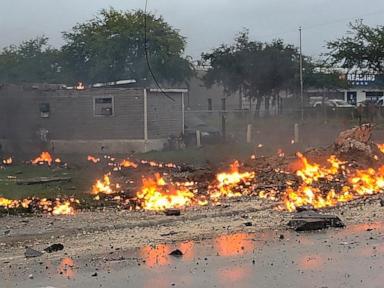
When news breaks that a Learjet carrying nine people has crashed in Palm Beach County, Florida, the initial Federal Aviation Administration (FAA) statement is always brief. That's by design.
Most local news outlets rush to publish those first three sentences from the FAA press desk and call it a day. They leave readers hanging with zero context about how South Florida airspace actually operates, what an investigation of this scale entails, or why private business jets face unique risks in coastal weather corridors. If you want to understand what happens on the ground and in the cockpit during a Palm Beach County aviation emergency, you have to look past the breaking news wire.
The Reality of Breaking FAA Crash Reports
The FAA doesn't speculate. Ever.
When a twin-engine business jet like a Learjet goes down near Palm Beach International Airport (PBI), Boca Raton Airport (BCT), or North Palm Beach County General Aviation Airport (F45), the agency's initial notice only confirms the aircraft type, the approximate time, the number of souls on board, and the agencies responding.
Nine people on a Learjet puts the aircraft right at the upper limit of its standard passenger capacity. Depending on the specific variant—whether it's an older Learjet 35A or a larger Learjet 60 or 75—a manifest of nine typically means two flight crew members and seven passengers. Running near maximum gross takeoff weight changes everything about how an aircraft climbs, handles turbulence, and responds to an engine-out scenario.
I've spent years analyzing general aviation and Part 135 charter safety data, and the biggest mistake the public makes is assuming the FAA runs the crash investigation. They don't. The FAA's primary job after a crash is checking pilot certifications, airworthiness directives, and whether air traffic control (ATC) followed proper separation protocols. The actual hunt for the cause belongs entirely to the National Transportation Safety Board (NTSB).
Why Palm Beach County Airspace Is Unforgiving
Palm Beach County isn't just another stretch of suburban runway. It's one of the busiest private aviation corridors in the United States.
During peak travel months, the skies between Miami-Opa Locka and Palm Beach are packed with corporate jets, flight school trainers, and commercial airliners all funneling into narrow coastal approach paths. ATC controllers at Miami Center and Palm Beach Approach manage staggering traffic volume. When things go wrong, they go wrong fast.
Three specific environmental and operational factors define flying a Learjet in this region:
- Convective weather cells: South Florida's coastal sea breeze creates violent, localized microbursts and wind shear that can form in minutes. A business jet on final approach has very little margin for sudden tailwind shifts.
- High-density departure corridors: Jets departing PBI or Boca Raton frequently face immediate altitude restrictions to stay clear of commercial traffic descending into Fort Lauderdale or Miami. Leveling off low burns more fuel and keeps the aircraft in the thickest, most turbulent layer of coastal air.
- Wildlife and terrain hazards: Just west of the coastal cities sits the Arthur R. Marshall Loxahatchee National Wildlife Refuge and miles of Everglades marshland. A forced landing off-airport means choosing between densely populated residential subdivisions to the east or deep swamp and canals to the west.
Inside the Learjet Flight Profile
Learjets have a legendary reputation for speed and climb performance, which is why corporate operators love them. Yet that same high-performance wing design demands respect from the crew.
Unlike sluggish trainers that float down the runway, a Learjet approaches at high speeds. Its swept wings are built for cruising efficiently at 41,000 feet, not muscling through low-altitude aerodynamic stalls. If a crew experiences a mechanical failure shortly after takeoff—such as a bird strike, a fuel control unit malfunction, or an asymmetric thrust event—they have seconds to pitch for the correct airspeed, clean up the landing gear, and run emergency memory items.
When nine people are aboard, weight and balance calculations become critical. Every pound of baggage, fuel, and passenger weight affects the aircraft's center of gravity and required runway length. Investigators always pull the weight-and-balance manifest within the first 24 hours to verify the jet wasn't overloaded for the ambient temperature and humidity. High South Florida humidity actually makes the air less dense, reducing engine thrust and wing lift—a phenomenon pilots call high density altitude.
How the NTSB Reconstructs the Final Minutes
Once Palm Beach County Fire Rescue secures the scene and tends to survivors or handles recovery, the site transforms into a federal forensic zone. Nobody touches the wreckage without NTSB clearance.
If you're following the updates on a Palm Beach Learjet crash, ignore the armchair experts on social media claiming they know what happened from a grainy ring-camera video. Real investigators rely on hard telemetry. Here is how they actually piece the puzzle together:
- ADS-B and Radar Tracks: Long before reaching the crash site, investigators pull Automatic Dependent Surveillance-Broadcast (ADS-B) data. This gives them second-by-second readouts of the jet's GPS position, groundspeed, vertical climb or descent rate, and heading.
- ATC Audio Recordings: Every transmission between the Learjet pilots and Palm Beach Tower or Approach is recorded and timestamped. Investigators listen not just to the words, but to the background cockpit noise, warning chimes, and stress levels in the pilot's voice.
- Cockpit Voice and Flight Data Recorders: Most modern Learjets operating with nine occupants are equipped with Cockpit Voice Recorders (CVRs) and Flight Data Recorders (FDRs). These hardened boxes capture control inputs, engine parameters, and every word spoken between the captain and first officer.
- Maintenance Logs and Operator History: Investigators immediately subpoena the aircraft's maintenance records. Was it a private Part 91 flight operated by a corporate flight department, or a commercial Part 135 charter flight? Charter flights face stricter federal oversight, duty-time limits, and maintenance intervals.
Separating Rumor From Verified Aviation Data
News cycles move fast, and initial reports frequently confuse basic aviation terms. You'll often see early headlines call a private jet a "commercial airliner" simply because it was chartered, or misidentify the airport of origin based on where the plane was registered rather than where it actually departed.
Aircraft registration numbers—the "N-number" painted on the tail—are public record. Through the FAA Registry, anyone can look up the exact model year, engine type, and registered owner of a Learjet involved in an incident. However, many corporate jets are registered under holding companies or aviation trusts in Delaware or Montana, which doesn't tell you who was actually operating the flight that day.
If you want accurate, verified updates rather than sensationalized clickbait, track the official channels directly:
- Check the NTSB Aviation Investigation Search database roughly two to three weeks after the crash. That's when the preliminary report drops, containing verified factual data without speculation.
- Monitor the Palm Beach County Sheriff's Office (PBSO) and Palm Beach County Fire Rescue official press feeds for verified casualty counts, hospital transports, and road closures around the perimeter.
- Use live flight-tracking archives like FlightAware or ADS-B Exchange if you know the tail number, allowing you to view the actual altitude and speed profile before signal loss.
Stay skeptical of anonymous "aviation sources" quoted in the first six hours after an accident. Until the NTSB examines the engine turbines for rotational damage and downloads the black boxes, every theory about mechanical failure or pilot error is pure guesswork.