Recreational scuba diving is supposed to be a safe, controlled escape into an underwater paradise. But when divers push past the limits of their training and equipment, the ocean quickly reminds us how unforgiving it can be.
The recent disaster in the Maldives proves this in the most tragic way possible. What started as a private excursion from a luxury yacht has turned into the deadliest diving accident in the history of the island nation, claiming the lives of five Italian tourists and a dedicated local military rescue diver.
If you think a high level of experience makes you immune to the dangers of the deep, this tragedy shows exactly why that assumption is dead wrong.
What Happened Inside the Vaavu Atoll Cave System
On Thursday, May 14, 2026, a group of five Italian nationals left the 36-meter luxury liveaboard vessel, the Duke of York, to explore the waters near Alimathaa Island in the Vaavu Atoll. The group included Monica Montefalcone, an associate professor of tropical marine ecology at the University of Genoa, her 20-year-old daughter Giorgia Sommacal, marine biologist Federico Gualtieri, researcher Muriel Oddenino, and diving instructor Gianluca Benedetti.
Montefalcone and Oddenino were in the Maldives on an official scientific mission to study climate change and tropical biodiversity. However, the university clarified that this specific dive was a private, recreational trip.
The group descended to a depth of roughly 50 to 60 meters (164 to 197 feet) to explore a complex underwater cave system. This system is divided into three large chambers connected by incredibly narrow passages. They never made it back to the surface.
By Thursday evening, the body of the instructor, Gianluca Benedetti, was recovered near the mouth of the cave. The remaining four divers are believed to be trapped deep inside the third chamber of the cave system.
The Search Turns Deadly for a Maldivian Hero
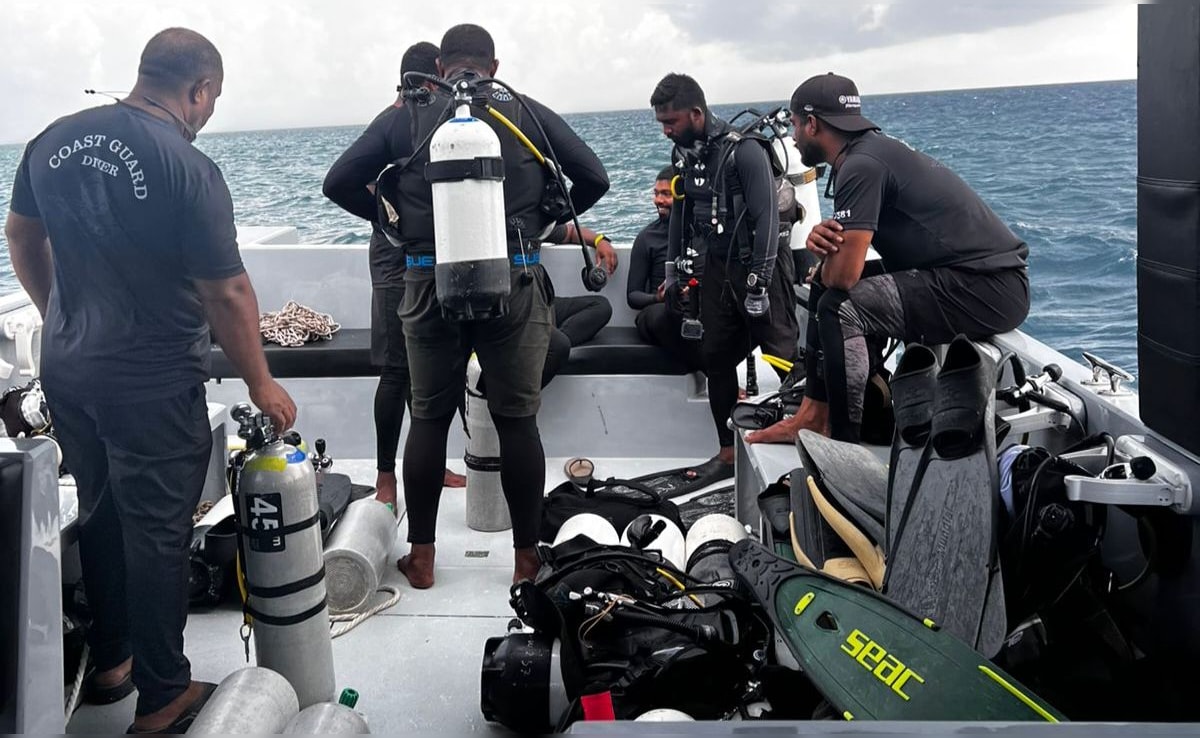
Recovering bodies from a deep underwater cave is one of the most hazardous operations on earth. The Maldivian National Defence Force (MNDF) deployed an elite eight-man team to navigate the pitch-black chambers. By Friday, the recovery team managed to search the first two chambers, but rough weather, strong currents, and extreme depth restricted their progress.
On Saturday, the mission took an even darker turn. Staff Sergeant Mohamed Mahudhee, a highly respected military diver who had personally briefed Maldives President Mohamed Muizzu on the rescue plan just the day before, suffered a catastrophic bout of decompression sickness during the operation. He was rushed to a hospital in the capital, Malé, in critical condition but tragically passed away.
"The death goes to show the difficulty of the mission," stated Maldives Presidential Spokesman Mohamed Hussain Shareef. Mahudhee will be buried with full military honors, leaving behind a legacy of immense sacrifice.
With the death toll now at six, local authorities have temporarily halted the operation. They are rewriting their strategy and awaiting the arrival of three Finnish cave-diving experts and two Italian deep-sea rescue specialists to assist in retrieving the final four bodies.
The Lethal Physics of Going Too Deep
To understand why this dive turned fatal, you have to look at the hard rules of scuba diving.
The strict recreational diving limit in the Maldives is 30 meters (98 feet). The Italians went nearly double that depth, plunging down to 60 meters.
Anything past 40 meters is no longer recreational diving. It is technical diving.
Technical diving requires specialized gas blends, redundant equipment, and completely different decompression profiles. Reports from local media indicate that an empty, single scuba tank belonging to the instructor was found at the scene. If the group was using standard recreational gear, they were fundamentally unequipped for what they attempted.
When you dive to 60 meters on normal compressed air, two massive physiological threats come into play:
- Oxygen Toxicity: Humans thrive on air that is 21% oxygen at sea level. But under the immense pressure of 60 meters of water, that same oxygen becomes toxic to the central nervous system. It can cause sudden, violent seizures without warning. If you have a seizure underwater, your regulator falls out of your mouth, and you drown instantly.
- Nitrogen Narcosis: Often called "rapture of the deep," high-pressure nitrogen acts like an anesthetic on the brain. At 60 meters, a diver's judgment, coordination, and reasoning skills are severely impaired. It feels like being completely intoxicated.
Carlo Sommacal, the husband of Monica Montefalcone, told Italian media that his wife was a disciplined, expert diver who would never recklessly endanger their daughter. "Something must have happened down there," he said.
In a deep cave, "something happening" to just one person can easily kill the entire group. If one diver panicked due to nitrogen narcosis, suffered an oxygen toxicity seizure, or kicked up silt from the cave floor, visibility would drop to absolute zero in seconds. Lost in total darkness, breathing heavily through their remaining air, panic would take over.
Industry Fallout and Next Steps
The Maldivian government is not taking this lightly. The Ministry of Tourism and Civil Aviation has indefinitely suspended the operating license of the luxury yacht Duke of York while a full criminal investigation gets underway. Officials want to know exactly how and why a group of recreational divers was permitted to blow past the legal 30-meter limit into a deadly, dark cave system.
If you are a diver, let this horrific incident be a stark reminder. No amount of academic knowledge or past experience alters the laws of physics and physiology. Never exceed the limits of your specific certification, never enter a cave without proper cave-diving training and redundant gear, and always respect the rules set by local maritime authorities.