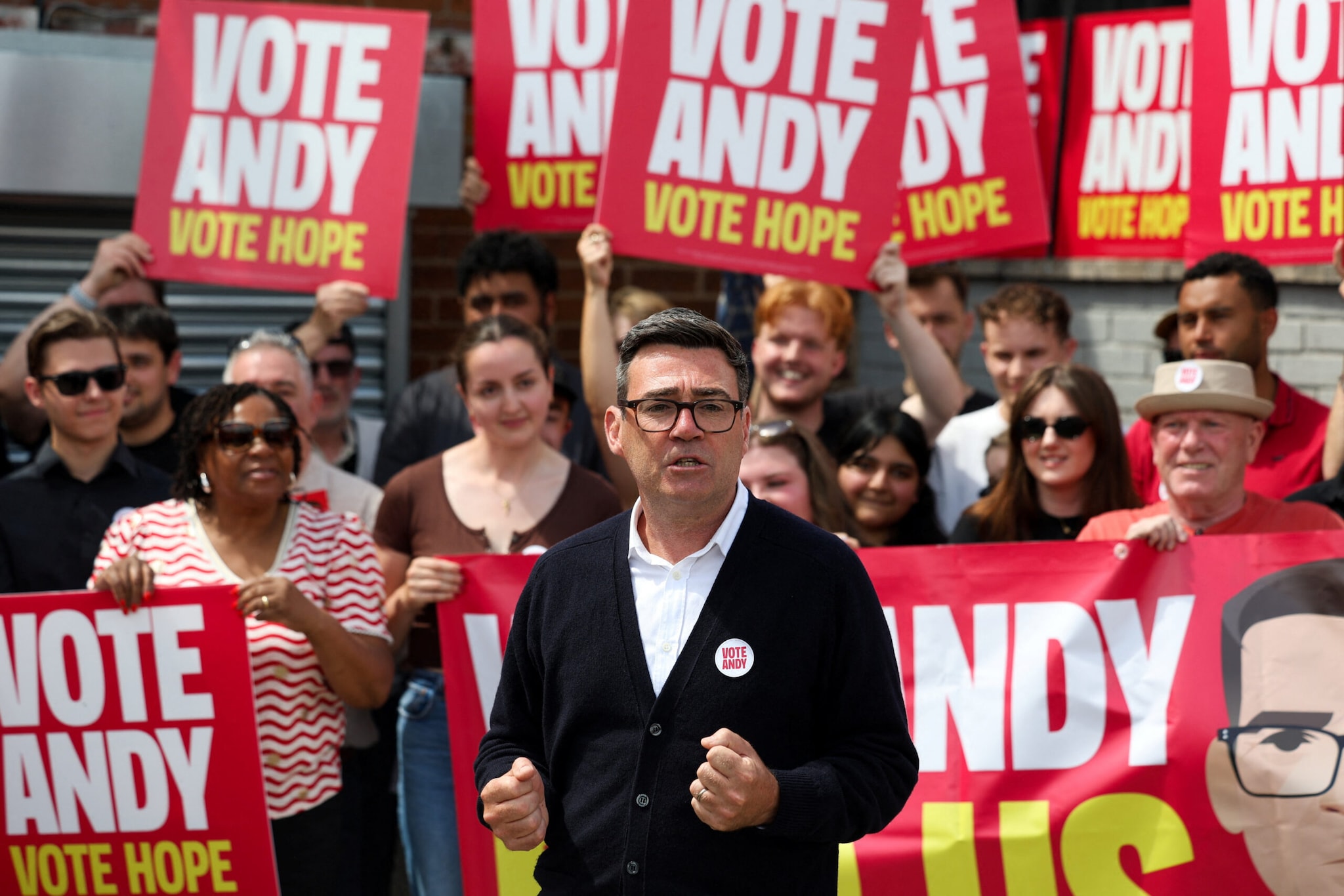
Andy Burnham has won the Makerfield by-election with a crushing 9,231-vote majority, returning to parliament to mount an immediate challenge against Prime Minister Keir Starmer. Winning 54.8% of the vote against Reform UK’s 34.5%, the Greater Manchester mayor has secured the legislative foothold required by party rules to trigger a leadership contest. The result leaves Starmer’s premiership in a state of terminal paralysis. This was not a routine local contest, but a highly coordinated, inside-out restructuring of the Labour hierarchy designed to replace a sitting prime minister without a general election.
The mechanics of this victory are unprecedented in modern British political history. Not since the Leyton by-election of 1965 has a sitting lawmaker voluntarily cleared a path for an outsider to force their way into the parliamentary party. Josh Simons, the former Member of Parliament for Makerfield, resigned his seat last month for the explicit purpose of creating this vacancy.
Inside the Civil War for the Soul of Labour
The victory in Greater Manchester exposes a profound factional rupture that has been quietly widening since July 2024. Starmer secured a historic landslide victory in the general election, yet his popular support has collapsed faster than that of any prime minister in modern history. The government has failed to stimulate economic growth, public services remain near total collapse, and a series of unforced administrative errors have destroyed Downing Street's moral authority. The tipping point arrived with the appointment of Peter Mandelson as the British ambassador to the United States, a choice that deeply alienated the party's rank-and-file lawmakers.
When the local election results in May revealed catastrophic losses across former industrial heartlands, the internal opposition mobilized. A shadow network of northern lawmakers, trade union leaders, and former cabinet ministers concluded that Starmer was an electoral liability who would lose the next national vote. They needed a candidate with proven executive authority and cross-factional appeal.
They found him in the mayor of Greater Manchester. Burnham had spent nine years outside Westminster, deliberately building an autonomous power base through a philosophy he terms "Manchesterism." By nationalizing the regional bus network, implementing aggressive urban regeneration schemes, and consistently picking public fights with Whitehall over regional funding, he cultivated an image as a defender of the neglected provinces.
The National Executive Committee tried to stop him. In February, party officials successfully blocked Burnham from contesting a vacancy in Gorton and Denton, hoping to keep the rebellious mayor locked outside the gates of parliament. But by May, Starmer’s internal authority had degraded to the point where high-ranking party figures, including Deputy Leader Lucy Powell and former Health Secretary Wes Streeting, openly defied Downing Street to clear Burnham’s path. The committee capitulated, allowing him to run unopposed for the Makerfield nomination.
The Mathematical Destruction of the Right Wing Alliance
To understand why this result has terrified Downing Street, one must examine the specific electoral data from the Makerfield count. The constituency, situated on the industrial fringe of Wigan, is exactly the type of working-class territory where Labour’s traditional base has been vulnerable to right-wing populism.
| Candidate | Party | Votes | Share |
|---|---|---|---|
| Andy Burnham | Labour and Co-operative | 24,927 | 54.8% |
| Robert Kenyon | Reform UK | 15,696 | 34.5% |
| Rebecca Shepherd | Restore Britain | 3,111 | 6.8% |
| Michael Winstanley | Conservative | 997 | 2.2% |
The numbers reveal a strategic triumph. Burnham did not merely win; he constructed a broad anti-Reform coalition that compressed the traditional right-wing vote into insignificance. In 2024, the Conservatives, Liberal Democrats, and Greens collectively secured 22% of the vote in Makerfield. In this contest, they were virtually erased, drawing just a fraction of their previous support as voters consolidated behind the two dominant factions.
Turnout reached 58.75%, an increase of more than six percentage points from the general election. This is an extraordinary anomaly for a mid-term by-election, which typically suffers from severe voter apathy. The high engagement demonstrates that the electorate understood exactly what was at stake. This was a national referendum on the leadership of the country, staged within the boundaries of a single northern constituency.
The right-wing challenge split under pressure. Reform UK ran a highly aggressive campaign focused on immigration and economic stagnation, but their momentum was blunted by the emergence of the hardline Restore Britain party. Rebecca Shepherd’s 6.8% share drew directly from the same disillusioned, anti-establishment demographic that Robert Kenyon needed to mount a genuine threat. Burnham finished the night with 6,100 more votes than Reform and Restore combined, a metric that provides him with immense leverage among wavering parliamentary colleagues in London.
The Anatomy of the Coming Westminster Showdown
A sitting prime minister cannot easily be removed, but the institutional leverage has shifted entirely to the north. Under current party rules, a formal leadership challenge requires the written support of 20% of Labour’s parliamentary estate. With the party holding more than 400 seats in the House of Commons, that threshold sits at 81 lawmakers.
Burnham’s allies believe they already possess the signatures. The strategy now is not an immediate, chaotic coup that could destabilize the currency and trigger demands for an early general election, but a structured extraction of power. High-ranking allies, including Culture Secretary Lisa Nandy and former Shadow Transport Secretary Louise Haigh, are already managing the narrative, publicly calling for an orderly transition of power.
The immediate obstacle is Starmer’s stubborn determination to survive. Speaking from the G7 summit in France, the prime minister insisted he would fight any internal challenge, pointing to his 2024 electoral mandate. But history shows that prime ministerial mandates are fragile illusions when the cabinet begins to fracture. If key figures like Wes Streeting, who resigned his ministerial post in May to protest Starmer's direction, coordinate a wave of resignations, the government will cease to function.
The constitutional reality complicates matters further. Burnham’s return to parliament immediately disqualifies him from holding the Greater Manchester mayoralty, an office that oversees a three-billion-pound regional budget. His departure triggers a massive mayoral by-election across an electorate of two million people, scheduled for late July. Labour will be forced to defend its crown jewel in the north against an energized Reform UK while simultaneously fighting an internal civil war in London.
The Makerfield Test as a National Blueprint
In his victory speech inside the Life Convention Centre in Wigan, Burnham declared that Makerfield would become the touchstone of his national policy. This was a deliberate rejection of the technocratic, Treasury-led governance that has defined Starmer’s tenure. The mayor’s political platform represents a fundamental departure from the fiscal orthodoxy dominating Westminster since 2010.
He intends to scale his regional policies into a national framework. This means the wholesale restructuring of public transport, aggressive state intervention in housing markets, and the decentralization of financial power away from the city of London. To prepare for this transition, Burnham has quietly spent the last month consulting with top-tier international economists to draft an alternative national budget. This shadow economic policy focuses on regional wealth retention rather than reliance on foreign direct investment into the capital.
The strategy is designed to appeal directly to the dozens of Labour lawmakers holding marginal seats in former industrial areas. These politicians know that if the economy remains stagnant, they will be wiped out at the next election by Reform UK. Burnham offers them a shield. By proving he can decisively beat populism on its own turf through unapologetic state-backed regional investment, he has transformed himself from a regional administrator into an existential alternative.
Westminster operates on momentum and fear. Right now, Starmer represents electoral terror for his backbenchers, while Burnham represents survival. The prime minister will return from France to find his authority completely evaporated, his cabinet plotting an exit strategy, and a formidable rival sitting on the green benches behind him. The question is no longer whether Starmer will be replaced, but how much damage the party will sustain during the eviction.