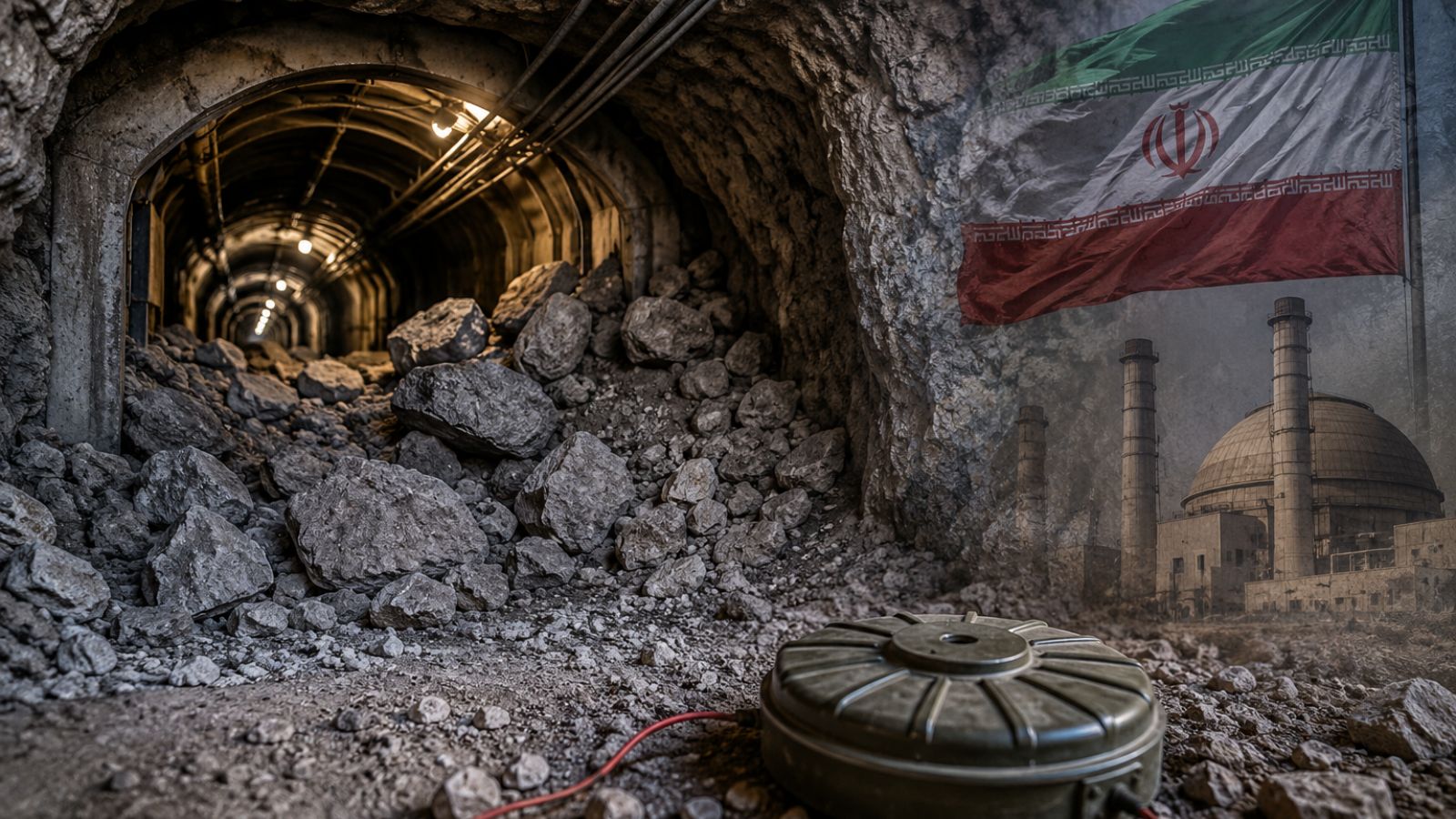
The white whale of the White House is roughly 440 kilograms of highly enriched uranium sitting in dark, entombed chambers deep within the Iranian earth. As Washington and Tehran edge toward a sweeping diplomatic framework to halt their brutal shadow conflict, the entire agreement hinges on a single, maddeningly complex physical requirement: Donald Trump demands that Iran surrender its near bomb-grade uranium stockpile, but United States intelligence indicates that Tehran has literally buried the prize behind collapsed tunnels, engineered cave-ins, and fields of defensive landmines.
This isn't a standard diplomatic impasse over compliance language or verification protocols. It is a raw engineering crisis. By intentionally bringing down the roofs of its own underground transport shafts and mining the entry points, the Iranian regime has effectively locked its most dangerous material in an inaccessible vault. The White House recently considered, then ultimately scrapped, a high-risk ground operation by U.S. special forces to seize the material by force, concluding the logistical complexity and risk to human life were too steep. Now, Washington is realizing that even if Tehran signs a piece of paper agreeing to hand over the uranium, actually extracting it could take months of hazardous demining and heavy excavation work under intense suspicion.
The Physics of Deception Underground
To understand how we arrived at this standoff, one must look at the physical architecture of Iran's nuclear complex, particularly around the Isfahan and Natanz networks. For decades, Western planners viewed subterranean facilities as targets to be penetrated with massive ordnance like the GBU-57 Massive Ordnance Penetrator. Tehran, however, realized that the earth could be used defensively in an entirely different way: not just to keep external actors out, but to lock their own assets in.
When U.S. and Israeli airstrikes crippled visible surface structures and known ventilation shafts over the past year, Iranian engineers executed a pre-planned contingency. They used controlled detonations to collapse the entry adits—the horizontal access tunnels—leading to the deep storage chambers where the 60% highly enriched uranium is kept.
- Controlled Cave-ins: These are not random piles of rubble. Engineers use calculated explosive charges to shear structural supports, dropping hundreds of tons of solid granite and reinforced concrete into the access arteries.
- Tactical Mining: Beneath and around the fallen debris, specialized military units have laid dense networks of sophisticated anti-personnel and anti-vehicle mines, turning a standard excavation task into a lethal trap.
- The Extraction Nightmare: Removing this material requires heavy earth-moving equipment, specialized ventilation systems to counter toxic dust, and manual explosive ordnance disposal experts working in pitch-black, structurally unstable environments.
This creates a severe verification asymmetry. If Iran agrees to hand over its inventory, Western inspectors cannot simply drive a armored transport vehicle up to a loading dock. They must rely on Iranian crews to clear the blockages, or send international teams into a literal minefield.
The Phantom Stockpile Strategy
The tactical utility of an unreachably buried stockpile goes far beyond simple physical protection. It serves as an ideal mechanism for strategic ambiguity. Veteran arms control experts point out that by entombing the uranium, Tehran has created a perfect environment for asset concealment.
"In this scenario, I would worry that Iran would claim that some portion of the highly enriched uranium was irretrievable," warns Scott Roecker, former head of the National Nuclear Security Administration’s Office of Nuclear Material Removal. "We wouldn’t have full confidence that Iran couldn't retain access to it at some point in the future."
Consider the operational reality of a verification team arriving at a collapsed mountain face in Isfahan. The Iranian government can provide logs, manifests, and digital telemetry claiming that a specific amount of fissile material is sealed behind 200 meters of fallen rock. But in the world of nuclear counter-proliferation, trust is non-existent. Without physical weight verification and gamma-ray spectroscopy on the actual canisters, Washington cannot verify if 440 kilograms are behind the rubble, or if 50 kilograms were quietly siphoned off to a secondary, undeclared mountain site before the detonations occurred.
The White House finds itself in a bizarre negotiation paradox. The Trump administration has maintained immense economic and military pressure to force Iran to dismantle its enrichment infrastructure and surrender its fissile material. Yet, the very success of that pressure campaign forced the Iranian regime to render the material physically uncollectible in the short term.
Why a Military Raid Was Taken Off the Table
Before shifting back to the negotiating table in Muscat, Oman, the Pentagon drew up actionable plans for an unprecedented ground incursion inside Iran. The objective was straightforward: land elite assault forces via low-observable aircraft, neutralize the local guard force, use specialized engineering charges to cut through the subterranean vaults, and fly out with the canisters of 60% enriched uranium.
It was a mission that eclipsed the 2011 Abbottabad raid in scale, danger, and complexity. The plan was ultimately paused by President Trump because the numbers simply did not add up.
| Operational Challenge | Tactical Reality |
|---|---|
| Time on Objective | Cutting through collapsed granite tunnels requires heavy drilling rigs, not handheld torches. Forces would have been exposed on Iranian soil for days, not minutes. |
| Air Superiority | While U.S. forces can suppress local air defenses temporarily, maintaining a secure perimeter around a major Iranian nuclear site for an extended extraction timeline is a logistical impossibility without launching a full-scale war. |
| Material Integrity | Utilizing high explosives to blast through an intentional cave-in risks puncturing the storage transport cylinders, creating a localized radiological disaster that would contaminate the very forces trying to secure it. |
With a direct military extraction deemed an unacceptable gamble, the crisis has been pushed entirely into the realm of coercive diplomacy. But the geography of the ground remains unchanged. A signed treaty does not automatically dissolve hundreds of tons of collapsed rock or neutralize a single pressure-sensitive landmine.
The Diplomatic Trap in Muscat
As negotiators from both sides exchange drafts through Omani intermediaries, the technical annexes of the proposed treaty are where the real battle is being fought. The broader framework of the emerging deal seems clear: Iran pauses all high-level enrichment, allows long-term inspections, and stops regional maritime harassment in exchange for the lifting of shipping blockades and access to billions of dollars in frozen assets.
However, the timeline for the physical removal of the uranium remains the ultimate sticking point. Washington wants the material out of Iran before major sanctions relief begins. Tehran argues that because the material is buried beneath collapsed infrastructure, extraction is a technical process that will take months—meaning they want sanctions lifted concurrently as excavation proceeds.
This leaves open a dangerous window. While international teams wait for Iranian engineers to clear the passages, the geopolitical landscape can shift overnight. A single hardline political shift in Tehran, or a sudden flare-up in the Persian Gulf, could cause the regime to halt excavation, leaving them with their near-bomb grade material still safely protected inside their mountain fortresses.
The physical reality of the earth has outpaced the political desires of Washington. Until a verifiable, heavily monitored engineering plan is established to systematically unearth the Isfahan vaults, the highly enriched uranium remains exactly what Tehran intended it to be: an invisible, untouchable insurance policy buried deep beneath the rock.


