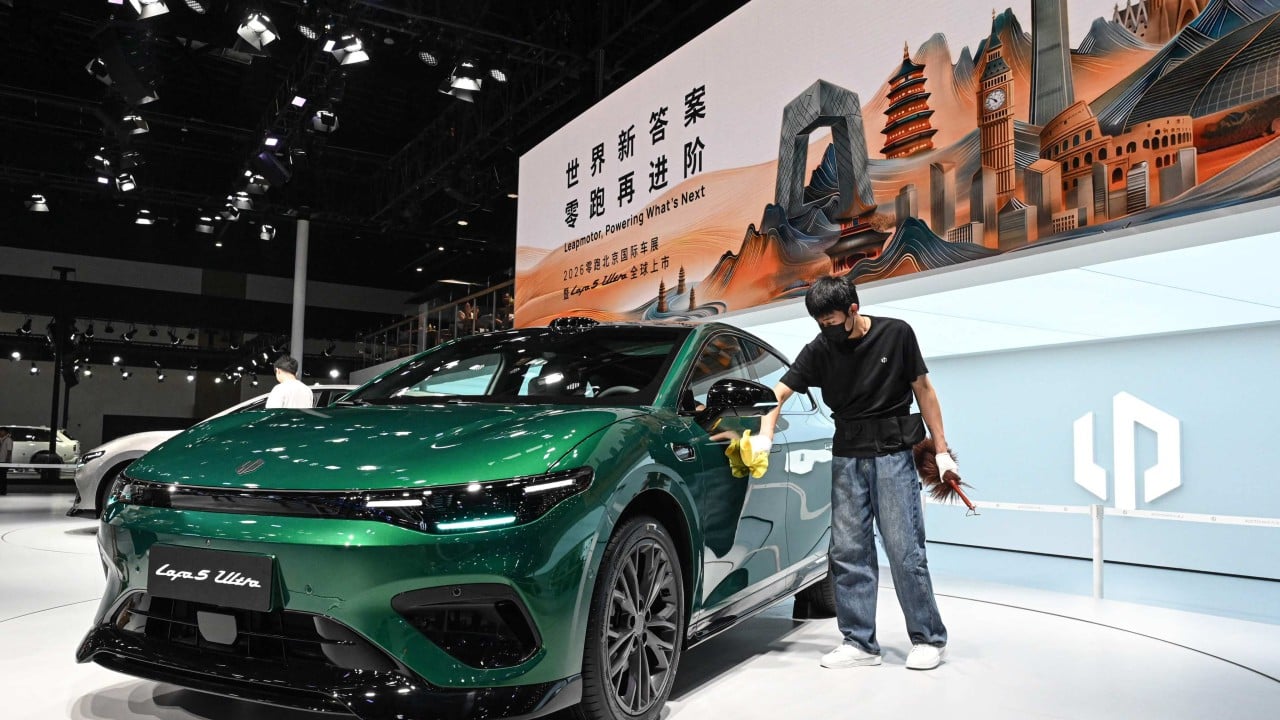
Chinese automakers are shattering monthly delivery records by deploying hardware architectures, ultra-fast charging platforms, and deeply integrated ecosystem software that make older product lines look increasingly obsolete. While Western analysts focus on price wars and subsidies, the reality on the ground in Shanghai, Shenzhen, and Hangzhou is an engineering sprint. Companies like BYD, Leapmotor, and Huawei's HIMA manufacturing alliance have out-paced the traditional industry standard by slashing vehicle development cycles to less than eighteen months. Tesla's long-held lead has shifted from a structural advantage to a historical footnote in the world's largest automotive market.
To understand the scale of this shift, one only needs to look at the recent mid-year production data. Domestic manufacturers are no longer just competing on leather seats and larger screens. They are winning on raw industrial execution, vertical integration of power electronics, and localized software environments that treat the car as an extension of the consumer electronics ecosystem.
The Illusion of the Shanghai Rebound
Recent data indicates that deliveries from foreign-owned factories in China have shown modest monthly bumps, but these short-term gains mask a deeper structural decay. Price adjustments and regional promotional programs can clear inventory, but they cannot fix an aging platform strategy. The core platforms underpinning the dominant American electric sedans and crossovers have remained largely unchanged for years. In the automotive world, a five-year-old platform is an old platform. In China, it is an antiquity.
Local manufacturers view vehicle architectures as iterative software releases. They do not wait for mid-cycle refreshes to introduce fundamental engineering revisions. If a more efficient silicon carbide inverter becomes available, or if a battery supplier develops a cell with ten percent better energy density, it is engineered into the assembly line within months. This constant revision cycle means that a consumer buying a domestic vehicle today is getting fundamentally different hardware than someone who bought the same model a year ago.
This structural speed creates an widening gap in product relevance. Foreign pioneers rely on massive global scale to amortize their tooling costs over millions of identical units. While this keeps production costs low, it locks their design choices in stone for half a decade. Chinese competitors have built flexible manufacturing lines that can absorb hardware iterations without requiring complete factory overhauls. They have traded the absolute efficiency of a static design for the market dominance of a fluid one.
The Modular Engineering Sprint
The mechanics behind these sales records come down to a philosophy of modular vehicle architecture. Consider the rise of companies like Leapmotor, which quietly secured whole-year profitability by mastering platform sharing. By developing standardized structural blocks that can support both pure electric powertrains and extended-range options, they have minimized the capital expenditures that traditionally kill automotive startups. They delivered more than 93,000 vehicles in June alone, a massive jump driven by this architectural flexibility.
Extended-range electric vehicles represent a massive tactical miscalculation by foreign brands. Western automakers largely abandoned plug-in hybrids and range extenders, betting that consumers would jump directly from internal combustion to pure battery power. This was a mistake. Chinese consumers have embraced vehicles that carry a small, highly efficient gasoline generator dedicated solely to keeping the battery pack topped up during long drives.
This hybrid approach solves the charging infrastructure deficit in lower-tier cities. It allows buyers to enjoy the low operating costs and instant torque of an electric motor without checking map applications for functional high-speed chargers during holiday travel. By treating the combustion engine as an onboard appliance rather than the primary drivetrain, domestic firms have captured the massive demographic of buyers who are hesitant to go fully electric.
Ecosystem Integration as a Weapon
Software has become the primary battleground, and it is here where the gap becomes a chasm. The modern Chinese urban buyer does not view a vehicle as an isolated transport mechanism. It is a node in a broader digital life.
Huawei’s Harmony Intelligent Mobility Alliance provides a clear example of this dynamic. By handling the software, smart cabin architecture, and automated driving systems for a loose coalition of manufacturing partners, the tech giant helped move over 50,000 units in a single month through its retail network. When a driver steps into an alliance vehicle, their phone apps, desktop workspace, smart home controls, and streaming profiles transfer to the dashboard.
+--------------------------------------------------------+
|               Unified Digital Ecosystem                |
+--------------------------------------------------------+
                           |
        +------------------+------------------+
        |                                     |
        v                                     v
+-----------------------+           +--------------------+
| High-Speed Hardware   |           | Smart Cabin Sync   |
| 800V Charging, SiC    |           | OS, Apps, Mobile   |
+-----------------------+           +--------------------+
        |                                     |
        +------------------+------------------+
                           |
                           v
+--------------------------------------------------------+
|              Agile Modular Production                  |
+--------------------------------------------------------+
Foreign firms are crippled by their global software silos. An infotainment system designed in California or Stuttgart must comply with global corporate mandates, leading to localized versions that feel slow, stripped-down, and disconnected from the dominant local application ecosystems. Navigation systems often lack the lane-level precision needed for complex multi-level overpasses, and voice recognition systems struggle with regional dialects.
Furthermore, local driving assistance systems have adapted to the chaotic nature of domestic traffic far better than Western alternatives. Navigating a major third-tier city requires a vehicle to constantly negotiate with delivery scooters, erratic pedestrian behavior, and non-standard construction zones. Local autonomous driving suites are trained on hundreds of millions of miles of this specific, hyper-dense traffic data. They operate with a defensive, assertive logic that matches local driving habits, whereas foreign systems often freeze or disengage when faced with such unpredictable environments.
Battery Economics and the End of the Monolith
The absolute dominance of BYD highlights the power of total vertical control over the battery supply chain. Registering over 403,000 passenger vehicle sales in a single month is not a feat achieved by clever marketing. It is the result of controlling the raw chemistry, the cell manufacturing, the pack assembly, and the vehicle integration under one corporate roof.
By manufacturing its own lithium iron phosphate chemistry, the company avoids the margin squeeze that occurs when raw material prices fluctuate. This structural advantage allows them to offer vehicles with premium thermal management and advanced safety characteristics at price points that Western manufacturers can only achieve on their base, stripped-down models. The introduction of next-generation cell-to-body architectures, where the battery pack serves as the structural floor of the passenger cabin, has eliminated dead weight and maximized interior volume.
Other newcomers are achieving scale through alternative supply methodologies. Xiaomi entered the market with an asset-light approach to traditional automotive manufacturing but brought a consumer-electronics discipline to supply chain management. By driving down the cost of secondary components and maximizing production line automation, they managed to deliver over 30,000 units of their premier sedan model while maintaining exceptional gross margins for a new entrant. They proved that manufacturing efficiency is no longer the exclusive domain of legacy industrial giants.
The Global Export Pivot
The records broken within domestic borders are increasingly being replicated on the global stage. Overseas shipments now make up a significant portion of total production for the leading players. BYD shipped more than 174,000 vehicles outside of China in June, indicating that the domestic market saturation is forcing an aggressive international expansion.
This export push is not just about finding homes for excess inventory. The vehicles being sent to Europe, Southeast Asia, and South America are highly competitive products tailored to regional demands. They offer longer ranges for the price, superior build quality, and modern interior technology that legacy international brands have failed to provide in their entry-level lineups.
Western regulatory barriers, such as import tariffs and local sourcing requirements, may slow this expansion, but they cannot stop it entirely. Chinese firms are bypassing these hurdles by investing heavily in manufacturing facilities within Europe, South America, and ASEAN nations. They are transplanting their highly efficient supply chains directly into their target markets, ensuring they can compete on price even behind tariff walls.
Legacy automakers are running out of time to respond. The assumption that Western brand equity would protect historical market share has been proven false. When a consumer can purchase an advanced vehicle with an 800-volt electrical architecture that adds two hundred miles of range in ten minutes for less than the cost of a slow-charging Western vehicle built on a modified internal combustion platform, brand loyalty disappears. The market is re-aligning around structural value and technological velocity, and the companies unable to iterate at this pace will find themselves locked out of the future entirely.
Xiaomi SU7 electric sedan assembly line
This detailed industrial analysis highlights the manufacturing capabilities and production speeds of the top players reshaping the global automotive market.