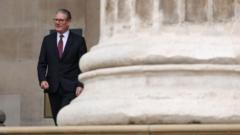
The sight of 10-year gilt yields climbing above 5% while a Prime Minister delivers a "last chance" speech is a haunting echo of recent British history. Sir Keir Starmer took the podium this week at the Coin Street Neighbourhood Centre not just to combat a set of brutal local election results, but to argue for his own relevance in a global market that is rapidly pricing in British instability. While the headlines focus on the 100 Labour lawmakers signing letters of support, the underlying reality is far more clinical. The Starmer project is facing a fundamental breakdown because it attempted to fix a structural economic crisis with a purely managerial aesthetic.
International investors and global media outlets have moved past the initial hope that the 2024 landslide would provide a decade of calm. Instead, they see a government paralyzed by a "permacrisis" that it promised to end but has instead merely inhabited. The failure is not just one of polling—though a 45% resignation demand from your own party members is terminal in most political playbooks—but a failure to decouple the UK from the volatile "Truss-era" risk premium that still clings to the City of London.
The Myth of Stability
For two years, the narrative from Downing Street was that competence alone would act as a fiscal stimulant. The theory was simple. If the adults were back in the room, the markets would lower the cost of borrowing, and growth would follow. That theory has now met the reality of a closed Strait of Hormuz and oil prices north of $100.
Global analysts are currently looking at a UK that has the highest borrowing costs in the G7 outside of Germany's unique debt-brake situation. This is happening despite a debt-to-GDP ratio that should technically make the UK a safer bet than many of its peers. The "Starmer Premium" is the cost of political indecision. By trying to be everything to everyone—promising a "reset" with the EU while refusing to discuss the single market, and pledging nationalization of British Steel while cutting capital investment—the government has created a vacuum.
In that vacuum, Reform UK and the Greens have feasted. The local election losses in England, Wales, and the SNP’s resilience in Scotland are not isolated incidents of voter fatigue. They are a rejection of a centrist model that has failed to produce a tangible "win" for the average household. When 163,000 jobs are at risk due to energy costs and the government’s only new offering is a youth experience scheme with the EU, the disconnect becomes a liability.
The Burnham Shadow and the NEC Blockade
The most significant internal threat to Starmer is not a hidden radical, but a very visible Mayor. Andy Burnham’s 72% favorability rating among Labour members makes him the "King across the Water" for a party that feels it is drifting.
However, the mechanism of Starmer’s survival relies on a technicality. The National Executive Committee (NEC) has currently blocked Burnham from seeking a parliamentary seat, a necessary precursor to any leadership challenge. This creates a dangerous "zombie" premiership. You have a leader who cannot win the country, and a challenger who is not allowed to enter the building.
This stalemate is being watched closely by Washington and Brussels. To the Biden or Trump administration (depending on the day’s geopolitical winds) and the European Commission, Starmer was supposed to be the man who brought the UK back into a predictable orbit. Instead, they see a leader who might be removed by his own backbenchers before the next G7 summit.
The Economic Dock
The "why" behind the falling approval ratings is found in the Treasury's inability to break the cycle of low growth and high tax. Investors are aghast not because of the political drama itself, but because of what it signals about the next three years. If a government with a 160-seat majority cannot push through meaningful planning reform or solve the housing benefit crisis—now projected to hit £39bn—then no amount of "weary confidence" from the Prime Minister will suffice.
The core of the crisis is that the UK is now being modeled as a "transactional" power that reacts to events rather than shaping them. The collapse of US-Iran peace talks and the subsequent energy spike should have been a moment for a government with a "green energy superpower" mandate to shine. Instead, it exposed the brittleness of the UK’s energy security and the lack of fiscal headroom to protect businesses.
The Brutal Reality of 2026
We are seeing a fracturing of the two-party duopoly that has defined British life for a century. The rise of multi-way marginals means that even a "safe" Labour seat is no longer safe. This is not a temporary aberration. It is the new operating environment.
Starmer’s insistence that he will not "walk away" is framed as a duty to the country, but the markets are interpreting it as an obstacle to the necessary reorganization of the British economy. The "make-or-break" speech did not break the fever because it lacked a "Flemish giant" policy—a move so bold it would force the markets to re-evaluate the UK’s trajectory. Without it, the government is just managing decline with better posture.
The real reason the project is failing is that you cannot solve a crisis of faith with a manual on procedures. Britain is waiting for a direction, and the world is tired of waiting. The gilt yields tell the story that the speeches can't hide. Confidence is gone, and in the world of high-stakes politics, once that goes, the exit is usually the only thing left to negotiate.