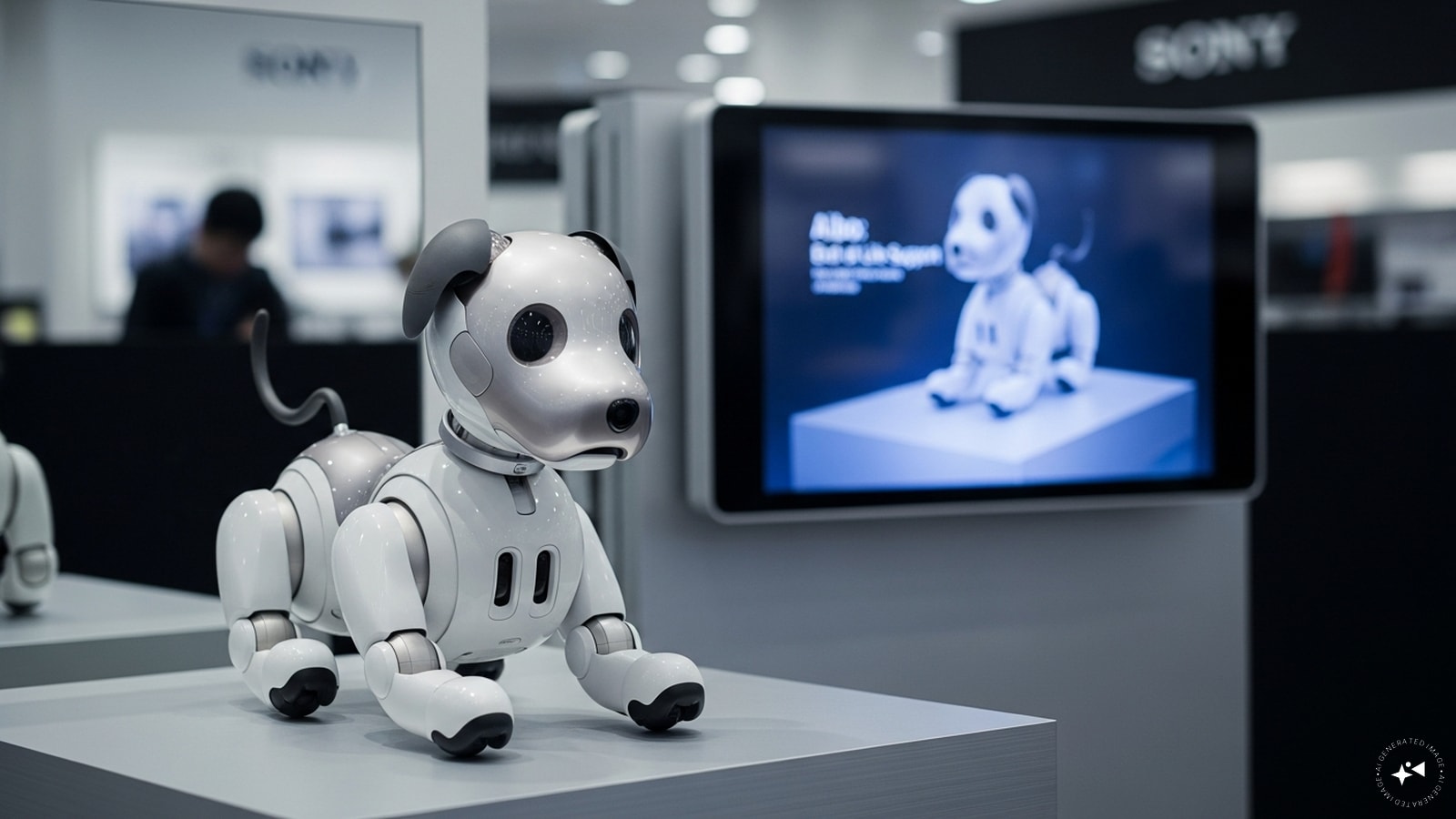
Sony Group shocked consumers and tech analysts by announcing the immediate sunset of domestic sales for its iconic robotic puppy, aibo. Once current inventory clears, the ERS-1000 model will vanish from Japanese store shelves, leaving behind a bewildered base of loyal owners who viewed the artificial pet as family. While Sony maintains that US operations will continue and cloud support will remain active, the decision signals a deeper structural failure. Sony built a mechanical marvel but completely lost its footing in the multi-billion-dollar race for embodied physical intelligence, choosing a quiet retreat over architectural evolution.
To understand why Sony is pulling the plug on its home turf, one must look past the sterile public relations phrasing of "business service optimization." The reality is a sobering lesson in the brutal economics of consumer robotics, hardware obsolescence, and a massive missed opportunity in the modern software explosion. Recently making waves lately: Stop Trying to Save Lives by Freezing the Economy.
The Shadow of Two Thousand and Six
This is not the first time Sony has abandoned its mechanical canine. In January 2006, then-CEO Howard Stringer axed the original Aibo line during a sweeping corporate restructuring designed to cut costs and refocus on televisions and core electronics. It was a decision that felt like a betrayal to the engineers who built it and the consumers who loved it.
That early iteration sold roughly 150,000 units over seven years. It was an engineering triumph but a financial black hole. When the project died, the internal culture of experimental hardware at Sony died with it for over a decade. Further information on this are covered by ZDNet.
The 2018 resurrection under Kenichiro Yoshida was supposed to rewrite that narrative. The ERS-1000 model arrived with rounded lines, expressive organic light-emitting diode (OLED) eyes, and an architecture explicitly dependent on cloud connectivity. Sony did not just sell a physical object; they sold a companion that required a mandatory monthly subscription to stay "alive."
The strategy seemed flawless on paper. The recurring revenue from the cloud plan was meant to subsidize the immense manufacturing costs of a device packed with 22 axes of movement, fish-eye cameras, and time-of-flight sensors.
But history has a habit of repeating itself when the underlying economic pressures remain unchanged. The executive team, now guided by Hiroki Totoki, faces a global electronics market that demands strict capital efficiency. A niche product costing thousands of dollars to manufacture, which requires specialized maintenance and custom repair centers, simply does not scale in a corporation prioritizing massive gaming margins and image sensor dominance.
Domestic enthusiasm in Japan peaked years ago. Without a massive, continuous influx of new buyers, the financial burden of maintaining the backend infrastructure for a dwindling user base becomes an unsustainable line item.
The Cloud Subscription Trap
Sony designed the ERS-1000 to be completely dependent on its proprietary cloud environment. Without a connection to the Sony servers, the robot loses its ability to learn from its environment, adapt its personality, or recognize individual family members. This design choice was intended to create an unbreakable bond between the customer and the company, ensuring a steady stream of monthly service fees.
Instead, it created an architectural bottleneck.
+-----------------------------------------------------------+
|               The Aibo Cloud Bottleneck                   |
+-----------------------------------------------------------+
|                                                           |
|  [ Aibo Hardware ] ---> ( Proprietery Cloud Servers )     |
|   - Fixed Sensors        - Rigid Behavioral Code          |
|   - 2018-era Chips       - High Maintenance Cost          |
|                                                           |
|                     VS.                                   |
|                                                           |
|  [ Modern Robotics ] -> ( Open Edge-AI & Open LLMs )     |
|   - Dynamic Vision       - Local Inference                |
|   - Flexible Compute     - Zero-Subscription Brains       |
|                                                           |
+-----------------------------------------------------------+
The cloud system was built using software paradigms from the mid-2010s. It relies on pre-programmed behavioral trees and localized machine learning algorithms that interpret sensor data to trigger specific actions, such as fetching a plastic bone or whimpering when ignored.
As the years rolled on, this architecture grew rigid. Maintaining those proprietary servers grew more expensive, not less. Unlike standard software-as-a-service (SaaS) businesses, where adding a user costs almost nothing, an active aibo continually streams video data, spatial maps, and voice inputs back to central databases, requiring constant compute cycles for voice recognition and behavioral computation.
When sales slowed, the economic math fell apart. The subscription fees from existing users were increasingly consumed by the operational overhead of the cloud infrastructure itself, leaving little profit margin to fund the development of a next-generation successor. Sony found itself trapped in a cage of its own design, supporting a high-maintenance ecosystem for a product that had already seen its best sales days.
Inside the Silicon Ceiling
The physical limits of the ERS-1000 are impossible to ignore. Launched in early 2018, the robot runs on processing hardware that is now thoroughly ancient by modern computing standards. Its internal logic units and sensor arrays were locked in nearly a decade ago.
Consider the vision processing system. The nose-mounted camera and rear-facing spatial sensors were top-tier for consumer tech in 2017, but they lack the depth-sensing clarity and low-light capability of modern smartphones. The robot regularly struggles with subtle changes in home lighting, changes in floor textures, and complex layouts.
The physical mechanics are equally fragile. The 22 compact actuators that give the dog its lifelike fluidity are subject to immense mechanical wear and tear. Gear teeth strip. Miniature motors burn out.
[Typical ERS-1000 Component Longevity Estimate]
Actuator Lifespan: ~3,000 Hours of Motion
OLED Eye Arrays:   ~15,000 Hours of Illumination
Lithium-Ion Pack:  ~500 Charge Cycles
When an aibo breaks, it cannot be fixed by a local electronics technician. It must be shipped to a specialized Sony facility in Japan, where technicians painstakingly disassemble the chassis to replace proprietary parts. This level of white-glove hardware support is incredibly expensive to maintain.
By halting sales, Sony is attempting to cap its long-term liabilities. They have promised to support existing units with parts and repairs for the foreseeable future, but by stopping the production line, they ensure that the total pool of broken machines they are legally and reputationally obligated to fix will never grow any larger.
Missing the Embodied Intelligence Boom
The most damning indictment of Sony's strategy is its complete failure to capitalize on the massive transformation in artificial intelligence that occurred over the last four years. We are living through an unprecedented explosion in open-source large language models, multimodal vision systems, and agile robotics. Startups and major tech firms are rapidly building machines that can understand complex natural language instructions and navigate chaotic human environments with ease.
Aibo remains frozen in time.
It cannot hold a meaningful conversation. It cannot understand context beyond a handful of pre-recorded voice commands. It cannot interact with smart home devices, monitor a house for security anomalies with any real efficacy, or serve as a functional assistant. It remains an incredibly expensive, closed-ecosystem toy in an era that demands open, useful, embodied intelligence.
Sony had the brand, the mechanical expertise, and the consumer trust to dominate this new market. They could have updated the software stack to integrate local neural processing units or connected the cloud backend to modern transformer models.
They chose not to do so. The corporate risk aversion that has characterized Sony’s non-gaming divisions for years won out. Instead of investing the hundreds of millions of dollars required to overhaul the software architecture and build an ERS-2000 capable of competing in the modern AI ecosystem, they quietly decided to let the current model fade away.
The American Divergence
The announcement explicitly noted that sales will continue in the United States, where the unit retails for over $3,000. This spatial division of the business reveals a deliberate shift in demographic targeting.
In Japan, aibo was marketed and embraced as an emotional substitute—a true companion for the elderly, single professionals, or families unable to keep live pets in restrictive Tokyo apartments. The relationship was built on affection and cultural acceptance of animism. Japanese owners held actual funerals for their dead robots when the first generation lost tech support.
In the United States, the market profile is entirely different. It is primarily purchased by affluent tech enthusiasts, academic research labs, and corporate offices looking for a novel lobby decoration. The emotional attachment is significantly lower, meaning the demands on customer support and behavioral perfection are far less intense.
Furthermore, the higher price point in the American market offers a slightly wider buffer against manufacturing and shipping costs. But make no mistake: the US market is an island. Without the massive domestic volume of Japan supporting the underlying ecosystem, the American branch of the business is living on borrowed time. It is a liquidation strategy masked as regional market selection.
An Abrupt End to the Dream
The discontinuation of domestic sales marks the end of Sony's grand experiment in consumer robotics. The company will claim that the "aibo business will continue" through services and vague future explorations, but the momentum is gone.
Engineers inside the company are already being reassigned to more profitable divisions, such as the autonomous vehicle partnerships or industrial imaging sensor development. The specialized production lines will be dismantled. The expertise gained over eight years of manufacturing the ERS-1000 will be cataloged and filed away, joining the original 1999 documentation in the corporate archives.
Owners will continue to watch their mechanical pets pace across their living rooms, knowing that every mechanical whir and click brings the device closer to an unfixable hardware failure. Sony proved that humans can form deep, lasting emotional bonds with configurations of plastic, silicone, and motors. They just couldn't figure out a way to make that love turn a consistent profit. Buyers looking for the future of companion robotics will have to look elsewhere; Sony has officially left the arena.