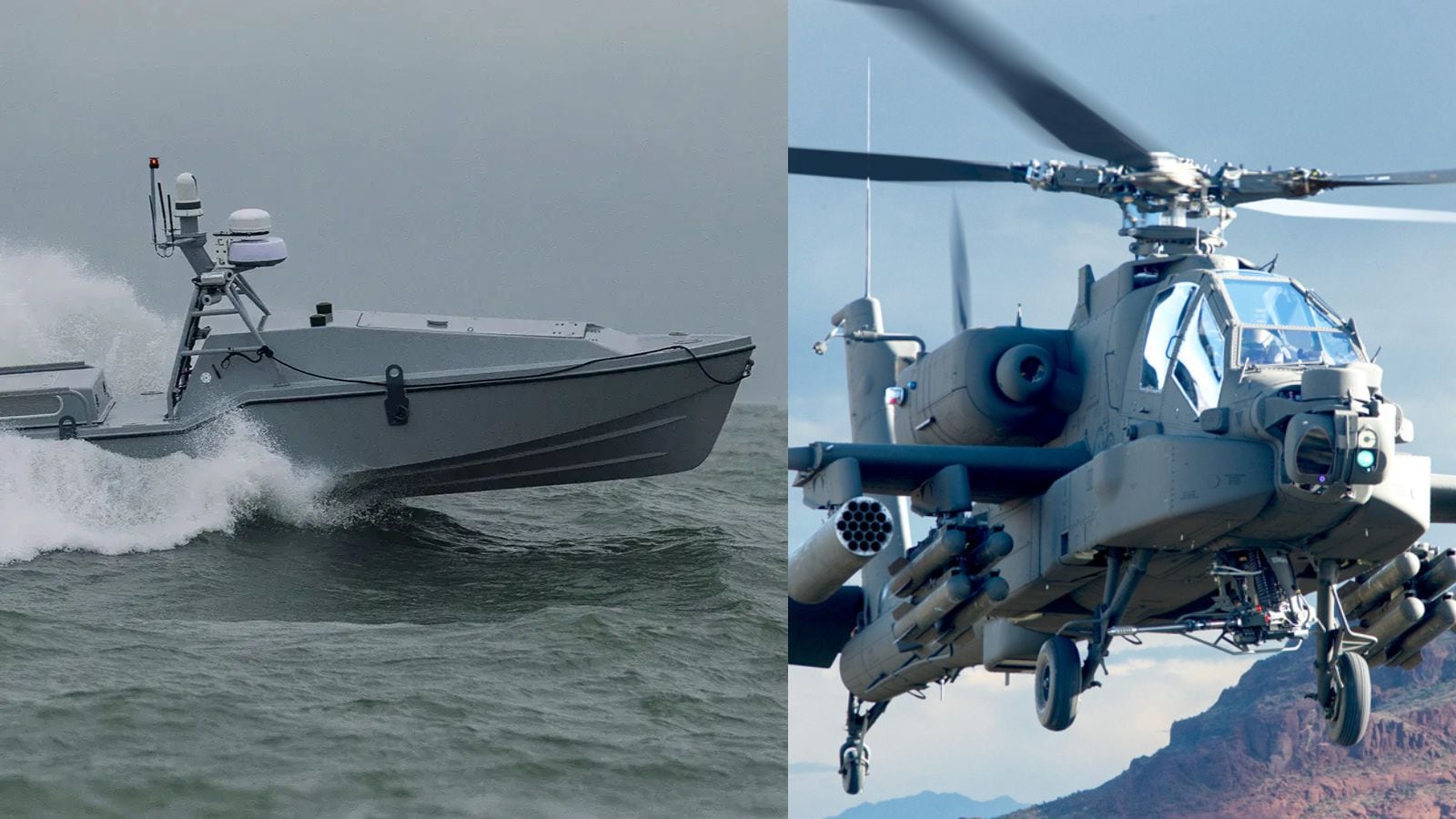
The recent rescue of two U.S. Army aviators in the volatile waters near the Strait of Hormuz has been widely covered as a triumph of modern technology. When an AH-64 Apache helicopter went down off the coast of Oman, it was not a traditional Navy Seahawk or a crewed patrol boat that pulled the stranded soldiers from the sea. Instead, a 24-foot autonomous surface vessel named the Saronic Corsair executed the first-of-its-kind robotic rescue. Behind the celebratory headlines lies a much harsher operational reality. The Pentagon is not rushing autonomous boats into theater out of a sudden passion for innovation. It is doing so because the traditional, heavily crewed American way of war is facing severe geographic and fiscal limitations.
The successful recovery of the Apache crew by an uncrewed system highlights a critical shift in maritime strategy. It provides a real-world proof of concept for the Pentagon's ambitious Replicator initiative. This effort aims to flood contested environments with thousands of relatively cheap, expendable autonomous platforms to counter numerical advantages held by adversaries like China.
The Anatomy of an Automated Rescue
The rescue occurred in the evening hours when the Army helicopter crashed while patrolling regional waters. For two hours, the aviators floated in a highly contested waterway, a narrow choke point where traditional search-and-rescue assets are vulnerable to shore-based anti-ship missiles.
Operating nearby was the Corsair, a sleek, diesel-powered autonomous vessel developed by Austin-based Saronic Technologies. Deployed by the Navy's Bahrain-based Task Force 59, the drone utilized its 360-degree passive sensing payload to pinpoint the downed crew in the dark without emitting radar signals that could reveal its location to hostile forces. The vessel maneuvered alongside the pilots, retrieved them from the water, and transported them to a safer coordinate where a manned helicopter performed a final hoist.
The mechanical specifications of the Corsair explain why it was chosen over traditional assets.
- Length: 24 feet
- Top Speed: Exceeding 35 knots
- Payload Capacity: 1,000 pounds
- Operational Range: More than 1,000 nautical miles
The vessel combines onboard computing, radar, and satellite communication with proprietary autonomous navigation software. It can execute complex patrol and recovery parameters without requiring constant telemetry from a human operator.
Breaking the Acquisition Bottleneck
The emergence of Saronic Technologies points to a deeper shift within the defense industrial base. Historically, the U.S. Navy has been trapped in a procurement cycle where building a single class of ships takes over a decade and costs billions of dollars. Saronic moved from an initial prototype to a $392 million Navy production contract in under 12 months.
This breakneck scaling was fueled by capital injections that traditional defense primes rarely see early in their lifecycles. Following the Corsair's theater deployment, Saronic closed a massive $1.75 billion funding round that valued the startup at $9.25 billion. The company is actively building out dedicated shipyards to produce dozens of these autonomous hulls annually.
For decades, the Pentagon relied on a handful of sprawling conglomerates to build massive, exquisite platforms. The Apache rescue proves that smaller, software-first companies can field operational hardware faster than legacy builders can finalize paperwork.
The Grunt Work of Autonomy
Despite the high-profile nature of the rescue, the true value of autonomous surface vessels lies in the tedious, dirty, and dangerous missions that rarely make the news. Before this incident, the Corsair fleet logged more than 79,000 nautical miles and 15,000 operational hours conducting routine surveillance, electronic warfare testing, and passive monitoring.
In places like the Red Sea and the Gulf of Oman, keeping human sailors on constant patrol wears down personnel and risks lives against low-cost threats like drone swarms and floating mines. An autonomous boat can idle at sea for days, managing its own fuel consumption and power usage while maintaining a constant data stream back to a central command post. If a missile strikes a Corsair, the loss is measured in a few million dollars of hardware, not a flag-draped coffin.
The Limits of the Robotic Fleet
The transition to a hybrid fleet of manned and unmanned systems is not without friction. While the Corsair proved it could pull people out of the water, it cannot perform medical triage. It cannot replace the deep institutional knowledge of a seasoned search-and-rescue crew when an operation goes sideways in heavy seas.
Furthermore, the software governing these vessels must operate in environments where GPS signals are routinely jammed and satellite links are severed. True autonomy means the boat must make navigation and mission decisions in a complete communications vacuum. If the machine misinterprets a civilian fishing vessel as a threat, the geopolitical consequences could be severe.
The Pentagon is betting heavily on these systems because it has no other choice. The current maritime reality demands a presence that a shrinking, aging manned fleet cannot sustain. The rescue off Oman was an impressive milestone, but the real test will be whether the military can scale these autonomous platforms before the next major conflict exposes the gaps in its traditional fleet.