Pyongyang is raising the stakes on the Korean Peninsula by framing regular American military sales to South Korea as direct acts of regional destabilization. The North Korean Foreign Ministry labeled these defense transactions as "war exports," threatening immediate, asymmetrical expansion of its own nuclear and conventional arsenals. While Western observers frequently dismiss such rhetoric as routine propaganda, the true strategy behind Pyongyang’s outrage is far more calculated. The regime is attempting to justify its own rapid, illicit arms manufacturing pipeline while simultaneously driving a wedge between Washington and its East Asian allies.
The Capital Expenditure of Deterrence
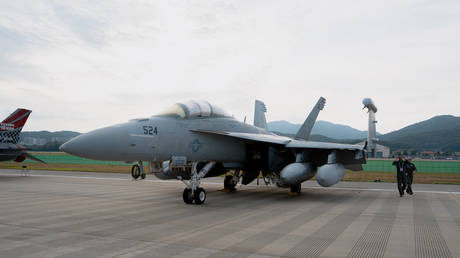
The immediate trigger for Pyongyang’s formal condemnation was a sequence of major defense acquisitions approved by the United States State Department. In mid-June 2026, Washington cleared a 292 million dollar Foreign Military Sales package for South Korea, featuring 70 AIM-120C-8 Advanced Medium-Range Air-to-Air Missiles (AMRAAM). This deal followed a much larger multi-billion-dollar authorization package that included 24 MH-60R Seahawk multi-mission naval helicopters and comprehensive upgrades for South Korea’s AH-64E Apache attack fleet.
From a purely tactical perspective, these systems are fundamentally defensive or stabilizing. The AMRAAM units allow South Korean fighter aircraft to intercept aerial threats at beyond-visual-range distances, neutralizing incoming cruise missiles or hostile aircraft before they reach high-density civilian centers like Seoul. The Seahawk helicopters focus primarily on anti-submarine warfare, monitoring the waters for North Korea’s increasingly active diesel-electric submarine fleet.
Pyongyang, however, rejects this defensive categorization entirely. State media accounts argue that these sales exceed ordinary defensive requirements and represent an integrated offensive posture. By labeling high-end radar and interception technology as instruments of aggression, North Korea shifts the public narrative. It frames the modernizing efforts of a democratic neighbor as a provocative arms buildup, using this accusation to validate its own violations of international law.
The Nuclear Production Cover Story
The primary diplomatic utility of criticizing American arms shipments is the domestic and international cover it provides for North Korea’s own weapons programs. Over the past five years, the regime has significantly expanded its fissile material production facilities. Independent defense monitors estimate that the state now possesses enough enriched material to assemble up to 90 nuclear warheads, with dozens already deployed on tactical ballistic missile systems.
Kim Yo Jong, the influential sister of the North Korean leader, recently declared that any Western expectations of denuclearization are anachronistic dreams. She made it clear that the expansion of the country's nuclear arsenal is an irreversible trajectory. When the United States supplies air defense components to Seoul, Pyongyang points to the deal as an existential threat that requires a direct countermeasure. It is a highly predictable cycle of diplomatic leverage. The regime utilizes the open, publicized nature of Western defense procurement to obscure its own covert, state-run factories, which are currently working to double their output of tactical warheads.
Global Transaction Duplicity
The core hypocrisy of North Korea’s "war exports" critique lies in its own booming defense trade. While condemning the transparent government-to-government sales conducted via Washington’s Foreign Military Sales framework, Pyongyang has quietly emerged as one of the most aggressive suppliers of conventional ordnance on the black market.
Military intelligence reports confirm that North Korea has shipped millions of artillery shells, along with short-range ballistic missiles, to active conflict zones in Eastern Europe. These illicit transfers violate multiple United Nations Security Council resolutions—resolutions that Pyongyang originally pledged to respect. In exchange for these conventional munitions, the regime receives vital economic aid, food shipments, and highly sophisticated technical assistance for its satellite and submarine programs.
The rhetorical attack on American defense sales serves to deflect attention from this lucrative shadow trade. By maintaining a loud, public focus on Western defense contractors, the regime seeks to normalize its own role as a primary weapons supplier to revisionist powers globally.
Fracturing the Trilateral Alliance
Pyongyang’s strategic messaging also targets a broader geopolitical objective: exploiting potential political fractures within the trilateral security alliance between the United States, South Korea, and Japan. The North Korean Foreign Ministry deliberately expanded its criticism beyond the peninsula, warning that American weapons transfers to Japan and Taiwan are the root cause of systemic instability across the entire Asia-Pacific theater.
This rhetoric aims directly at domestic political debates within South Korea. By emphasizing the immense financial costs of these American military contracts—noting that projected transfers could total 25 billion dollars by 2030—Pyongyang tries to stoke public resentment over defense spending. The goal is to cultivate a narrative that Seoul is compromising its own fiscal health and regional safety to satisfy the geopolitical ambitions of Washington.
The strategy fails to account for the reality of the regional security environment. South Korea's investments in American interoperable hardware are driven by an immediate need to counter an aggressive, nuclear-armed neighbor that has explicitly abandoned the goal of peaceful reunification. The procurement of advanced aircraft, naval assets, and missile guidance packages is a sovereign decision aimed at preserving a balance of power.
North Korea's ongoing complaints about Western hardware sales demonstrate that allied deterrence mechanisms are functioning exactly as intended. Pyongyang’s frustration is not born out of a fear of imminent Western invasion, but rather from the realization that its options for regional coercion are shrinking. Every integrated radar system and advanced interceptor missile deployed by the alliance reduces the political and military utility of North Korea's nuclear threats.


