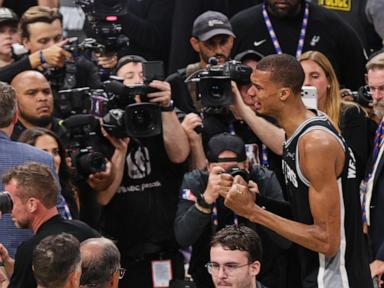
The NBA is quietly waging a war for your ears, and its newest weapons are an Emmy-winning prestige television composer and a Queensbridge rap legend.
Hours before the San Antonio Spurs and New York Knicks tip off Game 1 of the NBA Finals, the league unveiled a heavily produced creative spot titled "History is Calling." It features an original orchestral score by Nicholas Britell—the mastermind behind the anxious, wealth-drenched soundtrack of Succession—paired with the gravelly, authoritative narration of hip-hop icon Nas.
While the casual fan might view this as just another flashy championship promo, the underlying corporate strategy runs much deeper. This marks the official rollout of the NBA’s new global signature audio identity. Facing an increasingly fragmented media market where fans track games via silent social media clips rather than traditional television broadcasts, the league is attempting to anchor its brand through unmistakable, proprietary sound. It is an aggressive play to ensure that whether you are watching a game live on a television screen or muting a highlight on your phone, you instantly recognize the sonic footprint of professional basketball.
The Sound of Modern Attention Deficit
For decades, sports leagues relied entirely on visual cues to build brand equity. Logos, primary colors, and court designs defined the fan experience. The NBA understands that this purely visual model is failing in a multi-screen environment.
Audiences do not look at screens the way they used to. They second-screen, they scroll, and they consume game data via text updates. When they do watch video, it is often in short, commoditized bursts on social platforms. In this decentralized ecosystem, a logo in the corner of a video frame is easily cropped out, ignored, or actively obscured.
Sound, however, bypasses visual filters. A distinct audio signature can cut through a room, command immediate attention, and instantly signal institutional weight.
By hiring Nicholas Britell, the NBA is intentionally leaning away from the generic, brassy, bombastic synthesizers that have dominated televised sports since the late 1980s. Britell’s specialty is emotional progression. He builds tension using unorthodox orchestral arrangements, minor chords, and sudden shifts in momentum. It is a style designed to mimic the unpredictable nature of a high-stakes basketball game, where a single turnover can turn a raucous arena into a silent vault.
Nas provides the cultural counterweight. His voice introduces a raw, historical gravity, tracing the league's 80-year timeline while anchoring the presentation in hip-hop culture—a culture that the NBA has commodified and exported globally for nearly half a century. When Nas states that "the math is simple, the quest anything but," it bridges the gap between old-school prestige and modern sports analytics.
The Risk of Premium Branding in a Populist Sport
The league’s strategic pivot toward high-art audio is not without structural risk. The NBA is attempting to position its premier event as a high-prestige drama, akin to a prestige cable miniseries.
There is a fine line between elevating a sport and making it feel aloof.
The traditional sports anthem—think of John Tesh’s iconic "Roundball Rock" from the 1990s NBC era—worked because it was unapologetically populist, energetic, and easily hummable. It was populist art disguised as a sports theme. Britell’s compositions are fundamentally different; they are complex, layered, and demand a level of emotional investment that the casual viewer might find unnecessarily heavy during a Tuesday night regular-season broadcast.
Traditional Sports Themes          The New NBA Audio Identity
-------------------------          --------------------------
Brassy, up-tempo brass             Complex orchestration
Immediate hype generation          Slow-burn tension building
Designed for TV intros             Built for multi-platform utility
Populist, catchall appeal          Prestige, narrative-driven tone
Furthermore, an expanded partnership means this audio identity will eventually bleed out of the Finals and into everyday league programming. If every mid-season matchup between lottery teams is scored with the existential weight of a Shakespearean tragedy, the artistic currency risks immediate devaluation. The league must balance the desire for a premium brand image with the chaotic, fun, and often irreverent nature of actual sports fandom.
Monetizing the Silent Scroll
The real battleground for this audio initiative is the global distribution pipeline. The NBA is broadcasting the Finals to 214 countries and territories, translating the action into more than 50 languages.
Words do not translate seamlessly across those boundaries without massive localization costs. Melodic structures and rhythmic cadences do.
The partnership between Britell and Nas is designed to create an international shorthand for elite competition. By embedding specific musical motifs into every piece of digital content, the league creates an audio asset that functions like a trademark. In the near future, the specific cadence of a Britell string arrangement or a specific vocal drop from Nas could accompany every official highlight distributed on TikTok, Instagram, and global digital networks.
This is not about making a pretty commercial for Game 1. This is about building an audio asset that can be sliced, diced, and repurposed into thousands of hours of micro-content. It is a long-term corporate investment disguised as a marketing campaign, designed to solve the modern entertainment crisis: how to remain memorable when the audience has already looked away.