The collapse of the original High Speed 2 network is routinely blamed on predictable scapegoats. Politicians point to post-pandemic inflation, supply chain shocks from geopolitical conflicts, and administrative mismanagement. These factors are real, but they are symptoms rather than the root disease. The real reason HS2 is failing is an institutional obsession with absolute speed at the expense of basic engineering utility, combined with a political architecture that treats multi-decade infrastructure like a five-year electoral cycle.
By demanding a railway that could run faster than any other on Earth, British planners guaranteed a spiral of bespoke engineering, astronomical costs, and ultimate political panic. The resulting truncation of the route has left the UK with a multi-billion-pound line that achieves the exact opposite of its original intent. It is a textbook case of how not to build a nation. For a different view, read: this related article.
The Flawed Cult of Absolute Speed
For two decades, British transport planning has been captive to a specific delusion. That delusion is that speed cures all.
When the initial specifications for HS2 were drawn up, engineers were instructed to design a system capable of operating at 360 kilometers per hour, with the underlying structural capacity to reach 400 kilometers per hour. To put that into context, France’s highly successful TGV network typically operates around 320 kilometers per hour. Japan’s Shinkansen runs at similar limits. Similar analysis on this trend has been provided by Associated Press.
The decision to push for 360 kilometers per hour was not a minor technical upgrade. It was a compounding financial catastrophe.
The physics of high-speed rail dictate that as speed increases, engineering requirements do not grow linearly; they explode exponentially. To maintain stability and safety at those speeds, tracks must be straighter. This meant planners could not route the line around complex geographical features, environmental assets, or wealthy residential enclaves. Instead, they had to go through them, or under them.
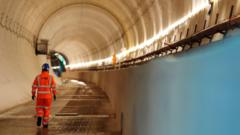
The consequence was an unprecedented reliance on tunneling and massive viaducts. Rather than using off-the-shelf European rail technology, the UK had to commission highly engineered, bespoke systems.
The recent findings from the Sir Stephen Lovegrove review confirm that this "gold-plating" was the project's original sin. By chasing a headline velocity that saved mere minutes on a trip to Birmingham, the state guaranteed a cost structure that would eventually break the national budget.
The Hardest Miles First
A basic principle of mega-project management is to build momentum through early, manageable victories. If a team can establish a functional supply chain and clear administrative hurdles on easier sections of a route, they can apply those lessons to more complex phases.
HS2 did the exact opposite.
Construction began on the most complex, politically sensitive, and geologically challenging section of the entire network: the stretch between London and the West Midlands. Engineers were immediately thrown into boring massive tunnels under the Chiltern Hills and navigating the dense urban topography of North London.
By starting with the hardest miles, the project encountered severe delays and budget overruns before a single mile of open track could be laid in the flat terrain of the Midlands. The cash burn rate peaked when the public and political willingness to tolerate it was at its lowest.
HS2 Strategic Design Mismatches:
+-----------------------+-----------------------+-----------------------+
| Engineering Design    | Political Reality     | Economic Outcome      |
+-----------------------+-----------------------+-----------------------+
| 360-400 km/h speed    | Inability to clear    | Massive reliance on   |
| requirement           | local planning easily | expensive tunneling   |
+-----------------------+-----------------------+-----------------------+
| Micro-managed route   | Frequent ministerial  | Constant scope shift  |
| changes               | turnover (DfT)        | and contract re-runs  |
+-----------------------+-----------------------+-----------------------+
| "Lean" client model   | Lack of in-house      | Exposure to punitive  |
| at HS2 Ltd            | commercial expertise  | cost-plus contracts   |
+-----------------------+-----------------------+-----------------------+
The Absence of Political Buffers
Major infrastructure takes decades to build. British governments last a maximum of five years, and transport secretaries rarely last two. This mismatch is fatal.
The James Stewart review into the project's governance laid bare a stark structural failure. Unlike other massive UK capital works—such as the Thames Tideway Tunnel or even the nuclear builds at Sizewell C—HS2 possessed no political buffer. It lacked independent joint sponsors, external regulatory shields, or insulated institutional shareholders.
Instead, HS2 Ltd sat in a direct, suffocating relationship with the Department for Transport. Whenever a local electoral scare arose or a new prime minister wanted to signal a shift in fiscal policy, the project’s scope was altered.
Every time a minister ordered a pause, a redesign, or a new environmental mitigation assessment to placate a rebellious backbench MP, the clock ticked. In major construction, time is money.
Contractors do not turn off their machinery for free; they charge holding fees. The constant chopping and changing of the northern legs destroyed the economic logic of the entire enterprise.
The Irony of the Truncated Line
The tragic irony of the current situation is that by cancelling the legs to Manchester and Leeds to save money, the government has created a torso network that fails on its own terms.
The primary business case for HS2 was never actually about speed. It was about capacity. The West Coast Main Line is completely saturated. By moving express passenger trains onto a separate, dedicated high-speed line, planners intended to free up enormous capacity on the existing tracks for regional commuter trains and freight.
Now, with the line stopping effectively at Birmingham and trains merging back onto the old network to go further north, the bottleneck remains unresolved. Tens of billions have been spent, yet the northern connections may end up with worse overall capacity and slower integration than under the original status quo.
How to Fix the Modern Infrastructure Crisis
To rescue British infrastructure from the ghost of HS2, the state must completely overhaul its approach to planning, contracting, and execution. The solution requires moving away from political grandstanding and returning to disciplined asset management.
Drop the Speed, Standardize the Tech
The current consideration by Transport Secretary Heidi Alexander to cap future operating speeds at 320 kilometers per hour must become permanent policy for all remaining builds. This single shift allows for the adoption of standardized, international rail components rather than custom-machined British alternatives. Lower speeds mean tighter turning radii, less tunneling, fewer compensation payouts, and immediate capital savings.
Establish Insulated Delivery Vehicles
The Department for Transport must be legally separated from the daily governance of mega-projects. Future builds should be managed by independent authorities with statutory funding guarantees that span across Parliaments. If a future government wishes to alter the scope of a project midway through execution, they should be legally required to pass primary legislation to do so, raising the political cost of arbitrary interference.
Kill the Cost-Plus Contract Culture
HS2 Ltd operated as a "lean" client, which in reality meant it lacked the deep commercial expertise required to police massive multi-billion-pound civil engineering alliances. Contracts effectively morphed into cost-plus arrangements, where the private sector supply chain faced minimal financial penalties for missing targets while the taxpayer bore all the risk. Government must rebuild its internal engineering capability so it can negotiate fixed-price risk allocations that protect public funds.
The failure of HS2 is not a failure of British engineering talent. It is a failure of British statecraft. Until the structural relationship between political expediency and technical reality is rebalanced, every major infrastructure project the UK attempts will suffer the same predictable, expensive fate.