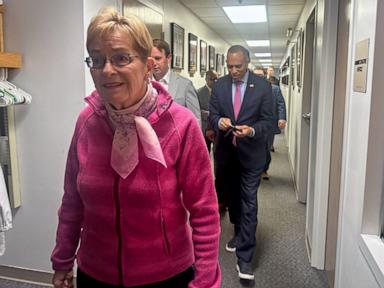
House Democratic Leader Hakeem Jeffries insists that the national political climate is holding firm for his party as they fight to reclaim the House majority. Yet behind the disciplined public optimism displayed during high-stakes campaign stops across Ohio, the battle for control of Congress rests on a volatile calculation. Democrats are betting that entrenched blue-collar incumbency and voter fatigue over living costs can withstand a relentless Republican push in Donald Trump's heartland.
The strategy was on full display in Toledo, where Jeffries spent a Sunday morning walking pews alongside Representative Marcy Kaptur. Kaptur, the longest-serving woman in congressional history, represents Ohio’s 9th District—a Rust Belt industrial stretch along Lake Erie that has drifted steadily rightward over the past decade. Republican challenger Derek Merrin is mounting a rematch after coming within roughly 2,400 votes of unseating her two years ago.
For Washington leadership, this is not just another district. It is a brutal litmus test for whether traditional Democratic labor populism can survive in territory that voted twice for Trump.
The Math Behind the Gavel
Retaking the House requires Democrats to hold a shrinking collection of working-class seats while simultaneously flipping suburban districts in California, New York, and Pennsylvania. House Speaker Mike Johnson has repeatedly argued that Republican momentum mirrored the conservative turnout spikes seen in recent general elections. Jeffries dismissed those assertions as completely disconnected from current economic realities on the ground.
National party leaders are pouring millions into defending veteran incumbents who used to win effortlessly. The defensive posture reveals how deeply the political geography has shifted.
Democratic Path to 218 Seats:
├── Defend Rust Belt Survivors (OH-09, PA-08, ME-02)
├── Flip Suburban Moderate Districts (CA, NY, PA)
└── Stave Off GOP Map Redraws (NC, OH)
Republican state legislators have spent months attempting to redraw congressional lines to dilute Democratic holds in places like Toledo and Akron. While legal battles and timing constraints have stalled some of those efforts, the systemic pressure on Democrats in the Midwest remains relentless.
Economic Strain and the Cost of Living Argument
Jeffries and his frontline candidates are framing the election almost exclusively around everyday household expenses. From groceries to utility bills, the Democratic message centers on accusing Republicans of failing to address core inflationary pressures while protecting corporate interests.
It is a difficult needle to thread. Voters frequently express deep frustration with current price levels, leaving incumbents forced to explain why relief has been slow to materialize.
Kaptur has leaned heavily into her local roots and constituent service to counter national political headwinds. Her campaign emphasizes tangible infrastructure funding, domestic manufacturing protections, and healthcare access.
Her opponent, Merrin, frames the race around national border security, fiscal spending, and alignment with the populist conservative agenda. Republican strategists view the district as one of their premier pickup opportunities nationwide.
Foreign Policy Collides with Local Ballots
National and international controversies have spilled directly into local campaign swings. Following recent executive actions regarding foreign sanctions, both party leaders found themselves responding to sharp foreign policy debates.
Kaptur issued scathing statements regarding administrative waivers on Russian sanctions, aligning her position with the region's significant Ukrainian-American and Eastern European diaspora.
These messaging pivots showcase how national security decisions instantly become campaign fodder in manufacturing hubs where international trade and defense supply chains affect local jobs.
The Limits of National Surrogates
Bringing high-profile national figures like Jeffries into working-class swing districts carries inherent strategic risks. While a party leader boosts fundraising and energizes core volunteers, Republican opposition groups quickly use those visits to tie local candidates to national party platforms.
Kaptur’s team has historically maintained a degree of separation from Washington leadership, emphasizing her independent streak. Yet the sheer cost of modern midterm campaigns makes high-level national coordination unavoidable.
Whether the Democratic strategy of pairing local longevity with national economic critiques will hold off a rising Republican baseline in the industrial North remains to be seen. The outcome in districts like Ohio's 9th will determine not just who holds the speaker's gavel, but whether the traditional Democratic coalition in the Rust Belt still has a viable path forward.
The margin between a House majority and the minority will ultimately be decided by a few thousand working-class voters along Lake Erie.