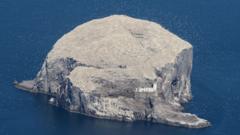
The Royal Society for the Protection of Birds (RSPB) has purchased the iconic Bass Rock and Craigleith islands in the Firth of Forth from the Dalrymple family, bringing the globally significant wildlife sanctuaries into charitable ownership for the first time in 320 years. Supported by a £586,000 grant from the National Heritage Memorial Fund, the acquisition transitions the management of the world’s largest northern gannet colony away from private aristocratic lineage. While early media coverage framed the sale as a heartwarming milestone for public conservation, the transactional reality is far more urgent. The transfer is not a celebratory victory lap for environmental charities; it is an emergency extraction operation for a collapsing marine eco-system.
More than 70 percent of Scotland's seabirds are in decline. The private stewardship model that sustained Bass Rock for three centuries has broken under the weight of modern ecological crises. Avian influenza, marine pollution, intensive overfishing, and the rapid expansion of offshore wind infrastructure have combined to form an unprecedented threat matrix. By relinquishing the land, the Dalrymple family has acknowledged that preserving global biodiversity now requires resources, legislative leverage, and scientific infrastructure that no individual landowner can provide.
The Illusion of Historic Stability
For generations, the narrative surrounding Bass Rock was one of unbroken continuity. Rising 106 meters above the sea like a sheer volcanic fortress, the island's chalk-white appearance is not a geological feature but a glaze formed by over 100,000 nesting gannets. The Dalrymple family held the deeds since 1706, witnessing a quadrupling of the gannet population during the lifetime of the previous owner, Sir Hew Dalrymple.
This population growth masks a fragile reality. Private ownership worked when conservation meant doing nothing. Historically, the best way to protect Bass Rock was to leave it alone, allowing the natural barriers of the North Sea to deter human interference. That strategy is obsolete.
Modern threats do not stop at the shoreline. Avian influenza devastated the colony, transforming the rock into a graveyard of infected carcasses. Concurrently, commercial overfishing has depleted the sandeel and herring stocks that the birds rely on to feed their chicks. When industrial pressures intersect with changing migratory patterns, passive preservation becomes a form of neglect. The Dalrymple family chose to sell because the island had transitioned from a proud ancestral asset into an active crisis management zone.
The True Cost of Modern Conservation
To understand why the RSPB intervened, one must look at the mechanics of contemporary environmental defense. Conservation in the 21st century requires intense data collection, continuous biological monitoring, and political advocacy.
The RSPB is partnering with the Scottish Seabird Centre to implement a highly coordinated recovery plan. The strategy involves deploying full-time research teams to track reproductive success, analyze dietary changes through fecal sampling, and map the precise flight paths of foraging birds. This level of intervention is expensive and legally complex.
A critical point of friction lies just over the horizon: the expansion of offshore wind farms. While essential for carbon reduction, poorly cited marine turbines present a literal barrier to seabird flight corridors.
[Threat Grid: Wind Turbines <-> Foraging Paths <-> Overfishing]
An individual aristocrat has very little leverage when confronting multi-billion-dollar energy consortiums during marine planning consultations. A charity with millions of members, an elite legal team, and statutory consultancy status carries immense political weight. The acquisition of Bass Rock gives the RSPB the legal standing as a direct landowner to contest, alter, or influence the development of offshore infrastructure in the Firth of Forth.
Balancing Public Access and Habitat Security
A major component of the purchase involves an injection of £372,036 in development funding from the National Lottery Heritage Fund. This money is earmarked for public outreach and responsible access, including an ambitious 360-degree real-time viewing theatre at the Scottish Seabird Centre in North Berwick.
This public-facing strategy highlights a fundamental tension in modern conservation. The RSPB reports an astonishing 1,088 percent increase in birdwatching interest among young people aged 16 to 29 since 2018. Capitalizing on this demographic shift is vital for fundraising and long-term institutional survival.
Yet, physical human presence on these islands can cause catastrophic disturbances. Nesting gannets and puffins are easily spooked, leading to broken eggs and abandoned nests.
+------------------------------------+------------------------------------+
| Conservation Action                | Ecological Impact                  |
+------------------------------------+------------------------------------+
| High-definition remote cameras     | Zero-disturbance behavioral study  |
+------------------------------------+------------------------------------+
| Regulated public boat tours        | Economic funding for local science |
+------------------------------------+------------------------------------+
| Physical island landings           | Strict limitation to researchers   |
+------------------------------------+------------------------------------+
The charity’s solution relies on digital proximity. By upgrading remote camera networks and broadcasting high-definition, live-streaming feeds to the mainland, the RSPB intends to satisfy public curiosity without putting boots on the ground. It is an expensive technological compromise. The success of the initiative hinges entirely on whether digital engagement can generate the same financial generosity as physical interaction.
The Broader Scottish Land Reform Subtext
The sale of Bass Rock and Craigleith also fits into a highly sensitive political conversation regarding Scottish land reform. For decades, Holyrood has pushed to reduce the concentration of vast tracts of land in the hands of a small number of private individuals.
While the transfer of these islands to a charitable body achieves the goal of removing land from private aristocratic ownership, it exposes a structural flaw in public funding. The purchase was heavily subsidized by public money via the National Heritage Memorial Fund.
Critics of the current system point out that public funds are effectively being used to liquidate the asset portfolios of wealthy families who can no longer afford the upkeep of their historic holdings. The Dalrymple family deserves credit for choosing a conservation buyer over a private billionaire developer. Even so, the transaction underscores a sobering economic reality: the public and charitable sectors are consistently expected to absorb the financial liability of deteriorating natural assets when private stewardship fails to remain viable.
No Room for Sentility
The romantic era of island ownership is dead. The purchase of Bass Rock proves that the preservation of global biodiversity can no longer coexist with feudal patterns of land tenure. Nature reserves can no longer be treated as isolated, self-sustaining fortresses. They are deeply integrated into broader economic, industrial, and climatic systems.
The RSPB now inherits a massive logistical and financial burden. Securing the land was the easy part; the real challenge lies in reversing a decades-long decline in an increasingly hostile marine environment.