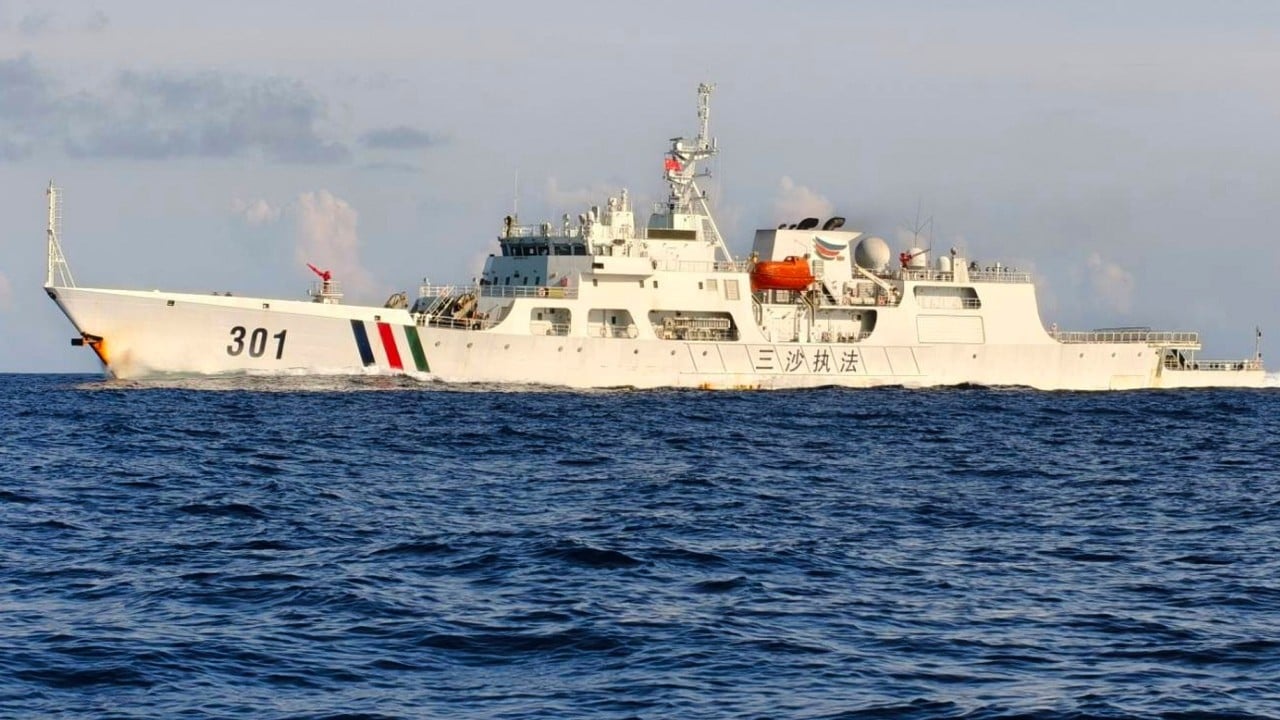
The recent deployment of China Coast Guard fleets into the deep waters east of Taiwan is not a routine response to shifting regional borders. It is a systematic attempt to rewrite the maritime law of the Western Pacific by erasing the legal boundaries of the Taiwan Strait. While Western capitals issue formulas of diplomatic concern, Beijing is establishing a permanent administrative presence on a vital global shipping artery. This shift uses domestic law enforcement assets to bypass traditional military warning triggers, achieving through white-hulled coast guard vessels what grey-hulled warships could not attempt without risking open conflict.
The international alarm sounded sharply following a rare joint declaration from Britain, France, and Germany, alongside an explicit rebuke from the United States. These powers warned that Chinese actions threaten regional stability and freedom of navigation. Beijing dismissed the criticism, stating its "special maritime traffic law-enforcement operation" was entirely legal and necessary.
The Western pushback misses the tactical ingenuity of the operation. Beijing did not deploy the People’s Liberation Army Navy to blockade Taiwan. Instead, it sent the China Coast Guard to inspect 198 passing vessels, intercepting merchant ships to demand destination logs and origin data. This transformation of an international shipping highway into a domestic policing zone represents a significant evolution in gray-zone coercion.
The Legal Shell Game
The immediate pretext for the patrols was a bilateral announcement by Japan and the Philippines to begin formal talks delineating their overlapping maritime boundaries. Beijing claimed these boundary talks encroached upon its own exclusive economic zone.
This justification hides a deeper strategy. By asserting that the waters east of Taiwan are subject to Chinese domestic policing, Beijing is forcing a legal reality where Taiwan possesses no sovereign waters of its own. When the China Coast Guard vessel Daishan leads a task group into these waters, it does not display the flags of wartime aggression. It acts under the guise of maritime safety, hydrographic surveying, and regulatory compliance.
This method exploits a vulnerability in international law. If a state fails to challenge persistent law enforcement activities within a specific zone, it risks implicitly accepting that jurisdiction over time. The Chinese Coast Guard is not trying to pick a fight with the Taiwanese military. It is trying to out-regulate them.
Beyond the Strait
For decades, the strategic consensus focused almost entirely on the narrow Taiwan Strait separating the island from the Chinese mainland. The deep waters off Taiwan’s east coast, facing the open Pacific, were viewed as a secure rear area for the island's defense forces. Taiwan's primary naval and air bases, including the underground hangars at Hualien and Taitung, were designed to survive an assault from the west and project power into the Pacific.
By establishing a permanent coast guard patrol pattern to the east, Beijing is closing this geographic escape route. The operations target areas housing critical undersea fiber-optic cables that connect Taiwan and Japan to the global internet. The China Coast Guard confirmed it conducted hydrographic surveys in these exact zones during its recent deployment. Mapping the ocean floor in these deep waters serves a dual purpose: it establishes administrative precedent while gathering vital acoustic and topographic data for submarine warfare.
The immediate impact falls heavily on commercial shipping. Three merchant vessels reported being intercepted and questioned by Chinese crews. For an international shipping industry hyper-sensitive to insurance premiums and war-risk clauses, the mere presence of an assertive maritime police force alters calculations. If commercial captains begin routinely complying with Chinese data demands to avoid delays, Beijing wins de facto administrative control without firing a single shot.
The Limits of Western Deterrence
The diplomatic pushback from Washington and European capitals reveals the gaps in Western maritime strategy. Joint statements expressing concern do little to deter a coast guard operating under domestic mandates. The United States described the harassment of commercial shipping as deeply destabilizing, yet Western naval assets are structured to deter military invasions, not to police international traffic cops.
Taiwan's Coast Guard Administration faces an asymmetry in scale. The China Coast Guard functions as a second navy, possessing massive, heavily armed vessels, some exceeding 10,000 tons, that dwarf the law enforcement ships of its neighbors. Forcing Taiwan to constantly deploy its limited maritime assets to intercept these patrols drains resources and exhausts crews.
This strategy avoids the traditional red lines that would trigger a U.S. military intervention or Western economic sanctions. There are no missile tests, no amphibious landing rehearsals, and no declarations of war. Instead, there is only a steady accumulation of bureaucratic and physical precedents.
The real danger is a gradual shift in the status quo. If Beijing successfully standardizes these patrols, the waters east of Taiwan will transform from an open international commons into a strictly managed Chinese domestic zone. The final point of this campaign is not a dramatic beach landing, but a quiet, regulatory chokehold that leaves the international community with no clear military justification to break it.