The squeak of rubber on maple usually sounds like panic.
If you sit three rows behind the baseline at Scotiabank Arena in late October, before the winter slush turns Bay Street grey and before the playoff race hardens into math, you can hear the exact moment a basketball possession dies. It is not the thud of a blocked shot or the roar of nineteen thousand people rising to their feet. It is a sharp, synchronized chirping of five pairs of sneakers sliding laterally in unison, followed by the sudden, suffocating silence of an opposing point guard realizing he has nowhere left to go.
For the past few seasons in Toronto, that sound was a memory. Watching the Raptors defend felt like watching someone try to hold water in cupped hands; no matter how frantically they scrambled, the leaks appeared faster than they could plug them. You watched games with your shoulders hunched, bracing for the inevitable corner three-pointer that always seemed to arrive wide open, like an uninvited guest walking through an unlocked front door.
Then came this autumn. Something shifted in the cold air north of the border, and it happened long before anyone expected a rebuilding roster to figure out the hardest part of professional basketball.
The Architecture of Trust
To understand why the Raptors’ defense is clicking so early in the season, you first have to abandon the box score. Points allowed per game will lie to you in November. Shooting percentages fluctuate wildly over a ten-game sample; a team can play brilliant coverage and still lose because a reserve forward gets hot from twenty-six feet, or look genius because an opponent misses six straight layups.
Instead, look at the geometry.
Imagine a hypothetical scenario to picture what Darko Rajaković is asking of five grown men moving at twenty miles per hour. Picture five people standing in a dark room, each holding the corner of a giant, taut bedsheet. If one person lunges forward to swat at a fly, the entire sheet goes slack, and everything collapses inward. If one person hesitates, the tension snaps. For the sheet to stay tight, all five people must move as a single nervous system, reading the twitch in a teammate's shoulder before the brain even registers a threat.
That bedsheet is modern NBA help defense. And for young teams, it is almost always a disaster.
Offense is selfish by nature; you get paid, praised, and drafted because you can put a leather ball through an iron ring. Defense is pure altruism. It requires you to sprint forty feet at maximum effort to cover for a mistake your teammate made three seconds ago, knowing full well that your reward will be getting dunked on or watching the ball swing to the next open man while your lungs burn.
Most young rosters spend the first forty games of a season arguing with their eyes. When a screen comes, they pause for a fraction of a second—Is that my guy or yours?—and in the NBA, a tenth of a second is an eternity.
Yet, right out of the gate this season, Toronto has erased that hesitation. Look at Scottie Barnes. For years, Barnes possessed the physical tools of a mythological creature—a six-foot-eight frame with a wingspan that seems to stretch across two time zones—paired with the wandering attention span of a kid chasing every shiny object on the floor. He wanted every steal. He wanted every block. Sometimes, chasing a highlight meant abandoning his post.
Now, watch him anchor the weak side. He isn't gambling anymore; he is conducting. You can see him pointing with his left hand while his hips are already turning toward the paint, calling out a backdoor cut before the cutter even plants his foot. When Barnes stops freelancing and starts orchestrating, the entire floor shrinks. Opposing offenses suddenly feel like they are trying to parallel park a tractor-trailer in a broom closet.
What the Numbers Actually Whisper
I remember sitting in the upper bowl during the 2019 title run, watching Marc Gasol and Kawhi Leonard dismantle the Milwaukee Bucks without ever seeming to break into a full sprint. Back then, defense was a veteran art form, built on scar tissue and years of shared film sessions. You didn't expect twenty-three-year-olds to understand those angles. You expected them to survive on athleticism and pray the fourth quarter stayed close.
Which is what makes this early-season surge so disorienting—and, frankly, a little hard to trust if you have been burned by early-season fools' gold before.
Let’s look at the actual mechanics driving this shift, stripped of the coaching clichés. Toronto’s defensive rating in the opening stretch hasn't just improved incrementally; it has jumped into the league's upper tier because they have radically altered their shot profile. Specifically, they are running opponents off the three-point line with a kind of reckless, coordinated violence while funneling ball-handlers directly into length at the rim.
Consider what happens when Jakob Poeltl is healthy and patrolling the paint. Poeltl is not a vertical athlete who will end up on posters; he is a human thermostat. He lowers the temperature of the entire game. When Poeltl drops back on a pick-and-roll, his positioning is so precise that guards are forced into the worst shot in basketball: the contested floater from twelve feet.
Behind him, wings like RJ Barrett, Ochai Agbaji, and Gradey Dick are no longer dying on screens. Last year, a simple high ball screen would send Toronto’s perimeter defenders spinning like tops, leaving Poeltl stranded on an island against two attackers. This year, the point-of-attack pressure has teeth. Davion Mitchell, arriving with a reputation as a human irritant, sets a tone the moment he checks in—picking up ninety-four feet from the basket, pressing his chest into the opposing guard's airspace until the shot clock bleeds down to twelve seconds before the offense even initiates its first set.
Contagion works both ways in a locker room. Laziness spreads like mold, but relentless effort is just as infectious. When a reserve guard dives onto the hardwood for a loose ball in the second quarter of a Tuesday night game in November, the starters on the bench feel a sudden, sharp pang of obligation. Nobody wants to be the guy jogging back when the guy next to him is bleeding from his elbows.
The Invisible Stakes of November
Why does any of this matter before American Thanksgiving? Cynics will tell you the NBA regular season doesn't truly begin until Christmas Day, that early standings are a mirage, and that teams with championship aspirations are merely coasting in second gear while hungry, young rosters treat every possession like Game 7.
There is truth in that cynicism. Contenders do pace themselves. Veteran stars do take nights off mentally in November.
The cynics miss the point entirely, though, because Toronto isn't measuring itself against the Boston Celtics or the Oklahoma City Thunder right now. Toronto is fighting a much older, quieter enemy: the rot of losing habits.
When a franchise pivots toward youth, the greatest danger isn't missing the playoffs; it is teaching young players that losing is acceptable as long as their personal statistics look clean. Once a twenty-two-year-old learns how to score twenty-two points in a fifteen-point loss without getting angry, you have lost him forever. You cannot coach that apathy out of a player three years later when the stakes finally get real.
Defense is the only reliable vaccine against that rot.
Think about what it takes for a scorer like Gradey Dick or Immanuel Quickley to buy into this system. Dick came into the league labeled as a pure shooter—a specialist who needed to be hidden on the defensive end like a fragile heirloom. If he stays on the floor this season, it won't be because he shoots forty percent from deep; it will be because he learned how to use his chest, slide his feet, and take a charge without flinching. Every time he survives a switch against a bigger forward, his value to this franchise doubles.
The Ghost in the Machine
Still, watching this team defend comes with a lingering, uncomfortable question that keeps analysts awake at night: is this sustainable when the scouting reports catch up?
Right now, Toronto enjoys the element of surprise. Opposing coaches spend October worrying about their own rotations, running generic offensive sets rather than hunting specific mismatches. By January, every assistant coach in the league will have a folder thick with video clips detailing every flaw in the Raptors' coverage. They will know which defender over-helps from the strong-side corner. They will know how to drag Poeltl away from the basket with five-out spacing. They will test whether this young roster has the emotional maturity to keep communicating when they miss six straight shots on the other end and the crowd grows restless.
Because defense is fragile. Unlike a jump shot, which belongs to an individual, a team defense belongs to everyone at once. All it takes is one injured starter, one selfish stretch of possessions, or one frustrating three-game road trip on the West Coast for that taut bedsheet to go slack again.
You could see flashes of that vulnerability even in their best wins—moments where a miscommunication on a cross-screen left a shooter wide open in the corner, followed by two players staring at each other with palms upturned, silently arguing over whose assignment it was. Those cracks haven't disappeared; they have simply been papered over by frantic second efforts and sheer physical exertion.
Where the Noise Lives
Yet, if you strip away the projections and the January skepticism, something undeniably real is happening on that floor.
You can see it in the fourth quarter, when the legs get heavy and the jump shots stop falling. Last season, those were the minutes when Toronto unraveled, giving up thirty-five-point quarters as their shoulders slumped and their transitions slowed to a walk. This season, when the offense stalls—and with a young roster still learning how to create half-court shots, the offense will stall—the defense doesn't sulk. It tightens its grip.
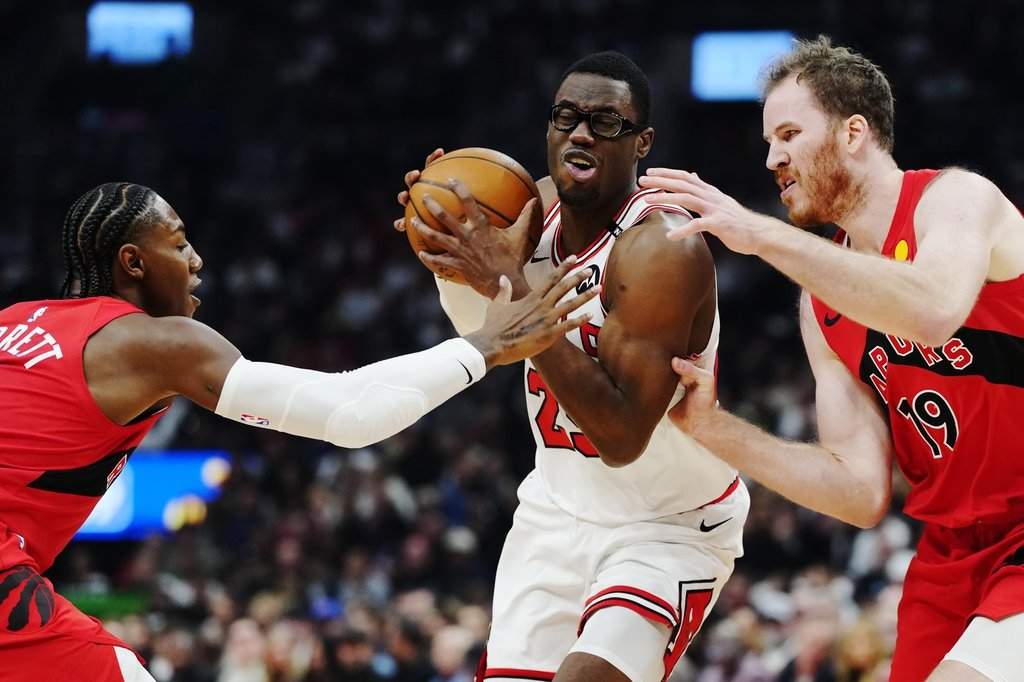
Watch a possession late in the fourth quarter when the game hangs by two points. The ball swings from the top of the key to the wing. Agbaji closes out with high hands, taking away the shot. The attacker puts the ball on the floor, driving baseline, only to find Barnes sliding over like a sliding glass door slamming shut. The ball gets kicked out to the opposite corner, where Barrett arrives a split second after the catch, chest puffed, hands wide, forcing an awkward, off-balance heave as the shot clock buzzer blares.
Nobody scored. No highlight clip will make the morning shows. Half the fans in the arena were probably looking at their phones.
Down on the baseline, though, five guys in red and black slap hands, chests heaving, eyes locked on the other end of the court. They didn't just get a stop; they proved to themselves that they don't need to be perfect to survive. In a league obsessed with effortless brilliance, the Raptors have found a much dirtier, much more reliable way to live—one bruised rib, one contested closeout, and one agonizing twenty-four-second possession at a time.