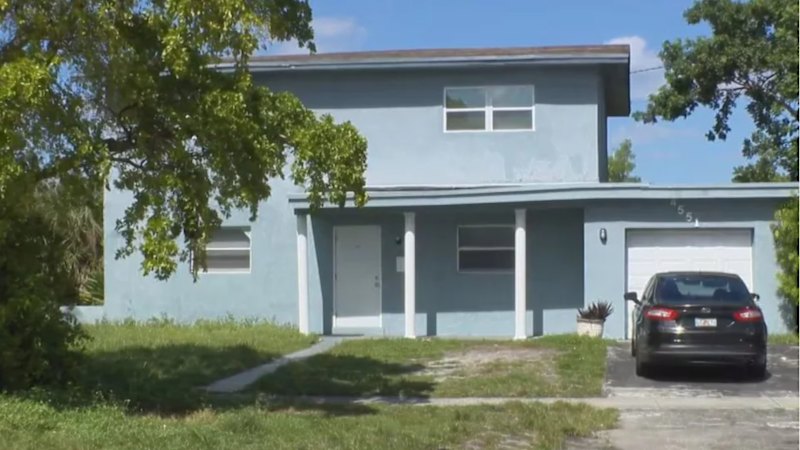
The salt-heavy air of Broward County carries a particular stillness during a summer welfare check. You knock on the screen door. Nobody answers. You peer through a narrow strip of glass, listen for the hum of a television or the shuffle of slippers on tile, and then you smell what every first responder learns to dread before the front door even swings open.
When a man dies alone inside a house in South Florida, the quiet that follows feels heavy enough to press against your ribs.
In July 2022, Officer Brian Louis Sguros of the Lauderhill Police Department responded to a welfare check at the two-story home of 71-year-old Dennis I. West. West had died from cardiovascular disease. On paper, it was a routine call—a sad ending to a solitary chapter, a file to be closed and handed over to the proper channels. Instead, prosecutors and investigators later alleged that a routine welfare check became the opening move in a multi-year shadow life. According to authorities, Sguros told the county medical examiner that he was close with West and that West had no living family, signed off on his cremation, used law enforcement database access to pull West's personal identifiers, moved into the house, paid bills and taxes in the dead man's name, forged signatures on permits, and spent more than $200,000 renovating the property—only for the arrangement to unravel when a real estate buyer acquired the home from West's relatives, leading to Sguros's arrest on multiple felony charges and his resignation from the department in October 2026.
Read as a headline, it sounds like a dark pulp thriller. Read with a magnifying glass, it exposes something far more unsettling than a single rogue badge: how easily a person's final exit, their paper trail, and their physical home can drift into a blind spot where nobody is watching closely enough.
When a Welfare Check Becomes a Crossroad
Nobody sets out in life expecting their final afternoon to be narrated by someone who barely knew them. Yet when someone lives quietly—or when relatives live miles away, or drift out of weekly contact—the first person across the threshold after a death holds an extraordinary amount of early leverage.
Consider a hypothetical scenario (not a depiction of a specific case, just a composite of how bureaucratic gaps open): Imagine a retired watchmaker named Arthur who lives two states away from his niece. They speak on holidays and exchange birthday cards. One week, Arthur stops answering his phone. A neighbor calls for a check. For the first forty-eight hours after discovery, the paperwork moves faster than grief can travel across state lines. If someone misstates who is in the picture—or if records take days to link a death certificate to property rolls and next-of-kin inquiries—time becomes a currency that favors whoever is already standing in the hallway.
That is the human tension at the heart of the Lauderhill allegations. A home is never just drywall, roof trusses, and square footage. It holds birthdays, tax bills, unmailed letters, old warranties, and the quiet dignity of a person who worked decades to own a piece of ground. When a man dies, his body leaves the room, yet his legal and financial footprint lingers in county ledgers, utility accounts, and appraiser files.
I have spent years reporting on property disputes, probate tangles, and local government records, and I can tell you the dust inside an abandoned or contested house smells unmistakable. It is a mix of damp cardboard, old citrus cleaner, sun-baked plaster, and stagnation. You walk through rooms where clocks stopped or mail piled up by the entryway, and you feel the strange friction between human memory and cold administrative machinery. Bureaucracy moves in slow, literal gears. It trusts forms until a human being forces it to look twice.
The Mechanics of an Invisible Occupation
How does someone step into a dead man's house and stay there for years?
Think of a house like a locked safe with several tumblers. The first tumbler is physical access—having the keys, knowing the layout, standing inside before neighbors or distant relatives even know what happened. The second tumbler is identity and paperwork: Social Security numbers, driver's license details, utility accounts, property tax notices, and building permits. The third tumbler is silence—the stretch of months or years where no alarm goes off because the lights stay on, the grass gets cut, and the property taxes keep getting paid.
According to court filings and reporting on the Broward County case, Sguros allegedly turned those tumblers one by one. Authorities alleged he abused his law enforcement access to look up West's Social Security and driver's license information, paid utilities and taxes under West's name, forged West's signature on building permits, and poured roughly $214,000 of his own money into overhauling a property he claimed had trash, roof damage, and structural instability—telling neighbors he intended to turn it into an Airbnb.
Why didn't a bell ring immediately?
Because local government systems were built to process transactions, not to interrogate intent at every counter. A tax collector's office cares whether the bill is paid on time. A permitting desk checks whether plans meet code and bear required signatures. A utility company sees an account in good standing. Unless a red flag crosses between agencies—medical examiner records, law enforcement audit logs, property appraisers, and title registries—a clever or brazen actor can make an irregular situation look routine from the street.
Admittedly, real estate and property law can feel dizzying when you first look under the hood. Even seasoned reporters sometimes pause over how a deed, a tax bill, a probate filing, and an adverse possession claim interact. You don't need a law degree to grasp the core idea, though: paying bills or fixing up a house is not the same thing as owning it. Fixing a leaky roof does not erase a rightful heir's claim, and wearing another man's name on a form does not make you him.
Money, Renovation, and the Illusion of Ownership
One of the sharpest ironies in the allegations is financial. Spending over $200,000 of your own money on a house sounds, on the surface, like the opposite of a cheap grift. Why would anyone sink six figures into walls that aren't legally theirs?
Human rationalization is a powerful thing. People convince themselves of all kinds of stories when they want an outcome badly enough. In his affidavit, Sguros stated he took possession in August 2022—less than a month after finding West—and spent two and a half years repairing a damaged, trash-filled structure. Later, after a real estate group bought the property from West's relatives and moved to take possession, Sguros sued the buyer seeking reimbursement for his repair costs, while authorities argued he had engaged in a criminal takeover and identity misuse.
Look at what happens when someone builds a castle on borrowed ground. Every new coat of paint, every contractor invoice, every permit stamped in another person's name starts to feel like proof of belonging to the person doing the work. It creates a psychological trap: the deeper you wade into the project, the harder it is to admit you never had the right to start it.
And when the reckoning arrives—when a legitimate buyer shows up with a deed traced back to the real family—the illusion shatters all at once. Suddenly the renovations aren't a triumph. They are a sunk cost in a dispute that has escalated into felony charges, official misconduct allegations, a ruined career, and a courtroom fight.
Public Trust and the Weight of a Badge
Badge.
Just one word, yet it changes the math of almost every room it enters.
When an ordinary neighbor or a random stranger tries to steer what happens after a death, people ask questions. When a sworn police officer is the one who arrives on scene, the instinct in many corners is to assume procedure is being followed to the letter. That assumption is the bedrock of public trust. When a law enforcement officer is accused of exploiting official access and authority for personal gain, the damage reaches far beyond a single case file.
It makes everyday citizens wonder: Who audits the people who have the keys to the databases? How quickly do agencies catch a mismatch between a deceased person's status and active records? And what happens to vulnerable or isolated homeowners when nobody is checking in?
Those are fair, uncomfortable questions. History shows again and again that institutions rarely fail from a single dramatic explosion alone; they fray through small, unchallenged shortcuts that go unnoticed until someone pushes them too far. Whether the vulnerability lies in thin next-of-kin verification, siloed municipal databases, or delayed cross-checks between vital statistics and property records, every gap invites someone to test it.
What Families and Neighbors Can Actually Do
You don't have to live in fear of a movie plot to take practical steps that protect your family and your property. Most real-world headaches involving a loved one's home start with something much simpler: missing paperwork, out-of-date contact records, or silence after a passing.
Keep a clear, current folder of vital documents—deeds, title insurance policies, mortgage or tax statements, utility providers, and contact details for trusted relatives—somewhere safe and known to the people who need it. Stay in steady contact with older or isolated relatives, and make sure local authorities or trusted neighbors know how to reach next of kin if an emergency ever happens.
Check property records periodically if you hold family land or inherit a home from afar. In many counties, you can monitor property filings or verify tax status online without waiting months for word-of-mouth updates. If something looks off—an unfamiliar filing, an unexpected lien, a strange change in status—ask questions early, while records are fresh and witnesses are easy to reach.
Above all, don't treat paperwork as an afterthought. A house holds memories, yes, but deeds, wills, and clear records are what keep those memories protected when grief hits hardest.
Sunlight still cuts hard through the palms in South Florida, bright enough to bleach the paint on a porch rail in a single season, yet a single locked front door can keep secrets hidden for years until the day someone turns the key and finds the lock no longer fits.