The rain in Copenhagen does not fall so much as it settles, a cold, salt-heavy mist blowing in off the Øresund that turns wool coats into damp armor and forces cyclists to squint against the gray.
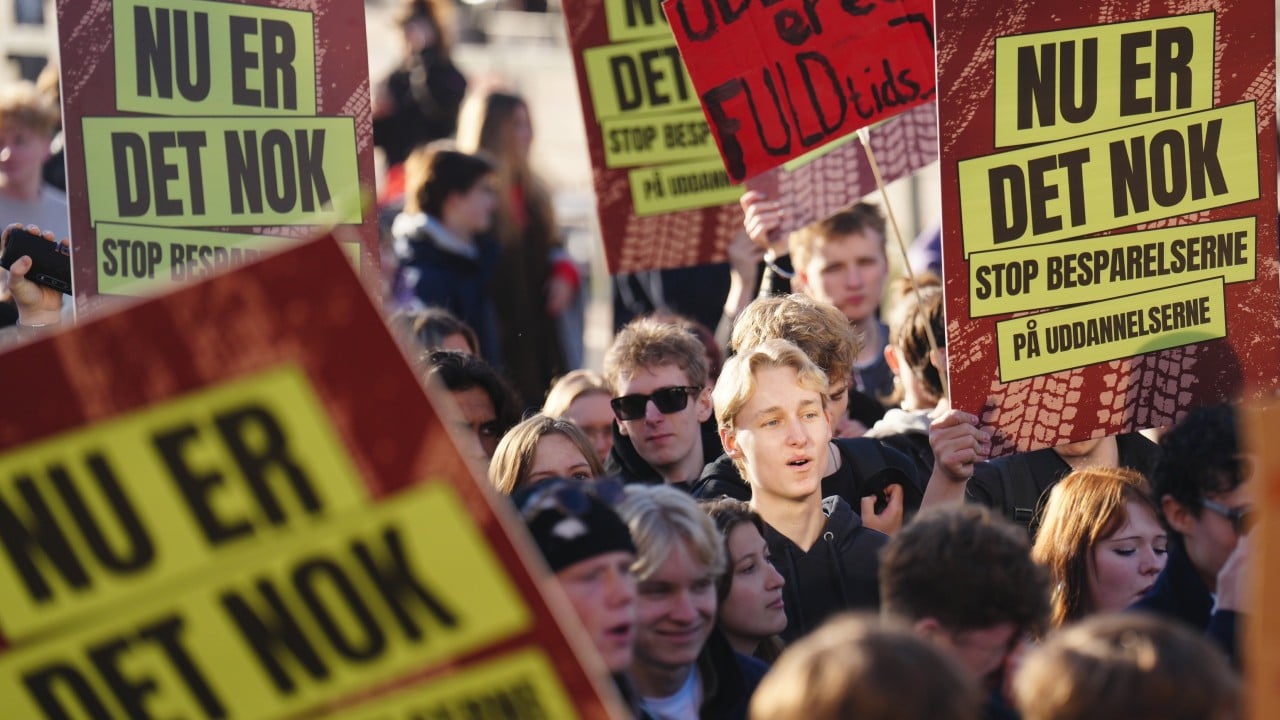
On a Tuesday morning in late autumn, the air outside the Danish Parliament at Christiansborg smelled of wet cobblestones, cheap coffee from thermoses, and freshly painted cardboard. Thousands of young people stood shoulder to shoulder in the square. They were not shouting the rehearsed chants of seasoned political operatives. They were holding hand-lettered signs with ink bleeding in the drizzle, shifting their weight from one cold foot to the other, looking less like an angry mob and more like a generation that had just looked up from its textbooks and realized the floor was missing.
Wait.
Look closer at the faces in that crowd. In a country routinely ranked among the happiest, wealthiest, and most egalitarian on earth, why were teenagers and twenty-somethings walking out of high schools and universities across Aarhus, Odense, and Copenhagen?
To understand what happened on those wet cobbles, you have to understand the quiet, unspoken contract that has held northern Europe together for generations. And you have to feel what happens when the ink on that contract suddenly begins to fade.
The Architecture of a Broken Promise
If you grew up in Denmark, or anywhere within the orbit of the Nordic social model, you were raised on a specific, comforting arithmetic. You worked hard in school, you paid some of the highest taxes in the world once you entered the workforce, and in return, the society around you guaranteed a baseline of dignity. Education was not a luxury commodity traded on an open market; it was the oxygen of the democracy. It was free, and students were even paid a modest monthly stipend—the Statens Uddannelsesstøtte, or SU—so that the daughter of a bus driver in Jutland had the exact same shot at becoming a neurosurgeon or a historian as the son of a shipping magnate in Hellerup.
For decades, that system was the envy of the world.
Then came the spreadsheets.
Across Europe, from the lecture halls of Berlin and Paris to the gymnasiums of Madrid and Rome, a familiar, creeping chill has settled over public budgets. Governments facing aging populations, rising defense commitments, and sluggish post-pandemic growth began looking for places to trim the fat. Inevitably, their eyes landed on the classrooms. In Denmark, proposed reforms and sweeping budget adjustments threatened to shorten master’s programs, tighten the screws on student grants, and force young people through the educational pipeline faster, cheaper, and with narrower margins for error.
On paper, in the fluorescent-lit offices of finance ministries, these changes looked tidy. A few billion kroner saved here. A slightly earlier entry into the labor market there. An efficiency gain.
To the people actually sitting in the desks, it felt like the slow dismantling of the ladder they were standing on.
Inside the Lecture Hall at 4 PM
Let us make this real. Consider a hypothetical student—we will call her Freja—sitting in the back row of a humanities lecture hall at the University of Copenhagen.
Freja is twenty-two. She is the first person in her family to attend university. Her parents run a small bakery outside Roskilde, a business that survived the energy crisis by the skin of its teeth and still leaves them awake at three in the morning worrying about flour prices and electricity bills. Freja receives the SU, which covers her tiny, nine-square-meter room in a shared apartment and leaves just enough for oats, lentils, and the occasional bus ticket home. To afford anything else—books, a winter coat, a coffee with friends—she works fifteen hours a week shelving groceries.
When politicians talk about "streamlining" higher education, cutting a two-year master’s degree down to a single, compressed year, they see an accelerated pathway to tax-paying productivity.
Freja sees something entirely different.
She sees a pressure cooker where deep reading, intellectual curiosity, and the slow, messy process of learning how to think critically are replaced by a frantic race to pass exams. She sees what happens when she gets sick for two weeks, or when her anxiety flares up, or when she needs to take an extra shift at the supermarket to pay a dental bill. In a compressed system with reduced financial breathing room, one stumble does not just mean a bad grade. It means falling off the track entirely.
And Freja is not alone. Across the continent, a generation is waking up to the realization that they are being asked to run faster on a treadmill that is actively tilting upward.
The Ripple Across the Continent
If this were merely a local dispute over Danish fiscal policy, it would have stayed on the back pages of Copenhagen newspapers. It did not.
When Danish students walked out of their classes and marched toward Christiansborg, they were stepping into a current that was already surging across the European Union. Months earlier, high schoolers in France had blockaded campuses over educational inequalities and underfunded public schools. In Germany, university students occupied auditoriums to protest crumbling infrastructure and the rising cost of living that had turned student housing into a ruthless bidding war. In Italy, Spain, and Greece, youth strikes erupted over chronic underinvestment, precarious internships, and a widening chasm between what schools could offer and what the modern economy demanded.
Think of the European education system right now like an old, magnificent bridge that everyone relies on to cross a widening river. For forty years, the authorities have celebrated how many cars cross that bridge every day. They have boasted about the engineering. Yet, year after year, they have quietly diverted the maintenance budget to other projects. The paint is peeling. The cables are fraying. And when the engineers finally warn that the structure is groaning under the weight, the official response is not to repair the steel, but to tell the drivers to speed up so they spend less time on the span.
That is why the strikes spread. Young people in Copenhagen recognized their own reflection in the protests in Berlin and Brussels. They realized that what was being framed as a series of isolated, local budget adjustments was actually a continental shift in priorities.
What the Spreadsheets Miss
I remember the exact moment I stopped believing that education policy was just about numbers.
Years ago, while reporting on university funding in northern Europe, I sat in a freezing classroom where the heating had been turned down to save on municipal energy bills. Students were taking notes in mittens. The professor, a brilliant woman who had spent thirty years researching environmental policy, apologized to the room before beginning her lecture because the university could no longer afford the journal subscriptions required for their reading list. She had spent her own weekend scanning chapters on a home printer so her students would not fall behind.
That memory stays with you. It strips away the comforting illusion that quality education runs on autopilot.
When governments slash education budgets, the damage rarely looks like a dramatic explosion. It looks like a slow, quiet erosion. It looks like thirty-five students crammed into a seminar room designed for twenty. It looks like mental health counselors at universities booked solid for three months while student burnout reaches record highs. It looks like promising researchers leaving academia because the funding is too unstable, and working-class kids quietly deciding not to apply to university at all because the financial risk feels too heavy.
The economists who draft these cuts often argue that societies cannot afford the generous educational models of the past. Demographic shifts are real. Healthcare costs for aging populations are rising. Geopolitical instability requires money that was not in the budget five years ago. Those are genuine, agonizing dilemmas, and pretending otherwise would be dishonest.
Yet, there is a fatal flaw in treating education as an expense to be minimized rather than the engine that pays for everything else.
A small, resource-poor country like Denmark—and indeed, Europe as a whole—does not compete with the world through cheap labor or vast reserves of oil and minerals. Its only real asset is the ingenuity, adaptability, and educated judgment of its people. Cutting education to balance a budget is like a farmer eating his seed corn to survive a hard winter. It solves the hunger pangs of January, while guaranteeing starvation in July.
The Anatomy of a Youth Strike
Back in Copenhagen, the rain did not stop the march. If anything, it sharpened the mood.
What struck observers about the Danish demonstrations was not anger, though there was plenty of it beneath the surface, but a fierce, articulate clarity. These were not young people demanding handouts. Speaker after speaker took the microphone outside Parliament and laid out the math with a precision that would have embarrassed half the finance committee.
They pointed out that shortening master’s programs would devalue Danish degrees internationally, making it harder for graduates to compete for global fellowships or specialized roles in science and technology. They highlighted the mental health crisis already sweeping through Nordic youth—a phenomenon documented extensively by health authorities—and argued that piling additional financial and academic pressure onto teenagers was reckless. They connected the dots between climate anxiety, economic precarity, and the feeling that older generations were pulling up the drawbridge behind them.
A sixteen-year-old high school student from a suburb north of the city stood on a wooden crate, her voice cracking slightly through a borrowed megaphone. She talked about watching her older brother drop out of his engineering program because he could not balance the new pace of exams with the warehouse job he needed to pay rent.
"You tell us we are the future," she said to the gray stone facade of Christiansborg. "Stop treating us like a line item you can afford to cross out."
The crowd went dead silent for a heartbeat before erupting into applause that echoed off the canal walls.
The Invisible Stakes
Why should anyone outside Denmark—or anyone past their student years—care about a dispute over Nordic university reforms and European youth strikes?
Because what happens in the classrooms of Europe today dictates the resilience of our democracies tomorrow.
History shows us a remarkably consistent pattern: when pathways to upward mobility narrow, and when young people feel locked out of the institutions that once promised them a fair stake in society, trust evaporates. And when trust evaporates, political polarization rushes in to fill the vacuum. A generation that feels abandoned by the social contract is far less likely to defend democratic norms when those norms are tested.
Beyond politics, consider the sheer practical cost. The challenges barreling toward this generation—the green energy transition, the governance of artificial intelligence, the care of an aging population, the navigation of a fractured global economy—are vastly more complex than the challenges of the twentieth century. Solving them requires deep expertise, interdisciplinary thinking, and time. You cannot rush a civil engineer through the fundamentals of sustainable infrastructure. You cannot compress the training of doctors, teachers, and data scientists without paying for those shortcuts in hospital wards and classrooms ten years down the line.
When the Danish students linked arms with their peers across Europe, they were defending something much larger than a monthly stipend or an extra semester of study. They were defending the radical, fragile idea that a society’s wealth should be measured by how fiercely it invests in the minds of its young, especially those who were not born with a safety net beneath them.
Evening in Christiansborg Square
By late afternoon, the winter dusk began to settle over Copenhagen, turning the wet cobbles into dark mirrors reflecting the amber glow of the streetlamps.
The official speeches had ended. The sound trucks were packing up their cables. Most of the crowd had dispersed toward the train stations, heading back to cramped dorm rooms, part-time shifts, and half-finished essays.
Near the edge of the square, a small group of students lingered beside the canal, huddled under a single oversized umbrella, sharing the last lukewarm dregs of coffee from a dented steel flask. One of them bent down to pick up a soggy cardboard placard that had fallen against the stone wall, carefully tucking it under her arm so it would not end up in the water. Her fingers were red from the cold, stained blue where the rain had bled the marker ink across her knuckles. She looked up once toward the lit windows of Parliament, adjusted the strap of her backpack, and walked briskly toward the station to catch the evening train home.