The dining room table is usually reserved for taxes, homework, and the occasional spilled cup of chai. Tonight, it holds something heavier.
Let us consider a man sitting at this table. We will call him Sanjay. Sanjay is a hypothetical composite, a character drawn directly from the cross-tabs of recent demographic surveys and the silent realities of the American suburbs. He arrived in the United States in the late 1990s with two suitcases and an engineering degree. For two decades, he kept his head down. He navigated the labyrinth of H-1B visas, survived the dot-com crash, bought a house with a decent yard in a good school district, and focused entirely on the economic survival of his family. Politics was a distant, noisy theater. It belonged to other people.
Not anymore.
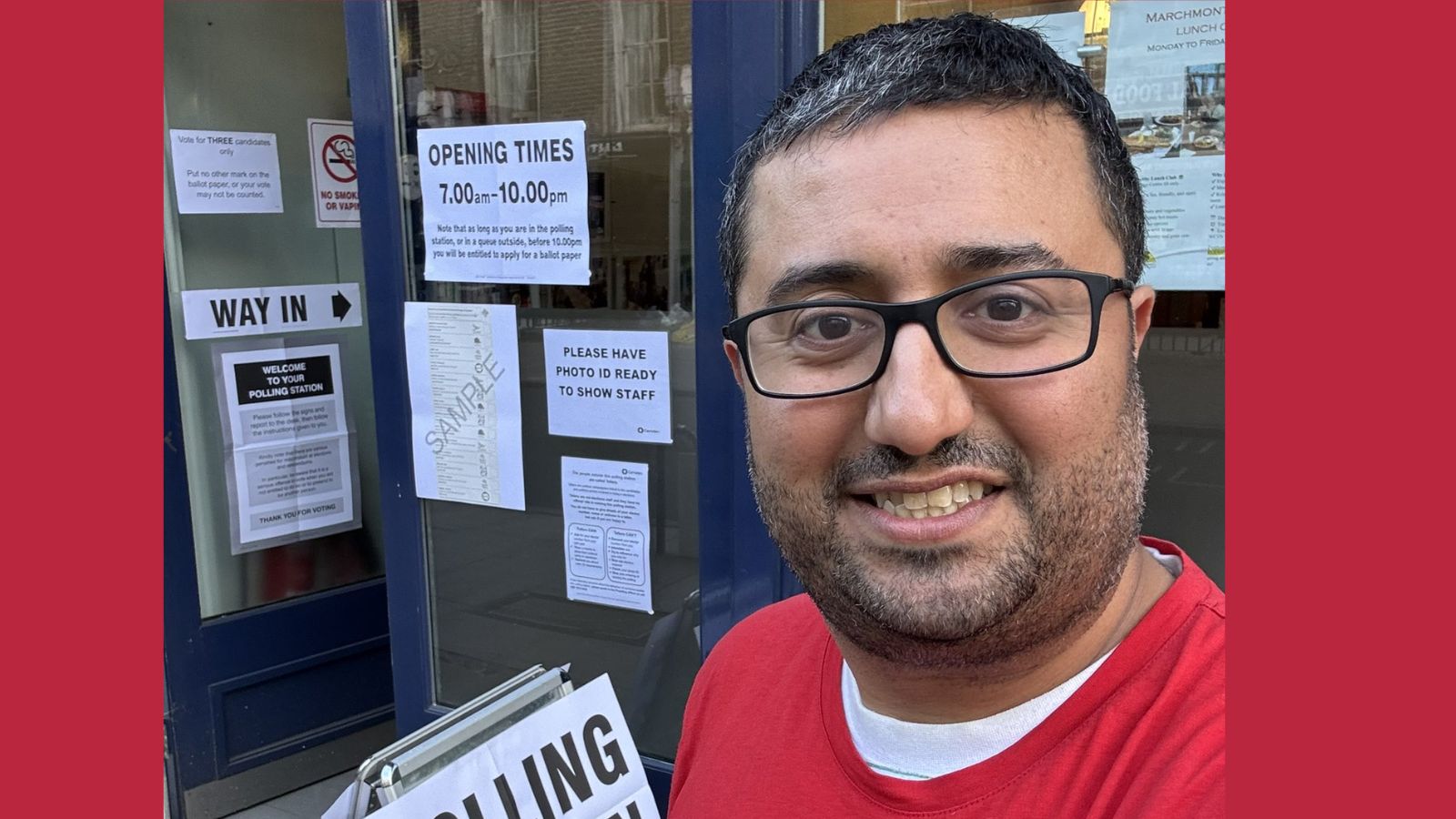
Under the warm glow of a pendant light, Sanjay smooths out a mail-in ballot for the midterm elections. Across from him sits his daughter, a college sophomore who has spent the last three weeks texting him links to voter guides. He clicks his pen. He looks at the names. And then, he votes straight down the line for Democratic candidates.
This quiet scene is playing out in hundreds of thousands of homes across the country. It is a scene that fundamentally breaks the established rules of American political science.
For generations, campaign strategists have operated on a rigid, almost mathematical assumption regarding voter behavior. The rule goes like this: as a demographic group accumulates wealth, they inevitably drift toward the political right. The instinct to protect capital, lower taxes, and deregulate business supersedes all else. It is the oldest playbook in Washington. Give a voting bloc a higher tax bracket, and watch them turn conservative.
Indian-Americans are the wealthiest immigrant cohort in the United States. Their median household income eclipses the national average by a staggering margin. They are overrepresented in medicine, tech, and corporate leadership. By all traditional metrics, they should be the ultimate reliable voting base for conservative candidates championing fiscal restraint.
They are not.
Recent surveys tracking midterm voter sentiment reveal a fascinating, undeniable reality. Indian-Americans are veering toward Democratic candidates by overwhelming margins. The numbers hover consistently in the high sixties and low seventies. It is not a fluke. It is not a temporary reaction to a single news cycle. It is a profound, structural realignment of a demographic that is realizing the sheer weight of its own political power.
To understand why this is happening, we have to look past the spreadsheets and look at the invisible stakes of the immigrant experience.
When you build a life in a country that is not your original own, your relationship with the concept of government is fundamentally different from that of someone born here. First-generation immigrants understand the machinery of the state intimately. They have waited in line at embassies. They have filled out endless forms in triplicate. They know that government is not just some abstract entity that taxes your paycheck; it is a force that can dictate where you live, who you can bring to live with you, and whether you belong at all.
In recent years, the rhetoric of the American right has taken a sharp, nativist turn. Political rallies frequently feature language that frames immigrants—even legal, highly skilled ones—as outsiders, as interlopers, as a threat to a vaguely defined "traditional" America.
Strategists on the right have often assumed that wealthy minorities will ignore this rhetoric if offered a tax cut. They assumed that a doctor in New Jersey or a software architect in Texas would look at a lower capital gains rate and simply plug their ears to the dog whistles.
They miscalculated.
Dignity, it turns out, is not for sale. When a political movement flirts with ethno-nationalism, it sends a chill through the bones of anyone who looks slightly different. You can earn a quarter of a million dollars a year, live in a gated community, and drive a luxury sedan, but if a politician goes on television and questions the patriotism of people with foreign-sounding names, the illusion of safety evaporates. The wealth offers no shield against xenophobia.
But the shift is not purely defensive. It is not just about voting against fear. It is about voting for a specific vision of society.
Look closely at the survey data regarding the issues driving Indian-American voters. The priorities are glaringly clear. Healthcare access. Public education. Gun violence prevention. Reproductive rights.
These are not the priorities of a demographic focused solely on hoarding individual wealth. They are the priorities of a community deeply rooted in the concept of collective welfare. In many South Asian cultures, the hyper-individualism that characterizes certain strands of American conservatism is entirely alien. The idea that you should pull yourself up by your own bootstraps and leave the rest to fend for themselves contradicts centuries of cultural conditioning that prioritizes family, extended networks, and communal responsibility.
Consider what happens next: the generational bridge.
The first wave of Indian immigrants, people like our hypothetical Sanjay, might have harbored quiet conservative sympathies purely on economic grounds. They grew up in a heavily bureaucratized, post-colonial India, which often made them inherently suspicious of expansive government programs. But they did not raise their children in a vacuum.
They raised them in American public schools. They raised them in an era defined by active shooter drills, climate anxiety, and the erosion of reproductive rights.
The children of these immigrants—the second generation—are now coming of age. They are voting. And they are dragging their parents to the left with them. The dinner table conversations have shifted. It is no longer just about getting into a good college; it is about what kind of country that college exists in.
When Sanjay’s daughter talks to him about climate change, she isn't reciting talking points. She is talking about the air she will breathe. When she talks about gun control, she is remembering the terrifying silence of hiding in a school closet during a lockdown drill. These lived experiences cut through the noise of economic policy. A 2% reduction in corporate tax rates means absolutely nothing if you are terrified your child won't come home from school.
This intergenerational dialogue is the quiet engine driving the midterm statistics. The WhatsApp groups, once notorious for circulating conservative misinformation or benign sunrise greetings, are now battlegrounds of political debate. The youth are armed with data, conviction, and the moral authority of the future. They are winning the arguments in living rooms across the nation.
Yet, if you watch cable television, you might get a completely different impression.
The media ecosystem is obsessed with outliers. It loves a contrarian narrative. Consequently, immense airtime is dedicated to high-profile Indian-American politicians who have aligned themselves with the hard right. They deliver fiery speeches. They champion hyper-conservative talking points. They are paraded as proof of a diversifying conservative base.
It is a mirage.
The camera focuses on the individual on the podium, completely missing the empty seats in the audience. The survey data destroys the illusion. While these figures may share a heritage with the broader Indian-American community, they do not share its values, its anxieties, or its votes. They are the exception that proves the rule. The silent majority of the community watches these spectacles with a mixture of bewilderment and alienation, then quietly proceeds to vote the other way.
The stakes of this silent rebellion are astronomical.
We are not talking about a demographic clustered entirely in deep-blue coastal enclaves. The geography of the Indian-American population has shifted dramatically. They have moved to the sprawling suburbs of Atlanta, the tech corridors of Virginia, the growing neighborhoods outside Philadelphia, and the expanding cities of Arizona.
They have, quite accidentally, positioned themselves in the exact geographic center of the American political battlefield. They live in the swing states. They live in the swing counties.
In elections decided by razor-thin margins—sometimes a few thousand votes—a highly educated, highly engaged, rapidly growing demographic that votes as a near-monolith is a political nuclear weapon. They have the mathematical power to flip districts. They have the power to decide who controls a state legislature, who takes a seat in the Senate, and ultimately, who controls the levers of federal power.
The tragedy for conservative strategists is that they failed to see this coming. They looked at a group of hardworking, family-oriented, financially successful immigrants and assumed they had a captive audience. They offered tax breaks while simultaneously tolerating rhetoric that questioned the very legitimacy of the immigrant presence. They demanded the labor, the intellect, and the tax revenue of the community, but offered no respect for its humanity.
The bill for that arrogance is coming due.
The shift we are witnessing is not a temporary backlash. It is a permanent political maturation. The era of the quiet, head-down immigrant, grateful just to be allowed in the room, is over. The new era is defined by an insistence on shaping the rules of the room. It is a demand for a society that values collective safety, equality, and dignity over pure, unadulterated economic self-interest.
Back at the dining room table, Sanjay finishes filling in the bubbles. He double-checks his signature. He folds the thick paper, slides it into the privacy sleeve, and places it inside the return envelope.
He seals it. The adhesive sticks to his thumb for a fraction of a second. Tomorrow morning, before he drives to the office, he will stop by the county library. He will walk up to a heavy metal drop box. It is a quiet, entirely solitary act. But when the envelope slips through the slot and falls, it will join a million others, hitting the bottom with the undeniable weight of a changing nation.