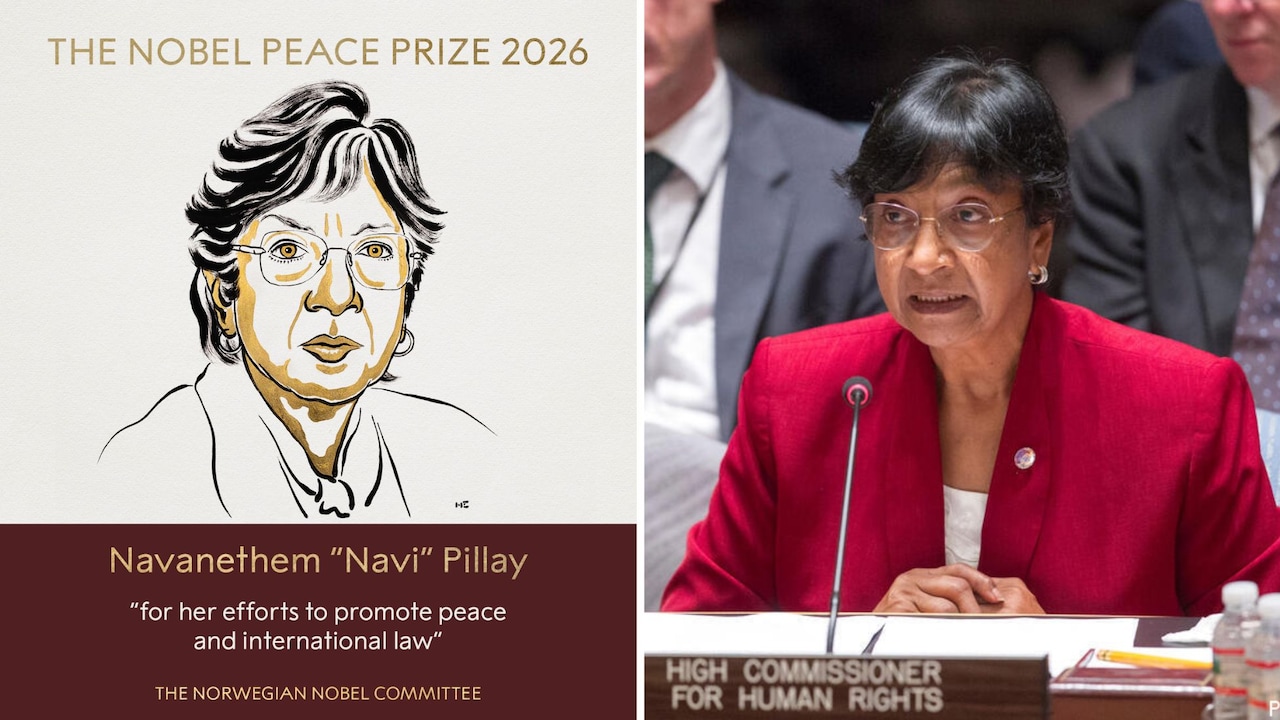
History does not always arrive with the thunder of falling walls. Sometimes, it enters quietly, wrapped in a dark judicial robe, carrying the weight of a lifetime spent listening to the unheeded.
Consider the courtroom in Durban, South Africa, decades ago. It is suffocatingly hot. The apartheid state is firmly entrenched, an architectural monstrosity of concrete, barbed wire, and systematic cruelty. A young woman stands before the bench. She is Indian-Origin, fierce, and entirely unwelcome in the spaces she occupies. Navi Pillay is not merely practicing law; she is committing an act of quiet subversion simply by breathing the same air as the magistrates who seek to silence her.
Now, look forward across the chasms of time. The year is 2026. The Nobel Peace Prize has just been awarded to Navanethem Pillay.
Between those two moments lies a life dedicated to dismantling impunity. But statistics do not tell you what it feels like to stand in front of a tyrant and tell them they are accountable to something greater than their own militia.
To understand the weight of this recognition, you have to step away from the podiums in Oslo and walk back into the damp prison cells of Robben Island, where Pillay fought tirelessly to represent anti-apartheid activists, political detainees, and victims of security-force torture. At a time when the legal system was weaponized to crush dissent, she treated the courtroom not as a theater of compliance, but as a battleground for human dignity. She defended those whom the powerful wished to erase.
Power hates a witness.
When Pillay later transitioned to the international stage—serving as a judge on the International Criminal Tribunal for Rwanda, presiding over the historic ruling that recognized rape as an act of genocide, and later stepping into the crucible of the United Nations High Commissioner for Human Rights—she carried that same unyielding stubbornness with her.
Imagine sitting across from heads of state who treat international law as a polite suggestion. Imagine staring down governments committing atrocities in the dark, armed only with facts, documentation, and an unshakeable moral compass. While diplomats whispered in gilded corridors, Pillay spoke plainly. She called out war crimes in Gaza, Sri Lanka, and Syria. She did not soften her words to preserve diplomatic decorum. She knew a simple truth: neutrality favors the oppressor, never the victim.
There is a heavy cost to such clarity.
When you challenge the architecture of impunity, you make powerful enemies. Governments threaten you. Bureaucrats try to freeze you out. The weight of global suffering settles into your bones. Yet, throughout her career, Pillay demonstrated that the law is not an abstract collection of dusty volumes on a shelf. It is a living, breathing shield for the vulnerable. If you pull away that shield, humanity is left entirely at the mercy of the strongest brute in the room.
The Nobel Peace Prize often goes to politicians signing fragile treaties that crumble before the ink is dry. It is a celebration of moments. But awarding it to Navi Pillay is a celebration of endurance.
It honors the woman who stayed up late into the night reviewing witness testimonies of mass slaughter. It honors the advocate who refused to look away when looking away would have been infinitely easier, safer, and more profitable. It honors the belief that justice is not a luxury reserved for times of peace, but the very foundation upon which peace must be built.
We live in an era where cynicism is routinely marketed as wisdom. We are told that international institutions are toothless, that might makes right, and that the arc of the moral universe is too heavy to bend toward justice.
Navi Pillay spent her entire life proving that cynicism is just an excuse for cowardice.
The prize money will be spent. The headlines will fade. The politicians will move on to their next crisis. But the precedent remains. A girl born into a modest family in a segregated province of South Africa grew up to tell the most ruthless architects of violence that their crimes had an expiration date.
The courtroom in Durban is long gone. The robes have aged. But the echo of a steady, unyielding voice remains in the air, reminding anyone willing to listen that the world is changed not by those who command armies, but by those who refuse to surrender their conscience.