Seven in the morning in Tel Aviv smells like burnt espresso, sea salt, and diesel exhaust.
Usually, on an election day—a mandated national holiday in Israel—that hour belongs to the runners on the promenade and the beachgoers dragging plastic chairs across the sand. People sleep in. They treat the civic duty like a chore to be squeezed in between a long brunch and an afternoon nap.
Not this time.
By 7:15 AM, the line outside a public elementary school in central Tel Aviv already wrapped around the cinderblock wall, spilling onto the cracked sidewalk. Nobody was checking their watches in annoyance. Nobody was complaining about the heat. They stood in near silence, clutching their blue plastic identity cards with white knuckles, waiting for the doors to unlock.
A thousand miles away in an American living room, a headline flashes across a screen: Israel’s voter turnout soars as Netanyahu faces a tight election.
It sounds clinical. Clean. A neat little data point for political junkies to dissect over morning coffee. Turnout is up by three percentage points. Coalitions are shifting. A veteran prime minister is fighting for his political survival.
Cold numbers lie by omission. They sanitize the sweat, the panic, and the sheer exhaustion of a country tearing itself in half at the ballot box. When turnout surges in a place already defined by hyper-politicized living, people aren't just exercising their democratic rights. They are staging an intervention.
The Anatomy of a Slow-Motion Panic
To understand why millions of people abandoned their beaches and barbecues to stand in suffocating gymnasiums, you have to understand what five elections in under four years does to the human nervous system.
Let’s create a composite character to ground this—call him Avi. Avi is forty-two, runs a mid-sized logistics firm outside Haifa, and spent his twenties in an armored brigade. He isn’t an ideological zealot. Five years ago, he barely knew the names of half the cabinet ministers. Today, he can recite the parliamentary seat projections for twelve different micro-parties in his sleep.
For Avi, the ballot box stopped being a tool for progress around the third election cycle. It became a fire extinguisher.
You don't grab a fire extinguisher because you want to redecorate the kitchen. You grab it because the curtains are smoking and your kids are asleep upstairs.
In a proportional representation system like Israel's, voters don't choose a local representative; they vote for a party list. Every single vote shifts the tectonic plates of a 120-seat parliament, the Knesset. To form a government, a leader needs 61 seats. Sixty is failure. Sixty-one is absolute power. That razor-thin margin turns every apathetic neighbor into an existential threat. If your side stays home to grill steaks, the other side gets the 61st seat, and by Sunday morning, the rules of your daily life—who gets drafted, how much your groceries cost, whether the Supreme Court still exists as a check on power—can be rewritten entirely.
This is the invisible engine driving soaring voter turnout. It isn't optimism. Optimism makes you skip the line because you assume your guy has it in the bag.
Dread makes you show up at dawn.
The Man at the Center of the Gravity Well
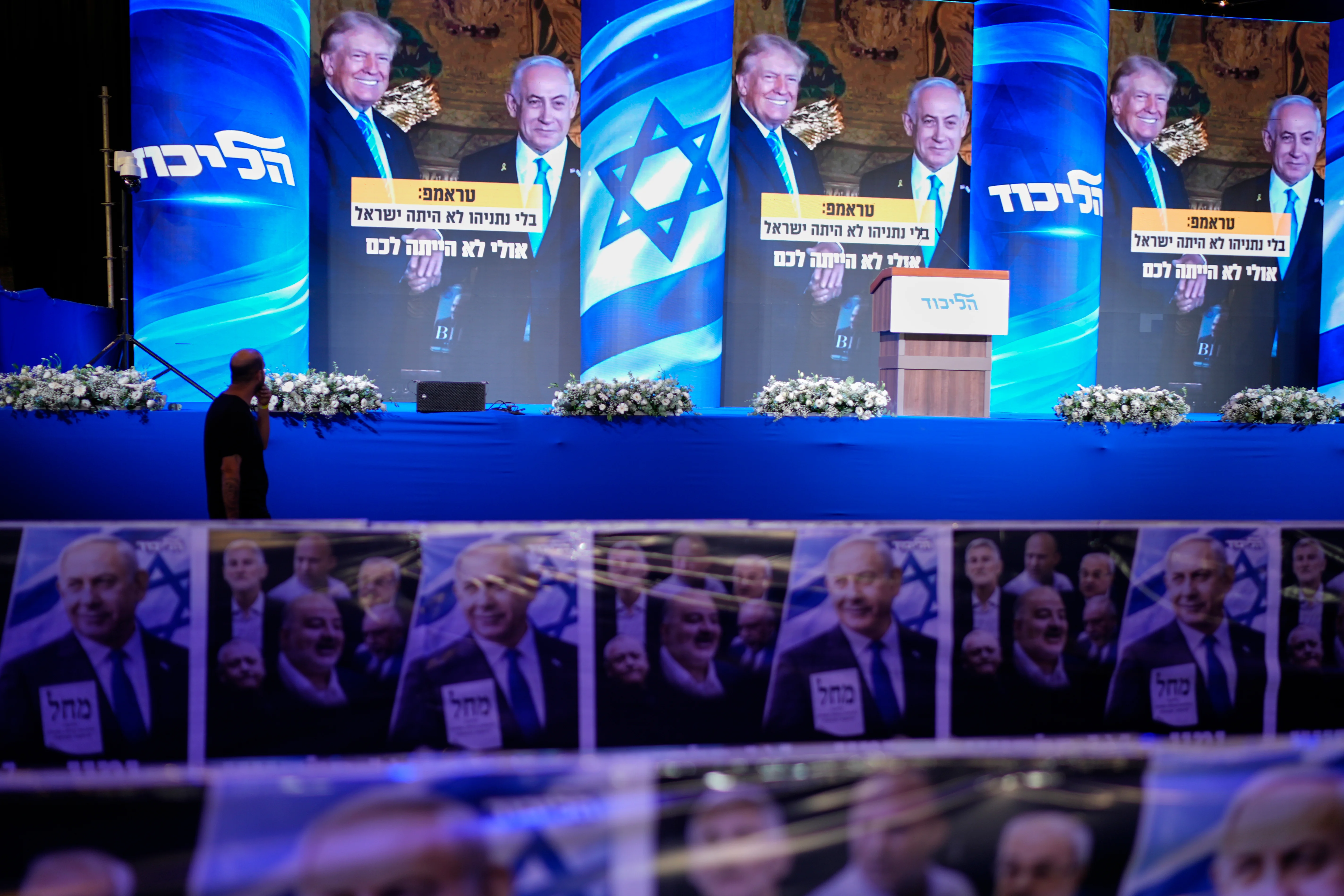
You cannot tell this story without looking directly at the gravitational center of Israeli politics for the last generation: Benjamin Netanyahu.
Love him or loathe him—and in Israel, there is no middle ground left, only scar tissue—Netanyahu is a political force of nature. To his fiercely loyal base, largely concentrated in working-class towns, religious communities, and peripheral cities far from the coastal wealth of Tel Aviv, he is not merely a politician. He is a shield. He is the man who kept the economy humming through global recessions, who brokered historic peace accords with Arab neighbors without giving up territory, and who speaks English with the baritone authority of an American statesman while telling foreign presidents "no" when it counts.
When his supporters look at the legal battles surrounding him—the ongoing corruption trials involving cigars, champagne, and favorable media coverage—they don't see a crooked leader. They see a rigged system. They see an entrenched, elitist establishment trying to use the courts to topple the man they democratically elected because they couldn't beat him at the polls.
Now, step across the street to the opposition.
When they look at the exact same man, they see an existential danger to the country’s democratic soul. They see a leader willing to burn down state institutions, attack the judiciary, and hand unprecedented power to far-right, ultranationalist allies just to stay out of a prison cell.
Think about what happens when two halves of a family look at the same house and one sees a fortress while the other sees a burning building. You don't compromise. You mobilize.
How Elections Break a Dinner Table
I remember sitting at a Friday night Shabbat dinner in Jerusalem during one of these relentless election cycles. The challah was warm, the wine was poured, and the air was thick enough to choke on.
Within twenty minutes, a casual remark about the price of cottage cheese—a classic Israeli economic flashpoint—spiraled into a shouting match between a grandfather who fought in 1973 and his twenty-something granddaughter who works in tech.
"You don't understand what it was like when we had nothing!" he barked, his hand trembling slightly against the tablecloth. "He made us strong! Without him, they'll eat us alive!"
"And what are we becoming to stay strong, Saba?" she shot back, tears of frustration pooling in her eyes. "If we lose the courts, if we lose our democracy, what are we even defending?"
Nobody finished their soup. The plates were cleared in rigid, polite silence.
That dinner table is repeated in a million apartments from the Golan Heights to the Negev desert. The staggering voter turnout numbers reported on the evening news are just the statistical shadow cast by those ruined family dinners. People aren't voting for tax brackets anymore. They are voting to validate their reality. They are voting to prove to their own brothers, sisters, and parents that they aren't crazy.
The Arithmetic of Desperation
When analysts talk about "tight elections" and "soaring turnout," they often miss the mathematical mechanics that turn a slight bump in participation into a political earthquake.
In Israel, every party must cross an electoral threshold—3.25% of the total valid votes—just to enter the parliament. If a party gets 3.24%, every single vote cast for them evaporates into thin air. Those seats are then redistributed among the surviving parties.
This creates a terrifying game of chicken.
When overall turnout skyrockets, the raw number of votes required to hit that 3.25% threshold climbs higher and higher. Suddenly, smaller fringe parties that thought they were safe find themselves drowning. Conversely, if a historically disenfranchised bloc—such as Israel’s Arab citizens, who make up roughly twenty percent of the population—decides to stay home out of cynicism and fatigue, the threshold drops for everyone else, handedly gifting extra seats to the nationalist right.
Consider what happens next: political operatives know this math cold. By noon on election day, parties aren't campaigning on policy. They are running emergency triage operations.
Text messages flood millions of phones every fifteen minutes. “The Arabs are flocking to the polls in droves,” one camp warns in a notorious, recurring tactic designed to trigger primal fear. “The right-wing bloc is at 61 seats—if you don’t vote right now, democracy ends tonight,” screams the opposing camp’s automated dialers.
It is psychological warfare waged via SMS. And it works.
By 4:00 PM, the Central Elections Committee releases the interim turnout figures. If the number is two points higher than the previous cycle, panic sets in at campaign headquarters. Field organizers are dispatched to knock on doors in stronghold neighborhoods. Volunteers literally drive elderly voters to polling stations, arm-in-arm, treating a frail eighty-year-old woman like a decisive artillery shell.
The Myth of Voter Fatigue
Political scientists used to have a neat little rule: hold too many elections in a row, and voters get exhausted. They tune out. Turnout plummets.
Israel broke the rulebook.
Instead of inducing apathy, the endless political deadlock acted like a pressurized cooker. With every collapsed coalition and every wasted billion shekels spent on another campaign, the stakes didn't shrink—they compounded.
Let's be honest about how confusing and unsettling this is to watch from the outside. Most democracies rely on a healthy dose of boredom. Good governance is supposed to be dull, predictable, and quietly competent. When politics becomes the primary source of adrenaline for an entire nation, something in the civic bloodstream has gone toxic.
Yet, standing in those polling lines, you witness something strangely moving alongside the anger.
You see a woman in a wheelchair being carefully lifted up three concrete steps by two strangers—one wearing a knitted kippah, the other wearing a faded peace-activist t-shirt. Neither asks who the other is voting for. They just lift, set her down gently by the cardboard voting booth, nod once, and step back into their separate ideological universes.
You see young soldiers, fresh off an overnight bus from bases in the south, rifles slung across their backs, joking around while they wait to drop a tiny paper slip into a blue cardboard box.
They know the system is broken. They know the politicians are flawed, cynical, and often self-serving. Nobody in that line harbors illusions that tomorrow morning will magically heal the country.
The Slip of Paper Behind the Curtain
Step behind the blue plastic curtain of an Israeli voting booth, and the noise of the country suddenly vanishes.
It is dead quiet in there. Just you, a fluorescent light buzzing overhead, and a wooden tray divided into dozens of tiny compartments. Each compartment holds stacks of small white paper slips printed with one, two, or three Hebrew letters representing a political party.
There are no touchscreens. No mechanical levers. No pens to fill in bubbles.
You pick up a single slip of paper—maybe it’s Mahal for Netanyahu’s Likud, maybe Peh-Heh for the centrist opposition, maybe a religious bloc or an Arab alliance—and you slide it into a plain blue envelope. You lick the glue, seal it shut, walk out from behind the curtain, and push it through a narrow slot into a locked ballot box while three poll watchers from rival parties stare intently at your hands to make sure you didn't slip two envelopes in at once.
That’s it. A piece of paper the size of a business card.
Yet, as the sun sets over the Mediterranean and the polling stations finally lock their doors at 10:00 PM, the tension across the country becomes almost unbearable. Millions of people gather around television screens waiting for the exit polls—the midgam—to flash onto the screen.
When the numbers finally appear, showing turnout at levels not seen in decades, there is no unified cheer. Half the country gasps in relief; the other half stares at the screen in hollow disbelief.
A headline thousands of miles away will summarize the night in ten sterile words about soaring turnout and a tight race. It will tell you who won, who lost, and how many seats shifted.
It won't tell you about the silence at the breakfast table the next morning, when two people who love each other deeply pour their coffee, avoid looking at the newspaper, and quietly try to figure out how to keep sharing the same small piece of earth.