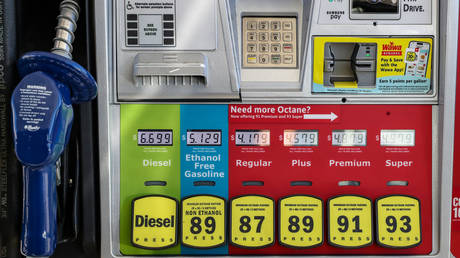
At four in the morning, the air at a truck stop off Interstate 80 tastes like burnt coffee, wet asphalt, and unburned hydrocarbons.
If you have ever stood beside an idling eighteen-wheeler in the dead of winter, you know the sound. It is a low, rhythmic thrum that vibrates right up through the soles of your boots and settles behind your sternum. That engine is burning diesel. Every gallon that passes through those injectors dictates the price of the milk in your refrigerator, the lumber framing a new house down the street, and the freight rates keeping a family-owned hauling business from going under. In other updates, read about: Asymmetric Urban Crowd Dynamics and State Riot Control Mechanics in Paris.
Most people never think about where that diesel comes from until the numbers on the pump start climbing. Even fewer realize that the molecular chain inside that fuel tank is currently at the center of a fierce, high-stakes standoff between the White House and the United States Congress.
In Washington, headlines rarely smell like exhaust. They arrive stripped of grease and urgency, reduced to procedural jargon about sanctions waivers, energy diplomacy, and legislative riders. When news broke that a coalition of American lawmakers was moving to block a Trump administration arrangement involving Russian-origin diesel, the standard coverage treated it like just another Beltway turf war. Reuters has also covered this fascinating subject in great detail.
It is anything but.
Behind the committee doors on Capitol Hill lies a collision between two irreconcilable realities. On one side is an administration trying to cool inflation and stabilize global fuel markets by allowing targeted flows of refined Russian petroleum products back into Western supply chains. On the other is a bipartisan group of senators and representatives convinced that every barrel of Russian fuel permitted back into the global bloodstream directly finances Moscow’s war machine in Ukraine and undercuts American energy independence.
To understand why this fight is tearing through Washington—and why it matters to anyone who buys groceries—you have to look past the podiums and follow the barrel.
The Architecture of a Global Chokepoint
Crude oil gets all the glory in geopolitical thrillers, yet crude oil is practically useless until it enters a refinery.
Think of crude oil as raw timber and refined products—gasoline, jet fuel, and diesel—as the finished floorboards and roof trusses. You cannot build a house out of raw logs, and you cannot run a combine harvester or a cargo ship on unrefined crude. For decades, the global economy operated on an intricate, invisible division of labor. Russia pumped massive quantities of heavy, sour crude oil and processed much of it into middle distillates—the industry term for diesel and heating oil—before shipping it to Europe and across the Atlantic.
Then came the 2022 invasion of Ukraine, followed by sweeping Western embargoes and the G7 price cap.
Suddenly, one of the world’s largest diesel exporters was walled off from its closest, most lucrative markets. On paper, the sanctions looked clean and decisive. In the physical world of tankers, pipelines, and storage terminals, the results were messy. Russian diesel did not vanish from the earth; it simply took the scenic route. Tankers began steaming thousands of extra miles to refineries and blending hubs in India, Turkey, Brazil, and the Middle East. There, Russian molecules were refined, mixed, or re-labeled before finding their way back into global commerce.
This rerouting came with a hidden tax paid by every consumer on earth. Longer shipping routes meant higher freight costs, tighter tanker availability, and sudden, violent price spikes whenever a refinery went offline for maintenance.
Two Men, One Ledger
To see how this macro-economic puzzle lands on real people, consider a hypothetical composite drawn from thousands of actual operators across the American Midwest.
Call him Ray. Ray owns four long-haul trucks out of Ohio. He is not a geopolitician; he is a man with a clipboard, a commercial driver's license, and razor-thin margins. When diesel jumped past five dollars a gallon a few years ago, Ray did not read white papers on G7 maritime insurance bans. He simply watched his weekly fuel bill eat his profit margin whole. Every time fuel spikes, Ray has to choose between raising rates—and risking losing contracts to larger carriers—or absorbing the loss until his savings run dry.
Now consider a second figure, equally grounded in documented reality. Call her Olena, a logistics coordinator living in central Ukraine, where diesel generators hum outside hospitals and municipal water stations whenever missile strikes knock out the electrical grid. To Olena, Russian energy revenue is not an abstract economic metric. According to the Centre for Research on Energy and Clean Air, fossil fuel exports remain the single largest pillar of the Kremlin’s federal budget, funding artillery shells, drones, and military salaries.
Ray wants affordable fuel so he can keep his trucks rolling. Olena wants Moscow’s revenue choked off so her city can survive the night.
The tragedy of the current political fight in Washington is that both Ray’s livelihood and Olena’s survival are tethered to the exact same global supply pool.
The White House Gambit
Inside the Trump administration, economic advisors have long viewed energy prices as the master switch of the American economy. Bring down the cost of diesel, the logic goes, and you bring down the cost of transporting every physical good in the country. Inflation cools. Interest rates ease. Voters feel relief at the checkout counter.
According to policy analysts and reporting on the administration’s energy strategy, the push to ease restrictions or grant targeted carve-outs for Russian diesel stems from a strictly transactional worldview. Administration officials have argued that strict embargoes have failed to stop Russian oil from reaching global markets anyway—they have merely added friction, enriched middlemen in third-party nations, and kept prices artificially elevated for American consumers and allies.
By negotiating a structured arrangement—allowing certain volumes of Russian refined products back into regulated channels, potentially tied to broader diplomatic leverage over a ceasefire in Eastern Europe—the White House aims to accomplish two goals at once. First, flood the distillate market with supply to push prices down. Second, use access to Western markets as a bargaining chip at the negotiating table with Moscow.
From a purely short-term market perspective, the math has a cold, undeniable appeal. Diesel inventories in the United States and Europe have hovered near multi-year lows, leaving the market vulnerable to any hurricane in the Gulf Coast or strike at a European refinery. Adding Russian supply back into the equation acts like opening a pressure relief valve on an overheating boiler.
Revolt on the Hill
The moment word of the arrangement began circulating among lawmakers, however, the political boiler exploded.
Opposition on Capitol Hill did not come solely from predictable partisan corners. Instead, it brought together defense hawks from the Republican party and staunch Ukraine supporters among the Democrats—a rare bipartisan alliance forged by deep skepticism of the Kremlin and fierce protection of American strategic interests.
Lawmakers leading the pushback, including members of the Senate Foreign Relations and Banking committees, immediately began drafting legislative roadblocks. Their strategy relies on tools Congress has sharpened over the past decade: binding statutory sanctions that strip the executive branch of waiver authority, secondary sanctions targeting foreign banks and shipping companies that facilitate the trade, and riders attached to must-pass defense and appropriations bills.
Their argument rests on three pillars that go far beyond partisan point-scoring.
First, there is the question of leverage. Critics of the deal argue that lifting energy restrictions before securing verifiable, irreversible concessions from Moscow gives away the West’s strongest economic weapon for free. Once Russian tankers are welcomed back into Western ports and insurance markets, rebuilding that blockade becomes nearly impossible.
Second, lawmakers point to the sheer hypocrisy of asking European allies to wean themselves off Russian gas and oil—often at enormous economic pain to their own citizens—only for Washington to reopen the tap for diesel. European leaders spent years and tens of billions of euros building new liquefied natural gas terminals and restructuring their grids to break free from Moscow’s energy blackmail. A unilateral U.S. shift threatens to shatter the transatlantic coalition that has held since 2022.
Third, and perhaps most quietly, there is domestic industry pressure. American refiners along the Gulf Coast invested heavily to maximize diesel output and capture the market share left behind by Russia. Letting discounted Russian fuel back into global trade undercuts U.S. producers and threatens American energy dominance—a core promise that lawmakers from energy-producing states like Texas, Louisiana, and North Dakota are unwilling to surrender.
The Illusion of the Clean Choice
Watching this unfold, it is tempting to look for a villain and a hero. That is how cable news packages complex policy, and it is almost always a lie.
When I first started tracking global energy supply chains years ago, I assumed sanctions worked like a light switch. Flip it off, and the money stops flowing. Flip it on, and commerce resumes. Sitting in dusty port offices and reading through maritime tracking logs quickly cures you of that illusion.
Oil is fungible. Once a cargo of diesel is blended in a storage tank in Fujairah or Rotterdam, no chemist on earth can easily separate the Russian molecules from the Saudi or American ones. Enforcement is a constant, exhausting game of cat-and-mouse involving shell companies, disabled transponders, and aging "shadow fleet" tankers sailing without Western insurance.
Because the system is so opaque, honest people can look at the exact same data and reach opposite conclusions.
One economist looks at the shadow fleet and concludes that sanctions are a leaky bucket that hurts Western truckers more than it hurts the Kremlin. A national security official looks at the exact same shadow fleet and points out that forcing Russia to sell its oil at steep discounts and pay exorbitant shipping fees has still deprived Moscow of tens of billions of dollars in war revenue—money that cannot be spent on tanks or missiles.
Neither side is lying. Both are describing different halves of the same broken mirror.
How Congress Plans to Lock the Door
If you want to understand how lawmakers actually derail a presidential foreign policy initiative, forget dramatic floor speeches. Watch the fine print of legislative procedure.
Under the U.S. Constitution, the president holds sweeping authority over foreign affairs, yet Congress holds the keys to commerce and the purse. Over the past ten years, legislators have perfected the art of "sanctions-proofing" policy against executive reversals. They did it in 2017 with the Countering America’s Adversaries Through Sanctions Act, which forced the White House to submit any attempt to ease Russian sanctions to a mandatory congressional review period—effectively giving lawmakers a veto.
The current legislative effort follows that exact blueprint, updated for the realities of 2026.
Lawmakers are moving to codify existing executive orders on Russian petroleum imports into permanent statute. Once a restriction is written into law rather than held together by a presidential pen, the White House cannot simply waive it away on a Tuesday afternoon. To unlock those barrels, the administration would have to formally certify to Congress that Russia has met strict, verifiable conditions—such as a full withdrawal from occupied territories or an internationally monitored peace settlement—and then survive a thirty-day window in which Congress can pass a joint resolution of disapproval.
At the same time, congressional aides are targeting the plumbing of the trade: maritime insurance, port access, and dollar clearing. Even if the White House declines to enforce certain penalties, foreign banks and shipping conglomerates are deeply risk-averse. If a U.S. law explicitly threatens any institution touching Russian diesel with cutoff from the American financial system, compliance departments in London, Singapore, and Zurich will freeze those transactions themselves, regardless of what the White House signals diplomatically.
The Invisible Ripple Effect
While senators trade drafts and administration officials calculate barrel-per-day projections, the market itself is already reacting.
Energy traders hate uncertainty far more than they hate bad news. When the White House hints at easing supply constraints, futures prices dip. When lawmakers announce a bipartisan bill to block the deal, prices twitch upward again. That volatility creates its own quiet damage. Airlines struggle to hedge fuel costs. Farmers delay locking in diesel contracts for the planting season. Shipping companies add fuel surcharges to invoices, passing the anxiety straight down the chain to small businesses and families.
Think back to Ray, sitting in the cab of his truck off Interstate 80, watching the digital numbers tick upward on the glowing sign beside the highway. He does not get a seat at the table in the Senate Foreign Relations Committee, and he does not get invited to diplomatic summits. Yet his bank account is the scoreboard where this geopolitical chess match is tallied.
At the same time, thousands of miles away, the outcome of this legislative battle will help determine whether Moscow has the hard currency to sustain another winter of attrition.
That is the real weight sitting beneath those dry, procedural headlines. Every energy policy is a trade-off written in invisible ink. Lower prices at the pump today can mean higher strategic costs tomorrow; standing firm on principle today demands paying a premium at the register tonight.
In Washington, lawmakers are preparing to vote on whether to slam the door shut on Russian diesel for good, locking the administration out of a deal it believes will bring economic relief. Out on the highways, the engines keep idling, waiting to see who pays the bill.


