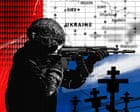
The snow in a provincial cemetery four thousand miles east of Moscow does not melt cleanly. It turns gray, heavy, and crusted with coal dust, clinging to the edges of freshly dug trenches where the earth has been thawed with diesel fires just enough to accept a pine box.
Look closely at the wooden crosses here. You will not find them in the shiny, state-televised memorials in the capital. You will find them in the mud of Buryatia, along the gravel roads of Dagestan, and behind the rusted iron gates of forgotten industrial towns in the Urals. Each cross carries a laminated photograph, a birthdate in the late nineties or early two-thousands, and a date of death that arrives like a sudden cliff. For a different look, check out: this related article.
Numbers do a terrible job of explaining grief. When analysts in London or Washington tally the casualties of the war in Ukraine, they speak in ranges, estimates, and statistical confidence intervals. They debate whether the true figure of Russian war dead sits at one hundred thousand, two hundred thousand, or higher. Those numbers are vast, clinical, and strangely numbing. The human brain simply was not built to process a stadium full of corpses.
To understand the real cost of this conflict, you have to shrink the lens. You have to look at a single kitchen table in a small town where the heating pipes rattle in the winter, and notice the chair that nobody sits in anymore. Similar analysis on this trend has been published by Associated Press.
The Architecture of Silence
Consider a hypothetical family—let us call them the Volkovs—living in a three-room apartment in a Siberian timber town. Their story is an amalgam of thousands of documented cases pieced together by independent journalists, open-source researchers, and grieving relatives who risk prison simply by posting an obituary online.
Dmitry Volkov is twenty-four. Before the mobilization orders arrived in the autumn of 2022, he worked as a welder at a local rail depot. His wages were modest, often delayed, and barely enough to cover groceries and winter boots for his daughter. When the summons came, he did not go out of ideological fervor. He went because the state offered a monthly salary four times what he earned with a welding torch, and because refusing meant a criminal record that would ruin his family's life.
Six months later, Dmitry stopped answering his phone.
In a transparent society, a soldier’s death triggers a clear bureaucratic chain: notification, repatriation, a death certificate, a public record. In wartime Russia, the machinery works in reverse. It is engineered not to account for the dead, but to obscure them.
For four months, Dmitry’s mother, Elena, is told he is missing in action. This classification is not a clerical error. It is a financial and political convenience. A missing soldier requires no immediate state compensation payout—the famous "coffin money" promised by the Kremlin to quiet grieving mothers. More importantly, a missing soldier does not appear in the regional mortality registries. He exists in a bureaucratic purgatory, alive on paper, rotting in a treeless field near Bakhmut or Avdiivka.
Elena spends her savings traveling to regional military offices, clutching a folder of blurry Telegram photos and unreturned letters. She meets dozens of other women in those dimly lit corridors. They do not shout. They whisper. They trade phone numbers of volunteer searchers and compare notes on how to bribe a morgue clerk in Rostov-on-Don just to look at a spreadsheet of unidentified remains.
This is the invisible toll of the conflict: a nation quietly hollowed out from the bottom up, while the surface remains painted in the bright, defiant colors of state propaganda.
How You Hide an Army of Ghosts
How does a modern state conceal casualties on a scale not seen in Europe since the Second World War? Think of it like an iceberg. The part visible above the waterline—the official Ministry of Defense briefings—is tiny, rigid, and carefully sculpted. Beneath the surface lies a massive, submerged structure of deliberate omission.
Independent researchers, including teams from the BBC Russian Service and the independent outlet Mediazona, have spent years mapping that submerged mass. Because official casualty lists are classified as state secrets, investigators had to invent a forensic accounting method from scratch. They scoured local newspapers, municipal social media pages, school memorial plaques, and freshly dug graves across hundreds of cemeteries.
By cross-referencing these public traces against excess mortality data from Russia's inheritance registry—a database where relatives must file claims to settle a deceased person's estate—a clearer picture emerged. When a twenty-five-year-old man dies, he rarely leaves behind property or a will, meaning the inheritance registry actually underestimates the youngest fatalities. Yet even with those blind spots, the spike in male mortality between the ages of twenty and forty-five tells an unmistakable story.
The state employs several distinct mechanisms to keep the true numbers blurred:
- The Wagner and Penal Battalions: Tens of thousands of prisoners were recruited directly from penal colonies, promised pardons in exchange for six months on the front lines. Many were used as human wave assaults. Because they were convicts, their deaths rarely triggered standard military reporting protocols.
- The Annexed Territories: Men conscripted from the Russian-occupied regions of Donetsk and Luhansk were thrown into the fiercest fighting early in the war. Moscow routinely excluded these men from its official Russian military tallies, treating them as expendable auxiliaries.
- The "Missing" Ledger: By delaying DNA identification and refusing to retrieve bodies from contested "gray zones," commanders keep unit casualty figures artificially low—a metric that directly affects their own promotions and survival.
Every one of these methods serves a single purpose: insulating the major population centers of Moscow and St. Petersburg from the visceral shock of mass death. If the coffins arrived by the thousands at train stations in the capital, the political calculus of the war would shift overnight. By drawing disproportionately from impoverished ethnic republics and rural regions, the Kremlin turned economic desperation into a buffer against domestic unrest.
The Demography of a Vanishing Generation
Walk through the villages of Buryatia or Tuva today, and the absence is physical. You feel it in the silence of the vocational schools. You see it in the storefronts that used to stay open late and now close at dusk because the young men who unloaded the delivery trucks are gone.
Demographers look at population pyramids the way doctors look at X-rays. A healthy society has a broad base of young workers supporting an older generation. Russia entered this war already suffering from a severe demographic hangover—the echo of the 1990s economic collapse, when birth rates plummeted. The cohort of men aged twenty to thirty-five was already unusually small.
Now, that exact cohort is being fed into an industrial meat grinder.
Imagine a bridge whose central support cables are being cut one by one. At first, traffic continues to flow. Cars cross, lights flicker, and the structure looks intact from a distance. It is only when a heavy storm hits—or when the cumulative weight finally exceeds the remaining steel—that the collapse happens all at once.
The economic consequences are already visible beneath the surface of Russia’s war-stimulated GDP. Factories are desperate for machinists, drivers, and engineers. Hundreds of thousands of men have fled the country to avoid mobilization, while hundreds of thousands more are dead or permanently disabled. Amputees have become a common sight on provincial streets, waiting for prosthetics that sanctions have made scarce and expensive.
Yet the deeper wound is psychological. When a society is forbidden from mourning publicly, grief does not disappear. It curdles.
The Price of Forced Forgetting
In the late 1980s, during the final years of the Soviet war in Afghanistan, a grass-roots movement called the Committee of Soldiers' Mothers broke through the wall of state censorship. Those women stood in public squares holding photographs of their dead sons, demanding answers from generals and politicians. Their raw, undeniable grief helped crack the legitimacy of the Soviet regime.
The current leadership in Moscow learned that lesson well. Today, the space for public mourning has been systematically dismantled. Independent mothers' groups have been labeled "foreign agents." Posting critical comments about military losses online carries sentences of up to fifteen years in prison under wartime censorship laws.
Even at funerals, families are often pressured by local officials to keep ceremonies brief and quiet. Grief is permitted only if it is wrapped in the approved language of heroic sacrifice. If a mother weeps because she believes her son died for nothing, she becomes a suspect.
Consider what happens to a person when they are forced to swallow their sorrow in silence. When Elena Volkov finally receives a zinc-lined coffin eight months after Dmitry vanished, she is told not to open the welded lid. There is no forensic report. There is a medal—the Order of Courage, awarded posthumously—and a lump-sum payment that buys a used car and pays off her mortgage.
She takes the money because winter is coming and her granddaughter needs a coat. That transaction—trading a son’s life for household solvency—leaves a silent, corrosive shame that no state television broadcast can ever wash away. Across thousands of towns, families are living inside this quiet bargain, estranged from neighbors who still repeat the official slogans, isolated by a truth they are not allowed to speak aloud.
The Ledger That Never Closes
Wars do not end when the treaties are signed. They linger for decades in the empty chairs at holiday dinners, in the children who grow up knowing their fathers only as framed portraits on a bookshelf, and in the quiet bitterness of mothers who were told their sons were heroes while their graves were left untended in the mud.
Official histories will eventually argue over borders, strategic blunders, and geopolitical ambitions. They will print clean maps with arrows showing advances and retreats.
The real history of this war is being written in much smaller ink. It is etched into the granite of provincial cemeteries where the rows of fresh graves keep stretching toward the tree line, long after the snow has turned gray.


