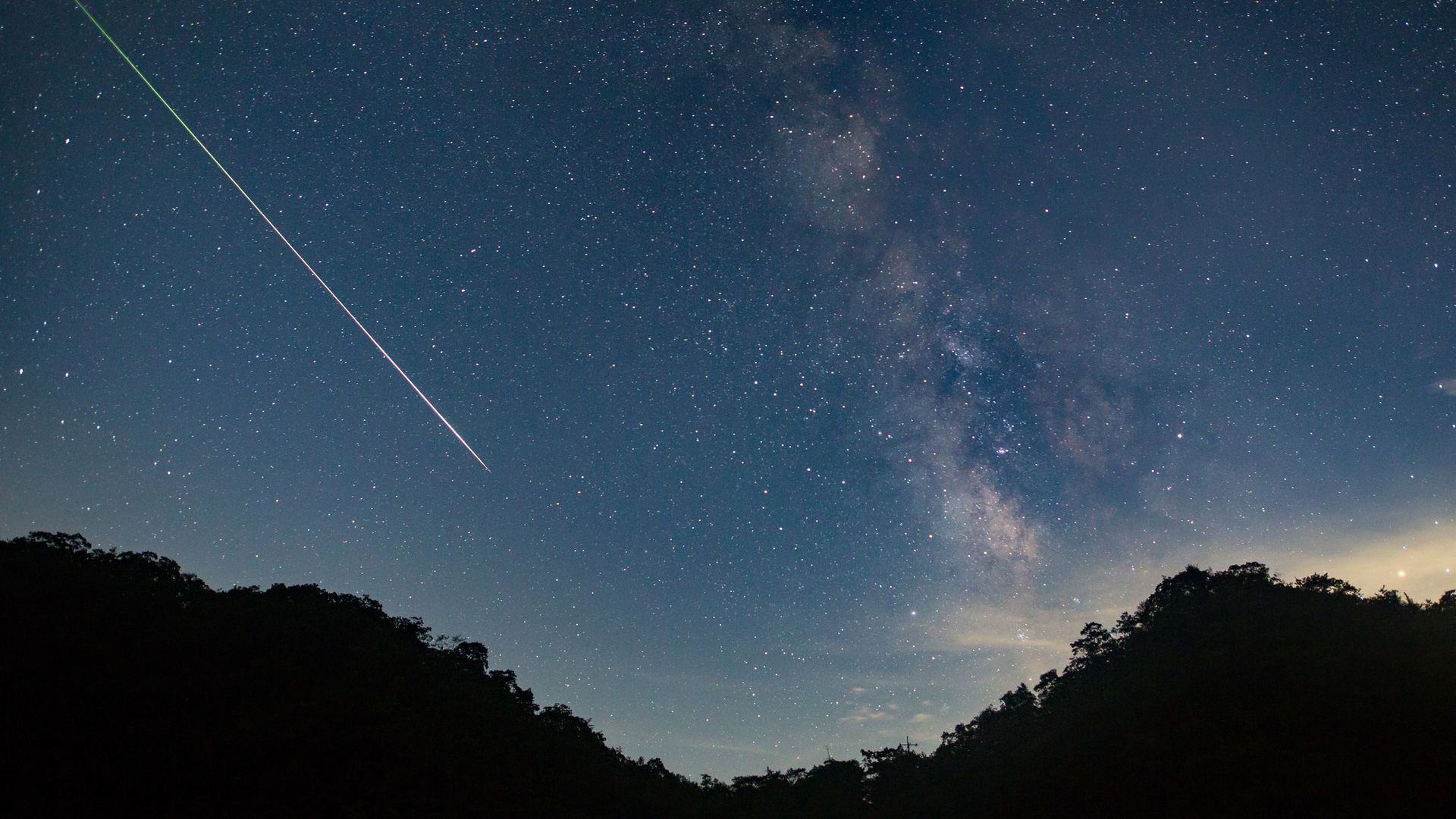
The visual appeal of a meteor shower is a byproduct of high-velocity kinetic energy conversion within the Earth’s thermosphere. While general media outlets frame these events as "light shows," an analytical perspective treats a meteor shower as a predictable intersection of planetary orbits and debris fields. Optimizing the observation of such events requires an understanding of orbital mechanics, atmospheric chemistry, and the physiological limitations of human optics.
The Kinematics of Debris Intersection
A meteor shower occurs when Earth’s orbital path intersects a stream of solid particles—meteoroids—left behind by a parent body, usually a comet or an asteroid. The intensity of the shower is determined by the density of this debris stream.
- Velocity and Kinetic Energy: Meteoroids enter the atmosphere at speeds ranging from 11 km/s to 72 km/s. The kinetic energy ($E_k$) of a particle is expressed as $E_k = \frac{1}{2}mv^2$. Because velocity is squared, even a particle with the mass of a grain of sand exerts tremendous energy upon impact with the atmosphere.
- Ablation and Ionization: As the particle encounters increasing atmospheric density, friction generates heat exceeding 1,650°C. This process, ablation, vaporizes the meteoroid. The resulting "streak" is not the burning rock itself, but a column of ionized air and vaporized material glowing as electrons return to lower energy states.
- The Radiant Point: The perceived origin point in the sky is an optical illusion of perspective, similar to railroad tracks appearing to converge in the distance. The position of this radiant determines the shower's name (e.g., the Perseids originate from the constellation Perseus).
Variable Constraints on Observation Quality
The "Zenithal Hourly Rate" (ZHR) is the standard metric used to quantify the intensity of a meteor shower. It represents the number of meteors a single observer would see per hour under a perfectly clear, dark sky with the radiant directly overhead. However, the realized rate is almost always significantly lower due to environmental and systemic bottlenecks.
The Light Pollution Tax
The Bortle Scale measures the night sky's brightness, ranging from Class 1 (Excellent dark-sky site) to Class 9 (Inner-city sky). Light pollution acts as a signal-to-noise filter. If the sky brightness exceeds the magnitude of the meteor's glow, the event is invisible. An observer in a Class 5 suburb will see approximately 10% of the meteors visible to an observer in a Class 1 wilderness area.
Lunar Interference
The Moon functions as a natural light polluter. When a meteor shower coincides with a Full Moon, the reflected solar radiation increases the sky's background luminance, effectively "washing out" all but the brightest fireballs. Analytical planning requires checking the lunar phase and moonset times to identify windows of maximum contrast.
Cloud Cover and Atmospheric Opacity
Meteor showers occur at altitudes between 75 km and 100 km. Local weather systems existing in the troposphere (below 12 km) act as a binary shutter. High humidity and aerosols also scatter light, reducing the "limiting magnitude"—the faintest star visible to the naked eye—and by extension, the number of detectable meteors.
The Physiological Bottleneck: Human Optical Constraints
The human eye is the primary sensor for meteor observation, yet it possesses inherent technical limitations that observers must mitigate.
- Dark Adaptation: The transition from photopic (day) vision to scotopic (night) vision involves the regeneration of rhodopsin in the retina. This process takes approximately 20 to 30 minutes. A single glance at a smartphone screen triggers immediate photobleaching, resetting the adaptation clock and reducing the observer’s detection threshold.
- Peripheral Sensitivity: The center of the retina (fovea) is packed with cones for color and detail but is less sensitive in low light. The periphery is dominated by rods, which are superior at detecting motion and low-intensity light. Effective observers utilize "averted vision," looking slightly away from the radiant to detect faint streaks via the peripheral rods.
Structural Strategy for Peak Observation
To maximize the probability of high-count detection, a structured approach is required.
Phase 1: Temporal Optimization
Observation should be scheduled for the post-midnight hours. This timing is a function of Earth's rotation. Between sunset and midnight, an observer is on the "trailing" side of the planet. After midnight, the observer moves to the "leading" edge—the windshield of the planet—as it sweeps through the debris field. This significantly increases the relative velocity and frequency of impacts.
Phase 2: Gear and Environment
Magnification is counterproductive. Binoculars or telescopes narrow the field of view, making it statistically unlikely to catch a random streak. The optimal "hardware" is a wide-angle, naked-eye view. Environmental management involves maximizing comfort to prevent "observer fatigue," which leads to decreased concentration and missed detections.
- Radiation Cooling: Even on mild nights, the body loses heat rapidly via infrared radiation to the open sky. Thermal insulation is a technical necessity, not a luxury.
- Field of View: Position the body so the radiant is roughly 30 to 45 degrees off-center. This allows the eye to catch longer "earth-grazing" meteors that travel further across the atmosphere.
Technical Classification of Meteor Types
Not all streaks are identical. Categorizing them allows for better data collection and reporting.
- Earth-grazers: Meteors that enter at a shallow angle, skimming the upper atmosphere. They are slow, long-lasting, and often colorful.
- Fireballs (Bolides): Meteors that reach a magnitude of -4 or brighter (brighter than Venus). These often involve larger fragments that may explode (sonic booms) or leave persistent "trains" of ionized gas that remain visible for minutes.
- Point Meteors: Meteors headed directly toward the observer. They appear as a stationary flash of light with no visible streak.
The Probability of Surface Impact
A common misconception is the risk of debris reaching the ground. The atmosphere serves as a highly efficient heat shield. Most meteoroids associated with annual showers are the size of pebbles or dust and are entirely consumed during entry. For a fragment to survive as a meteorite, the initial mass generally must exceed that of a basketball, and the material must be sufficiently dense (iron or stony-iron) to withstand the structural stresses of deceleration. Debris from cometary streams is typically "fluffy" and lacks the structural integrity for surface impact.
Systematic Data Contribution
Observation has evolved from passive viewing to active data contribution. Organizations like the International Meteor Organization (IMO) use standardized observation logs to refine debris stream models. By recording the start/end times, limiting magnitude, and the number of meteors seen within specific intervals, amateur observers contribute to the "flux" calculations used by space agencies to protect satellite infrastructure from hypervelocity impacts.
The upcoming meteor activity over the British Isles should be approached as a data-gathering exercise. Success is not a matter of luck but of minimizing environmental noise, maximizing sensor sensitivity, and aligning with the orbital mechanics of the Earth-debris intersection. Prioritize the window between 02:00 and 04:00 local time, move to a Bortle 3 or lower zone, and maintain strict light discipline to ensure the eye operates at its maximum scotopic capacity. This rigour transforms a casual glance upward into a high-fidelity observation of planetary-scale ballistics.