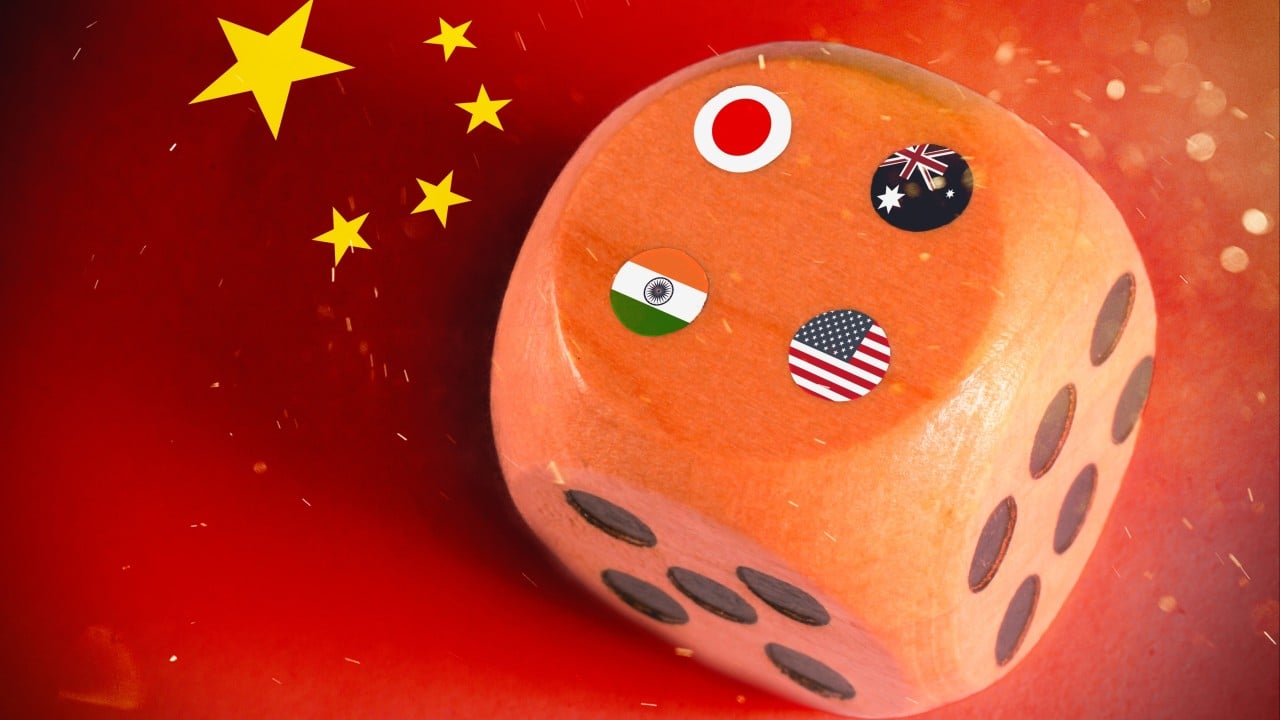
Western media loves a geopolitical David and Goliath story. For the past three years, the dominant narrative surrounding the Quadrilateral Security Dialogue—the Quad alliance of the United States, Japan, India, and Australia—has been focused on a single, intoxicating idea: breaking China’s chokehold on critical minerals.
The standard editorial template practically writes itself. It highlights the vast mineral reserves of Australia, the heavy industrial demand of Japan and India, and the financial might of Washington. It then points to recent diplomatic friction between Washington and New Delhi, asking if this "rift" will derail the grand strategy.
It is a comforting narrative. It is also fundamentally wrong.
The premise that a US-India diplomatic spat is the main obstacle to mineral independence assumes that the puzzle is purely geopolitical. It assumes that if the four capitals just sign enough memorandums of understanding, build a few processing plants, and smooth over trade friction, the supply chains will reorganize themselves.
They won't. The Quad’s mineral strategy is failing, and it isn't because of a political rift. It is failing because Western policymakers do not understand the difference between mining rocks and chemical refining, nor do they understand the brutal economics of commodity pricing. China did not build its monopoly by holding a monopoly on the geology; it built it by becoming the world’s only scaled chemical factory for processing raw ore into high-purity materials.
The Geology Fallacy: Rocks Are Not Supply Chains
Every amateur analysis of the critical mineral crisis starts with a map of global reserves. They look at Australia’s massive lithium deposits, India’s beach sand minerals, or America’s untapped rare earth elements (REEs) and declare that the West holds all the cards.
This is a fundamental misunderstanding of the material pipeline.
Mining the raw ore is the easiest, lowest-margin part of the entire process. The real power—and the real monopoly—lies in the midstream: cracking, acid leaching, separation, purification, and metallurgy. This is where raw rock turns into 99.99% pure oxides and metal alloys that can actually be used in electric vehicle batteries, fighter jets, and wind turbines.
Consider the physical reality of rare earth processing. When you mine rare earth ore, you get a mixed concentrate containing 17 different elements, all chemically locked together. To separate them, you must dissolve the ore in massive quantities of industrial acids and run it through hundreds of stages of solvent extraction.
China controls over 60% of global rare earth mining, but it controls nearly 90% of the refining capacity and over 90% of the magnet production.
[Raw Ore Mining] ---> [Acid Cracking & Leaching] ---> [Multi-Stage Separation] ---> [High-Purity Oxides] ---> [Metallurgy & Magnet Fabrication]
   (West Competes)          (China Dominated)             (China Dominated)          (China Dominated)            (China Dominated)
I have watched Western juniors raise hundreds of millions of dollars on the promise of a "world-class deposit," only to go bankrupt because they realized they had no way to refine the output without shipping it directly to facilities in Baotou or Ganzhou. If you are shipping your unrefined Australian or American concentrate to China for processing, you do not have an independent supply chain. You have a glorified quarry.
The Quad’s current strategy is like trying to break a microchip monopoly by buying more sand.
The Price Trap: The Invisible Hand is Made in Beijing
Even if the Quad builds processing infrastructure, it faces an existential economic hurdle that no government subsidy can permanently fix: the weaponization of overcapacity.
China’s state-backed state-owned enterprises (SOEs) do not operate on the short-term quarterly profit metrics of Wall Street or the ASX. They operate on long-term market share dominance. When Western competitor facilities try to come online, Chinese producers can simply flood the market, crash the spot price of lithium, cobalt, or neodymium, and starve the Western upstarts of capital.
We saw this play out clearly in the mid-2010s and again in recent pricing cycles. When the price of NdPr (neodymium-praseodymium oxide) spikes, Western projects look viable on paper. But the moment those projects near production, Chinese production quotas expand, prices plummet below the marginal cost of Western extraction, and private investment dries up overnight.
Imagine a scenario where a US-backed processing plant in Texas or an Indian facility in Odisha spends five years navigating environmental permits and $500 million in capital expenditure to produce lithium carbonate at a cost of $18,000 per metric ton. If Beijing intentionally depresses global prices to $10,000 per ton for two consecutive years, that Western facility goes into receivership. Private capital markets will not tolerate those losses. Beijing can absorb them indefinitely.
No amount of diplomatic alignment between Washington and New Delhi changes this economic asymmetry. The Western model relies on private equity and public markets that demand a return on investment. The Chinese model relies on state-directed credit lines designed to secure geopolitical leverage. You cannot defeat state capitalism with fragmented, risk-averse private financing.
The Environmental Hypocrisy Deadlock
Let's address the elephant in the refining room: processing critical minerals is a filthy, toxic, and radioactive business.
Rare earth ores are almost always co-located with thorium and uranium. Processing them generates thousands of tons of radioactive tailings and millions of gallons of highly acidic wastewater.
+------------------------------------+------------------------------------+
| Western Regulatory Pipeline        | Chinese Industrial Reality         |
+------------------------------------+------------------------------------+
| - 7-10 year environmental reviews  | - Centralized mega-hubs            |
| - Local NIMBY legal challenges     | - Streamlined waste management     |
| - Strict toxic waste liability     | - Low-cost industrial electricity  |
| - High compliance overhead costs   | - State-absorbed legacy pollution  |
+------------------------------------+------------------------------------+
This creates a paradox for Western democracies. The very factions that push hardest for the clean energy transition—which requires massive quantities of these minerals—are often the quickest to litigate against the domestic chemical plants required to process them.
The United States has spent years trying to restart its domestic mine-to-magnet pipeline, but it is constantly bogged down in regulatory stagnation and local opposition. Australia faces similar hurdles when trying to move up the value chain from digging dirt to advanced chemical manufacturing.
China, conversely, spent decades externalizing its environmental costs to build these massive industrial hubs. They have already paid the environmental price for global dominance; the West is unwilling to pay it. The Quad wants the geopolitical reward of a clean, secure supply chain without accepting the toxic backyard reality required to build it.
Dismantling the De-Risking Myth
When analyzing the Quad's mineral initiatives, trade publications frequently ask variations of the same flawed questions:
Can India replace China as the world's primary mineral processing hub?
💡 You might also like: The Turnberry Tariff Bluff Why the July 4 Deadline is a Gift to the EuroWill US funding for Australian mines solve the rare earth crisis?
These questions miss the point entirely. They view the problem as a logistical trade route issue rather than a structural chemical engineering deficit.
India has massive reserves of beach sand minerals containing monazite, a prime source of heavy rare earths. But India's state-controlled refining apparatus, IREL, has spent decades operating at a fraction of the efficiency needed for global commercial competition. To think New Delhi can suddenly scale this into a world-class, hyper-efficient commercial processing ecosystem that undercuts China within the decade is pure fantasy.
Furthermore, the idea of an American financial bail-out for Australian mining projects ignores the scale of the capital requirements. Building a single, mid-sized rare earth separation plant requires hundreds of millions of dollars and a highly specialized labor force that barely exists outside of East Asia. The United States lacks the chemical engineers, the metallurgists, and the operators who know how to run these complex solvent extraction lines at scale.
We have spent thirty years outsourcing our chemical industry. You cannot reverse that structural decay with a press release from a security summit.
Actionable Order: Stop Subsidizing Mines, Protect the Market
If the Quad actually wants to secure its technological survival, it must abandon the current playbook of giving sporadic grants to junior mining companies. That just creates more raw material for China to buy cheap and refine. Instead, the alliance must implement a brutal, protectionist strategy that forces a decoupled market into existence.
- Establish Monopsony Purchasing Blocks: The four Quad governments must form a unified buying entity that guarantees a long-term floor price for non-Chinese refined minerals. If the market price for lithium drops to $12,000 a ton due to Chinese dumping, the Quad buying block must commit to buying domestic production at a guaranteed price of $22,000 a ton to keep those facilities solvent.
- Mandate Feedstock Tracing by Origin, Not Processing Location: Current regulations are easily gamed. Companies import Chinese-refined metals through third countries and label them "clean." The Quad must mandate strict isotopic tracing for every gram of material used in defense and critical infrastructure. If the ore was cracked or separated using Chinese infrastructure, it must face a total procurement ban, regardless of where the final component was assembled.
- Build Strategic Chemical Stockpiles, Not Mineral Reserves: Storing raw spodumene or unrefined rare earth concentrate is useless during a blockade. Governments must fund and hold massive physical stockpiles of refined oxides, pure metals, and finished permanent magnets.
The Western alliance is bring a knife to a chemical warfare fight. Until policymakers accept that breaking this monopoly requires permanent market intervention, massive industrial subsidies, and a tolerance for domestic heavy chemical pollution, China’s grip on the modern world will remain unassailable.
Stop looking at the political rifts between Washington and New Delhi. Look at the chemistry, look at the capital expenditures, and look at the price charts. That is where the war is being lost.


