The generator sputtered twice before catching its breath. When it did, a sharp beam of white light sliced through the heavy, dust-laden evening air of Khan Younis, striking a scarred concrete wall that had survived the collapse of the neighboring block. For a second, there was only a blurry square of light. Then, a hand adjusted the lens, and the green grass of a pristine football pitch flickered into existence.
Dozens of eyes reflected that green glow. Children sat cross-legged on plastic mats spread over crushed stone. Old men leaned against plastic chairs with broken legs, their faces momentarily losing the tight, drawn look of survival. For ninety minutes, the world outside this makeshift theater did not disappear, but it was forced to wait.
The man behind the lens was not a politician, a soldier, or a diplomat. He was someone who understood that when everything is stripped away, the need for shared joy becomes as critical as bread. He was the one who gathered the wires, begged for fuel, and rigged up a screen so his neighbors could watch the World Cup.
Then the strike came.
To read the standard dispatches, his death was a data point. A brief line in a daily briefing, tucked between casualty counts and strategic updates. But a community does not mourn a data point. They mourn the silence that falls when the generator stops running for good.
The Architecture of a Distraction
In a place where the horizon is defined by blockades and the sky is a source of constant anxiety, football operates differently than it does in London, Madrid, or Buenos Aires. It is not a luxury. It is an anchor.
Consider what happens when a match begins. The arguments about water rations quiet down. The relentless internal calculation of risk—whether to walk to the market now or wait until afternoon—stills. The collective focus shifts to a ball moving across grass thousands of miles away. It is a form of time travel, transporting hundreds of people out of a war zone and into a global stadium where the rules are fair, the boundaries are clear, and merit dictates the outcome.
The man who organized these screenings knew this intimately. He spent days scouting locations that offered a modicum of shelter while still providing enough flat surface to catch an image. He negotiated for extensions cords. He patched together broken audio speakers using electrical tape and sheer willpower.
This was not about entertainment. It was about preserving a psychological boundary against despair. Every time he pressed the power button on that projector, he was asserting that the people around him deserved to experience the same collective gasps, the same heart-stopping near-misses, and the same ecstatic celebrations as anyone else on earth.
The Physics of the Ordinary
The crowd that gathered around the projector was always diverse. You had teenagers who modeled their haircuts after international superstars, replicating their moves on the dusty streets during the day. You had grandfathers who remembered a different Gaza, one where travel was possible and life possessed a predictable rhythm.
When a goal was scored, the sound that rose from the rubble was indistinguishable from the roar of a stadium. It was loud, chaotic, and entirely human. For those few seconds, the crushing weight of their immediate reality was suspended.
Imagine the technical fragility of this setup. The electricity grid had long since ceased to be reliable. Fuel for generators was a currency more precious than banknotes. Every screening was a minor miracle of logistics, requiring a network of small favors, borrowed equipment, and desperate ingenuity. If a cable frayed, someone had to splice it in the dark. If the signal dropped, a crowd of hundreds waited in breathless silence while one man climbed a makeshift ladder to adjust an antenna.
He became a custodian of normalcy. In a environment designed to fracture communities into isolated, terrified individuals, his screenings forced people together. They rubbed shoulders, shared thin blankets against the evening chill, and argued over referee decisions with the fierce passion of people who had nothing else to debate.
The Night the Light Went Out
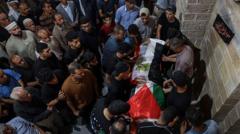
The strike did not announce itself. It rarely does. A sudden explosion, a shockwave that rattles the teeth in your skull, and the air turns thick with the grey, suffocating dust of pulverized mortar.
When the smoke cleared, the projector was twisted metal. The wall used as a screen was chipped further, its surface mapped with fresh shrapnel scars. And the man who had brought the world’s game to a darkened corner of the strip was gone.
The aftermath of such an event follows a predictable, tragic script. The international press runs a short segment. Commentators debate the legality, the targeting, the collateral cost. Figures are added to spreadsheets kept by human rights organizations.
But on the ground, the loss is measured in a much simpler currency: the return of the dark.
The next evening, people looked at the empty space against the wall. No one brought out a generator. No one adjusted a lens. The kids who would normally be fighting for the best viewing spots on the plastic mats stayed near their families, listening instead to the drone of aircraft overhead. The distraction was gone, and the reality of their situation rushed back in to fill the void with agonizing speed.
The Unseen Casualty
When we talk about conflicts, we often focus on the physical infrastructure. We count the buildings destroyed, the roads cratered, the water plants knocked offline. We measure the destruction in concrete and steel because those are things that can be photographed from satellites and quantified in reconstruction budgets.
We rarely talk about the destruction of the intangible social tissue.
The organizer was part of that tissue. He was an engineer of morale, a man who recognized that survival requires more than just biological persistence. It requires a reason to look forward to tomorrow evening. By eliminating the person who created these spaces of shared humanity, the strike did more than end a single life; it extinguished a communal hearth.
The tragedy of the situation lies in its repetition. Across every modern conflict, the individuals who dedicate themselves to maintaining the small, beautiful details of civilian life—the bakers who open their doors amid shelling, the musicians who play in bomb shelters, the sports enthusiasts who rig up projectors—are the most vulnerable. They are out in the open, trying to build something fragile while everything else is tearing down.
The World Cup continued. The matches were played, the trophies lifted, the million-dollar contracts signed. Millions of people cheered in pristine stadiums, or watched from the comfort of their living rooms, surrounded by snacks and air conditioning.
But in one specific neighborhood, the tournament ended early. The screen remains blank, a stark square of grey concrete reminding everyone who passes by of what happens when the light is put out.