For decades, the borders of Cambodia were not just lines on a map. They were valves.
If you lived in the dusty frontier towns of Banteay Meanchey or Battambang, your life was quietly regulated by decisions made in Bangkok or Hanoi. When you flipped a switch, the electricity that hummed to life in your lightbulb likely came from a Thai power grid. When you loaded a crate of garments onto a truck in Phnom Penh, its journey to the global market depended entirely on whether Vietnamese customs officers at the Cai Mep port were having a fast or slow day.
To be a small nation in a giant, interconnected world is to live with a constant, low-frequency anxiety. It is the realization that your daily existence is rented from your neighbors.
Then came the year the valves began to tighten.
Consider what happens when geopolitics gets personal. It is late spring, and a routine border skirmish escalates into a war of words. Across the border, politicians bluster about cutting off the digital and physical lifelines of their neighbor. For an ordinary Cambodian business owner, the threat is not abstract. A sudden drop in internet bandwidth means missed shipments, stalled payments, and silent factories. A sudden blackout means ruined stock.
In the past, the response to these tremors was a diplomatic shrug and a cautious negotiation. But something has shifted in Phnom Penh. The shrug has been replaced by a quiet, stubborn defiance.
The Night the Cables Went Dark
It happened almost overnight. Following threats of utility cutoffs from across the border, the order went out from the capital: disconnect. Within hours, Cambodian telecommunications operators severed their cross-border fiber-optic links.
To the outside observer, it looked like madness. Why deliberately unplug yourself from a major regional hub?
The answer lies in a psychological shift that is reshaping Southeast Asian economics. The country decided it would rather endure a temporary afternoon of sluggish connections than spend another year wondering if the plug would be pulled for them. It was an expensive point to prove—costing regional partners millions in lost transit revenue—but the message was unmistakable: Cambodia is tired of asking for permission to exist.
But internet bandwidth is the easy part. You can reroute data packets with a few keystrokes. Redirection of physical trade, however, requires moving millions of tons of earth.
Earth, Water, and the $1.7 Billion Gamble
To truly understand this bid for self-reliance, you have to look at the mud.
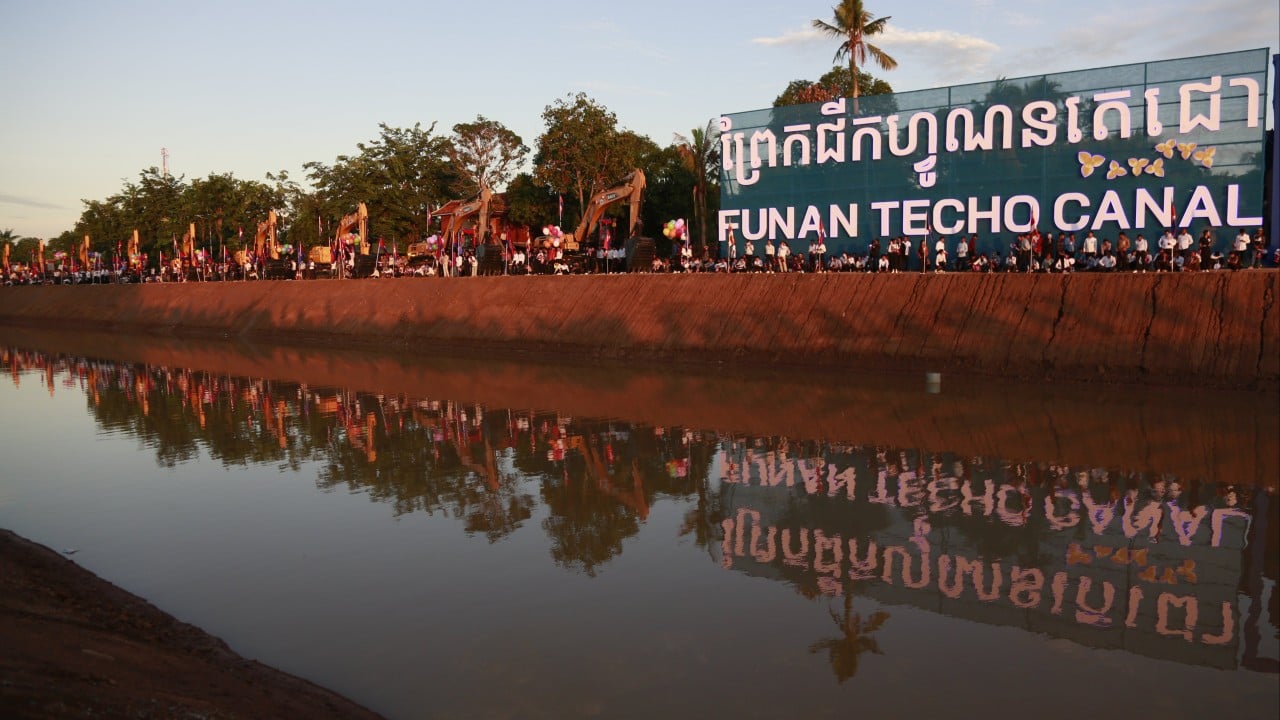
South of Phnom Penh, a massive scar is being carved through the countryside. This is the Funan Techo Canal, a 180-kilometer ribbon of water designed to bypass Vietnam’s shipping lanes entirely by connecting the Mekong River system directly to Cambodia's own deep-sea ports on the Gulf of Thailand.
[Phnom Penh Port]
       |
       |  (Funan Techo Canal - 180km)
       v
  [Kep / Gulf of Thailand]  --->  Direct Global Trade
For generations, Cambodian exporters had to play by someone else's rules. Shipping a container meant paying transit fees to Vietnam, navigating their regulatory hurdles, and accepting their timelines. The canal is a $1.7 billion declaration of independence.
But independence is rarely free, and it is never simple.
Critics and environmentalists point to the fragile mechanics of the Mekong Delta. Water is not a sovereign resource; it does not recognize passports. By widening old canals and building high levees, there is a risk of altering the natural wet-season floods that deposit vital nutrients onto agricultural lands downstream. What looks like a logistics triumph in Phnom Penh looks like an ecological threat in Hanoi.
This is the central paradox of the modern nation-state. To shed your dependency on a neighbor, you must often disrupt the very ecosystems you share with them.
Outgrowing the Lifeline
This hunger for autonomy is not just playing out along concrete waterways and fiber-optic lines. It is happening in the quiet offices of local civil society organizations.
For three decades, Cambodia was one of the world's premier laboratories for international aid. Following the UN transition in the early 1990s, foreign donors poured billions into local non-governmental organizations. It was a beautiful, necessary lifeline that rebuilt a shattered country. But lifelines, if left in place too long, can become tethering ropes.
Now, the global tide of charity is receding. Wars in Europe and the Middle East, combined with shifting domestic priorities in Western capitals, have caused foreign aid budgets to dry up. Major European development agencies are packing their bags.
The initial reaction among local advocates was panic. How do you protect forests, support rural women, or fund healthcare when the checks from Berlin, Stockholm, or Washington stop arriving?
But the real problem lies deeper than a lack of cash. The real crisis is structural dependency. When organizations spend thirty years writing grant proposals tailored to foreign sensibilities, they lose the ability to speak directly to their own communities. They become accountable to boards in Geneva rather than villagers in Prey Veng.
The current funding drought is forcing a painful, necessary evolution. Activists are realizing that survival means building local donor networks, relying on volunteers, and finding home-grown solutions. It is a transition from being a passive recipient of global goodwill to an active participant in domestic development.
The High Wire Act
It is easy to romanticize self-reliance. We love stories of the underdog cutting ties and standing tall.
But pure isolation is a luxury no modern economy can afford. The goal cannot be to wall oneself off from the world. True resilience is not about isolation; it is about options.
When Cambodia cuts its reliance on a neighboring port, it isn't retreating from global trade. It is trying to enter the global market on its own terms. When a local charity stops relying on foreign grants, it isn't stopping its work; it is ensuring that its work can survive the whims of a foreign electorate thousands of miles away.
This is a dangerous high-wire act. If you pull too hard on the threads of connection, you risk fraying the relationships that keep your economy afloat. If you don't pull at all, you remain a passenger in your own destiny.
The concrete on the Funan Techo Canal is drying, the severed fiber cables remain cold, and the office lights in local NGOs are burning late into the night as staff rewrite their business models. It is a messy, expensive, and deeply uncertain journey. But as the people of this resilient corner of Asia have learned through centuries of turbulent history, the only thing more costly than building your own road is letting someone else decide where it leads.