The dust in the highlands does not settle easily. It hangs in the air, a fine, amber shroud that coats the leaves of the eucalyptus trees and settles into the deep lines of a man’s hands. In a small town nestled in the green hills of southern Ethiopia, this dust recently bore witness to an quiet horror. It is a story not of statistics or sterile public health directives, but of an agonizing choice forced upon a community that had run out of options.
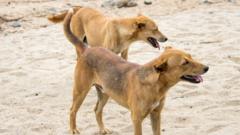
Consider a man named Tesfaye. He is a hypothetical composite of the farmers who walk these red earth roads, but his reality is entirely true to life. Tesfaye had a dog named Birru, a lean, tan animal with ears that permanently tilted toward the horizon, listening for the approach of stray hyenas or unfamiliar footsteps near the livestock pen. Birru was not a pet in the Western sense. He did not sleep on a cushion or wear a neon collar. He earned his keep. Yet, when the evening chill rolled off the mountains, Birru would rest his heavy chin on Tesfaye’s calloused foot, a silent contract of mutual survival sealed in the warmth of shared breath. Recently making news lately: The Fatal Flaw in How We Inspect America's Independent Motels.
Then came the biting.
It started with a stray. A scruffy, wild-eyed creature slid out from the acacia brush, its jaws snapping at shadows, a thick, milky froth bubbling at the corners of its mouth. It tore through a village path, biting two children playing near a water well before vanishing into the valley. Within weeks, the invisible shadow of rabies had woven itself into the fabric of the town. More insights on this are covered by The Guardian.
The Terror of the Water
To understand what happened next, we must look directly at the disease itself. Rabies is ancient. It is a viral phantom that targets the central nervous system with terrifying precision. Once the symptoms manifest, the mortality rate is not merely high; it is absolute. One hundred percent.
The virus travels up the nerves like a slow-burning fuse, moving toward the brain. For weeks, nothing seems wrong. Then, the nightmare wakes up. The throat spasms at the mere sight of liquid. Hydrophobia sets in. It is a cruel irony that a body burning with fever becomes utterly terrified of the one thing that could cool it. The infected suffer hallucinations, frantic aggression, and a agonizing paralysis before the heart finally quits.
In wealthy nations, a dog bite is an inconvenience solved by a swift trip to an urgent care clinic and a series of modern injections. But in rural communities where the nearest cold-storage facility holding post-exposure prophylaxis is a costly, multi-day journey away, a bite is often a delayed execution order.
When those two children died in the local clinic, their small bodies racked by spasms, the atmosphere in the town shifted from caution to sheer panic. The local administration faced a brutal mathematical reality. They had no access to thousands of doses of animal vaccines to create a barrier of herd immunity. They had no animal control vans, no tranquilizer darts, no shelters.
They had only one tool left. Elimination.
The Unthinkable Directive
The order came down from the town elders and local officials: every dog within the municipality limits had to be destroyed. Not just the strays. Every single one.
Imagine the weight of that mandate. The authorities did not have the resources to conduct a systematic, humane culling. Instead, the burden of execution was placed squarely on the shoulders of the owners themselves. Neighbors were required to look into the eyes of the animals that guarded their children, slept by their hearths, and herded their goats, and end their lives.
Tesfaye knew the law of the hills. He knew the agonizing sound of the children’s funerals. He looked at Birru, who was sitting perfectly healthy by the doorway, thumping his tail against the dirt floor.
The air was heavy with the smell of woodsmoke and dread.
The town became a place of grim processions. Men walked down the lanes carrying heavy wooden clubs, thick ropes, and old hunting rifles. The air, usually filled with the sounds of greetings, clinking coffee cups, and children laughing, was shattered by sudden, sharp barks that cut off into silence.
A Systemic Failure of Boundaries
It is easy for an outside observer to judge this desperation from afar, to condemn the methods as archaic or cruel. But judgment is a luxury of the safe.
The real tragedy is that this crisis was entirely preventable. Rabies is a disease of poverty and isolation. The World Health Organization has long maintained a goal of zero human rabies deaths from dog-mediated transmission by 2030. Yet, the supply chains for animal vaccines frequently break down long before they reach the dirt roads of highland towns.
When a community is left to fend for itself against a lethal biological threat, the line between civilization and raw survival thins out completely. The townspeople were not acting out of malice; they were acting out of a fierce, desperate love for their own offspring. They chose their children over their protectors.
Consider what happens next when an entire ecosystem loses its sentinels. Dogs do not just provide companionship; they form a predatory wall between human settlements and the wild reservoir of disease carried by jackals, foxes, and stray populations. By wiping out hundreds of local dogs, the town inadvertently cleared a path. A vacuum was created in the brush.
The Quiet Aftermath
The cull lasted three days. By the end of it, more than four hundred dogs were gone.
The bodies were collected in the backs of old trucks and buried in deep pits outside the town limits, covered in lime to halt the spread of decomposition and scavenging. The town became strangely, unnaturally quiet. The night-time choruses of barking that used to echo across the ridges, signaling to each other that the perimeter was secure, vanished.
Tesfaye sat outside his home on the fourth evening. His hands were clean, but they felt heavy, clumsy. He reached down out of habit to scratch an ear that was no longer there. The red dust swirled around his ankles in the twilight wind.
He had done what was required to keep his family safe from the frothing madness. The village had survived the outbreak, but the victory tasted like ash. The invisible stakes of global health inequality had landed squarely on a single, rural community, leaving behind a silence so profound it hurt to listen to it.