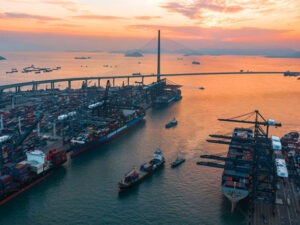
A Shipping Container in Long Beach
Imagine the sound of steel hitting steel at six in the morning.
It is a sharp, resounding clack that echoes across the saltwater mist of the Port of Long Beach, where massive orange cranes reach into the grey Pacific sky like mechanical giraffes. Below them sits a single forty-foot shipping container painted ocean blue. Inside that box are twelve thousand custom-molded silicone gaskets, manufactured in a factory outside Shenzhen and destined for an auto-parts supplier in Ohio. Also making news in this space: The Brutal Truth Behind China Electric Vehicle Expansion Beyond European Tariff Walls.
To a legal scholar in Washington, that container is a data point in a constitutional debate over administrative authority.
To United States Trade Representative Jamieson Greer, it represents the front line of a national industrial strategy designed to rebalance global supply chains. More insights on this are detailed by Harvard Business Review.
To a shop owner in Toledo waiting on those gaskets to keep twelve assembly workers on the payroll, that box represents rent, health insurance, and a mountain of unpaid invoices.
Trade policy is almost always discussed in the cold language of percentages, statutory sections, and tribunal rulings. We talk about tariffs as if they are abstract dials turned by unseen hands in panel-lined hearing rooms. But every time a government official adjusts those dials, the force travels down thousands of miles of wire, ocean, and asphalt until it hits a real person standing on a concrete warehouse floor.
Recent weeks have delivered a seismic shock to those dials. When the Supreme Court struck down a series of sweeping executive tariffs, striking at the heart of how emergency trade authorities had been used, many importers breathed a tentative sigh of relief. They assumed the storm had passed.
They were wrong.
Speaking with the quiet certainty of an administration determined to hold its ground, USTR Greer made the White House's position starkly clear: the overarching strategy has succeeded, and the void left by the court’s gavel will soon be filled with fresh, targeted measures.
The battle for America's commercial borders is not ending. It is merely changing its tools.
The Courtroom Meets the Dockside
To understand why the administration refuses to back down, you have to look at what these tariffs were meant to accomplish in the first place.
For decades, the standard playbook of global economics was simple: buy cheap, ship fast, and let the market sort out the casualties. Factories in the American Rust Belt closed their doors not because they forgot how to make things, but because competitor nations subsidized their own industries to a degree that made fair competition mathematically impossible.
The tariff policy was conceived as a hammer to break that dynamic. By slapping taxes on foreign goods, the government aimed to force companies to rethink their dependence on overseas manufacturing.
And according to trade officials, the hammer worked.
Key supply chains began shifting toward domestic producers or friendly allies. Investment in domestic manufacturing surged in strategic sectors like semiconductors, advanced batteries, and heavy machinery. From the perspective of trade strategists in Washington, the temporary pain inflicted on importers was a necessary trade-off for long-term national economic resilience.
Then came the judicial check.
In a landmark ruling, the Supreme Court drew a firm line around executive power. The justices concluded that key executive actions had overstepped the boundaries set by Congress, striking down specific tariff mechanisms that had been leveraged to levy broad duties.
For a brief moment, the business community thought the lever had been permanently broken. Importers began calculating potential refunds, wondering if the cost of doing business was about to drop.
But trade policy in the modern era does not simply yield to a single judicial ruling.
The Re-Tooling in Washington
Inside the Office of the United States Trade Representative, the mood was not one of defeat, but of recalibration.
Trade officials saw the court’s decision not as a repudiation of their core mission, but as a procedural speed bump. The underlying economic problem—unfair trade practices, structural overcapacity abroad, and the vulnerability of critical supply chains—had not vanished because a court interpreted a statute differently.
Greer’s signal was unequivocal. The administration views its trade strategy as an undeniable success, one that reshaped global commerce in favor of American interests. Rather than retreating, the trade office is reaching into its administrative tool chest for alternative authorities.
Instead of broad emergency decrees, expect surgical precision.
Officials are turning toward statutory mechanisms that carry explicit Congressional backing. Section 301 investigations into unfair foreign trade practices, Section 232 actions centered on national security vulnerabilities, and targeted anti-dumping petitions are all on the table. Where one sweeping policy once stood, a network of tailored, legally ironclad measures will rise to take its place.
This strategy shift changes the math entirely for American businesses.
Under broad broad-brush tariffs, entire product categories were swept up overnight. Under the new approach, the pressure will be focused like a laser on specific sectors, specific materials, and specific nations. It is a slower, more deliberate process, but one designed to withstand the highest levels of legal scrutiny.
The Human Calculus on the Ground
Back on the floor of that automotive parts supplier in Toledo, abstract legal strategies translate into immediate human decisions.
Consider a mid-sized business owner—let us call him David. David doesn't spend his mornings reading Supreme Court dockets or analyzing diplomatic transcripts from trade summits. He spends his mornings looking at balance sheets.
When the original tariffs were imposed years ago, David faced an agonizing choice. He could absorb the extra twenty-five percent cost on imported raw materials and watch his margins evaporate, or he could pass the cost onto his local customers and risk losing them to foreign competitors who shipped finished goods directly into the country.
He survived by splitting the difference. He cut overhead, delayed upgrades to his factory floor, and asked his workers to hold off on pay raises.
When news broke of the Supreme Court decision, David thought he might finally order the new CNC machine he had been eye-ing for three years. He thought about hiring two additional apprentices from the local vocational school.
Now, listening to the signals coming out of Washington, David pauses. He knows new measures are coming. He just doesn't know precisely where or when the next strike will land.
This uncertainty is the hidden tax of modern economic policy. It isn't just the percentage duty paid at the port of entry; it is the frozen capital, the delayed investments, and the sleepless nights spent trying to forecast the un-forecastable.
Yet there is another side to David’s story.
Across town, another factory owner named Sarah manufactures metal stampings. For fifteen years, Sarah was squeezed out of contract after contract by foreign rivals selling below the cost of raw steel. When the tariff policy hit, Sarah's phones started ringing again. Local buyers who had abandoned her a decade ago came back, desperate for a stable, domestic supply line that didn't depend on ocean freight rates or overseas political tides.
For Sarah, the Supreme Court ruling was a terrifying prospect. It threatened to wash away the protection that allowed her to rehire twenty workers and invest in her community. Hearing that new measures are on the horizon gives her hope that the floor won't collapse beneath her feet.
This is the central paradox of trade policy. There is no solution that makes everyone whole. Every protection given to one worker creates a cost for another. Every door opened for a domestic producer places an obstacle in front of an importer.
The Long View of Economic Warfare
What we are witnessing is not merely a bureaucratic dispute over trade regulations. It is a fundamental transformation in how the United States interacts with the global economy.
For nearly half a century, the overriding objective of American economic policy was integration. Lower the barriers, sign the agreements, and let capital flow wherever it found the cheapest labor and the highest efficiency.
That era has drawn to a close.
In its place stands an era of strategic friction. National security, supply chain resilience, and domestic industrial capacity have replaced pure cost-efficiency as the defining metrics of success. The administration's determination to replace overturned tariffs is proof that this shift is bipartisan, persistent, and structural.
The tools may change because of judicial rulings, but the underlying trajectory remains constant.
For businesses navigating this environment, the takeaway is starkly clear: relying on a return to the open-border trade models of the early 2000s is a strategy built on sand. The legal mechanics will evolve, the paperwork will change, and the specific tariff lines will shift, but the high-pressure environment at the port is the new baseline.
The Unbroken Chain
Late in the afternoon at the Port of Long Beach, the mechanical giraffes are still moving.
The ocean-blue container carrying twelve thousand silicone gaskets is lifted off the deck of the vessel, swung through the air in a slow, graceful arc, and set down onto the chassis of a waiting diesel truck.
The driver climbs into the cab, checks his paperwork, and pulls out through the security gates, merging onto the interstate heading east toward Ohio.
That container carries far more than manufactured goods. It carries the competing visions of a nation trying to define its economic future. It carries the legal arguments of lawyers in Washington, the strategic ambitions of trade officials, and the fragile hopes of workers waiting at the end of the line.
The rules governing that box will change again next month, and the month after that. New policies will replace the old, crafted to survive the courtrooms while continuing the quiet, relentless work of rewiring how America buys, builds, and competes.
The truck shifts gears and accelerates into the setting sun, carrying its cargo toward a world where nothing is simple, nothing is cheap, and the rules of the road are being rewritten with every passing mile.