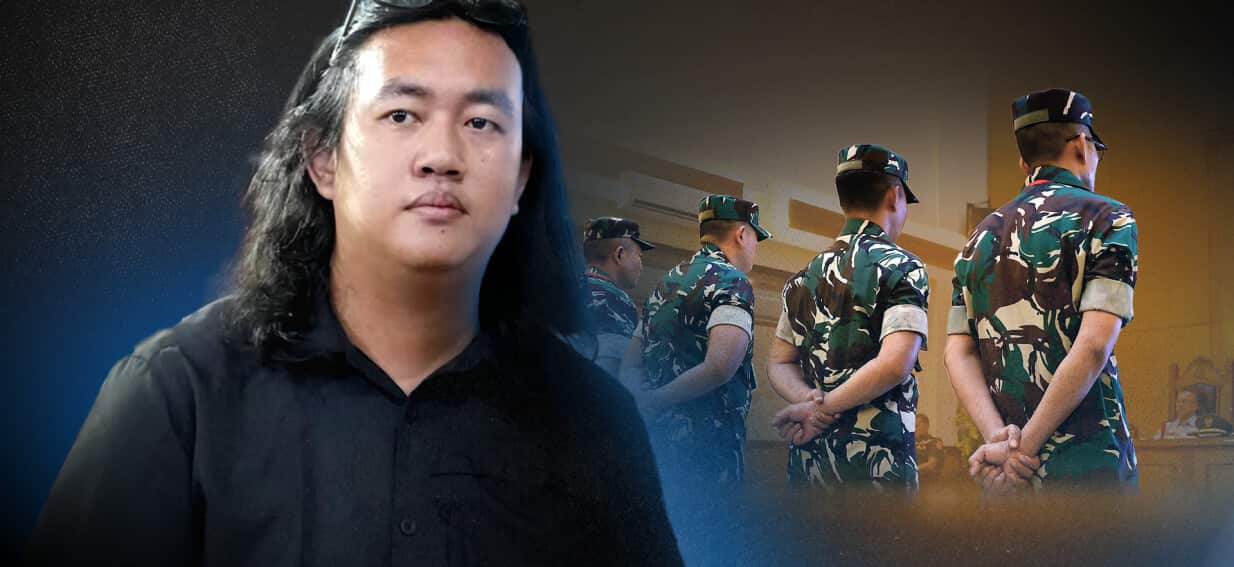
The air in Jakarta doesn’t just sit; it clings. It carries the scent of clove cigarettes, exhaust fumes, and the heavy, metallic tang of an impending monsoon. In a small, soundproofed room tucked away from the roar of the Jalan Thamrin traffic, Andrie sat before a condenser microphone. The red light flickered on. In that moment, he wasn't just a podcaster. He was a man pulling at a loose thread on a very expensive, very dangerous tapestry of national power.
He began to talk about the military.
Specifically, he spoke about the creeping reach of uniformed influence into civil life, a shadow that many Indonesians recognize but few care to narrate into a digital recorder. He hit "upload." The file drifted into the cloud, a digital ghost that would soon haunt its creator in the most physical way imaginable.
The Weight of the Unspoken
To understand why a man would be targeted for a digital audio file, you have to understand the specific gravity of silence in Indonesia. For decades, the Dwifungsi—the dual function of the military—was the backbone of the state. It meant soldiers weren't just in barracks; they were in boardrooms, local government offices, and the very fabric of social order. While reforms supposedly pushed the military back into the shadows after 1998, the muscle memory of an entire nation doesn't vanish overnight.
Andrie’s podcast wasn't a call to arms. It was an autopsy of influence. He interviewed activists and scholars, digging into how military figures were navigating the modern political machine. It was "dry" content by any metric of the TikTok age. But in certain corridors of power, information isn't measured by its entertainment value. It is measured by its potential to destabilize.
A week after the episode aired, the air in Jakarta changed for Andrie. It became thinner. Brittle.
The Geometry of an Attack
Violence is rarely a spontaneous explosion. It is a series of calculated choices. When the motorcycle pulled up alongside Andrie, it wasn't a random encounter in the chaotic sprawl of the city. It was the closing of a circuit.
Acid is a weapon of cowards, but it is also a weapon of symbols. It doesn't just kill; it erases. It seeks to dissolve the identity of the victim, to turn a face—the very seat of human expression—into a map of trauma. As the liquid hit, the world didn't go black. It went white with a heat that defies description. It is a searing, chemical scream that enters the pores and attempts to melt the soul.
Think about the irony. A man uses his voice to speak truth, and in response, the world tries to melt his face. The message was louder than any podcast episode: If you use your senses to observe us, we will take your ability to be seen.
The Digital Front Line
We often treat the internet as a playground or a sterile utility. We talk about "content creators" as if they are merely fueling an algorithm to sell mattress subscriptions. But for people like Andrie, the internet is the only available oxygen. When traditional media outlets are owned by conglomerates with ties to the old guard, the podcast becomes the last vestige of the town square.
The attack on Andrie wasn't just a physical assault; it was a cyber-physical bridge. It proved that the "delete" button isn't always digital. Sometimes, the delete button is a bottle of sulfuric acid thrown by a man on a motorbike who disappears into the smog of the afternoon.
This is the hidden cost of the information age in developing democracies. We celebrate the "democratization of media," but we rarely discuss the vulnerability that comes with it. When you remove the gatekeepers, you also remove the gates. You are standing in an open field, holding a lightning rod, wondering why the sky looks so angry.
The Ghost in the Machine
There is a psychological term for what happens after an event like this: the chilling effect. It is a frost that settles over a society's vocal cords. Every other podcaster in Jakarta looked at their equipment the next morning and saw something different. They didn't see a tool for expression; they saw a liability.
The military influence Andrie spoke of thrives on this frost. It doesn't need to arrest everyone. It doesn't need to shut down the internet. It only needs to melt one face to remind ten thousand others to keep their mouths shut.
But there is a flaw in the logic of the attackers. They assume that fear is a permanent state. They forget that scar tissue is tougher than the skin it replaces.
The Anatomy of the Aftermath
Recovery from an acid attack isn't a medical process; it’s a structural one. It involves skin grafts, yes, but it also involves the slow, agonizing reconstruction of the will. Andrie’s story moved from the news cycle to the hospital ward, and then into the whispered conversations of the Indonesian underground.
The facts of the case are standard: police reports filed, "investigations" launched, vague promises of justice issued by officials who often share tea with the very people Andrie criticized. The logistics of the attack—the type of acid used, the make of the motorcycle—are the details the "standard" reports focus on. But those details are noise.
The signal is the silence that followed. Or rather, the lack of it.
Because something strange happened. Instead of the podcast feed going dark, the numbers went up. People who had never heard of Andrie began searching for the episode. They wanted to hear the words that were worth a man’s face. They wanted to know what was so dangerous about a conversation.
The Invisible Stakes
When we consume news from places like Indonesia, we often view it through a lens of distance. We see a "human rights violation" or a "crackdown on free speech." We use clinical terms to describe visceral horrors.
But consider the moment Andrie returned to his microphone.
Imagine the scent of the studio—the foam padding, the electricity—reminding him of the day the world melted. Every breath taken to form a word is a victory over the impulse to hide. The stakes aren't just about military influence anymore. They are about the ownership of reality. Who gets to tell the story of a nation? The men with the medals, or the man with the scars?
This isn't a story about a podcast. It’s a story about the terrifying durability of the human spirit when it is backed into a corner by a bottle of chemicals.
The investigation into Andrie’s attackers will likely stall. The trail will grow cold in the humidity of the city. The men on the motorcycle will remain faceless. But Andrie’s face, changed as it is, remains a testament to a simple, brutal truth: power is most afraid of the things it cannot dissolve.
In a quiet room in Jakarta, the red light is on again. The air is heavy. The cloves are burning. And a man is leaning into the microphone, his voice steady, his story unfinished.