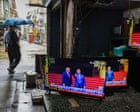
The neon lights of Taipei’s Shilin Night Market hum with a deceptive sense of permanence. Steam rises from vats of pork broth. Scooters weave through narrow alleys, their engines creating a familiar, comforting din. To the average tourist, this is a vibrant democracy at peace. But to anyone watching the geopolitical horizon, the air feels heavy, like the breathless quiet before a summer typhoon.
In a quiet apartment overlooking the Tamsui River, a semiconductor engineer named Chen—a hypothetical personification of Taiwan’s vital tech workforce—stares at a cleanroom monitor. His daily reality is measured in nanometers. He manipulates silicon chips so small and sophisticated that they power everything from the smartphone in your pocket to the guidance systems of advanced military aircraft. Chen’s livelihood, and the economic heartbeat of his country, relies on a fragile status quo. It is a status quo built not on absolute certainty, but on a carefully engineered diplomatic dance known as strategic ambiguity.
For decades, Washington has maintained a deliberate fog regarding Taiwan. The policy was simple yet brilliant: don't explicitly promise to defend Taiwan, but don't say you won't. This kept Beijing guessing and Taipei from doing anything rash. It was a diplomatic tightrope walk that preserved peace.
Then came the microphones.
The Rhetoric of the Transaction
When Donald Trump began publicizing his views on Taiwan, the delicate glass architecture of cross-strait diplomacy rattled. His statements weren't delivered in the calculated, cautious dialect of the State Department. They were delivered in the raw language of a real estate closing.
He pointed out that Taiwan is 9,500 miles away from the United States, while China is a mere 68 miles away. He suggested that Taiwan should pay the United States for its defense, comparing the geopolitical alliance to an insurance policy. He openly questioned the value of defending a distant island, suggesting that Taiwan had "stolen" America's microchip business.
To a domestic audience focused on economic nationalism, these remarks sound like common sense business logic. Why should American tax dollars protect a wealthy tech hub halfway across the world?
But geography and economics tell a far more brutal story. The idea that Taiwan stole the microchip industry is a fundamental misunderstanding of supply chain evolution. Taiwan didn't steal the industry; they built it through decades of immense capital investment, relentless work ethic, and strategic foresight. Today, Taiwan Semiconductor Manufacturing Company (TSMC) produces over 90 percent of the world’s most advanced microchips.
If that supply chain breaks, the global economy does not merely slow down. It halts.
Consider what happens next if that silicon lifeline is severed. The assembly lines in Detroit stop. Medical imaging equipment in European hospitals goes dark. Data centers powering the global internet face immediate shortages. A conflict over Taiwan is estimated to cost the global economy around 10 trillion dollars—approximately 10 percent of global GDP. That eclipses the economic damage of the COVID-19 pandemic and the 2008 financial crash combined.
This is not a simple insurance policy. It is the foundational infrastructure of the modern world.
The View from Beijing
While Western analysts dissect these transactional statements for domestic political implications, a different group of strategists reads them with intense focus. In Beijing, ambiguity is not viewed as a puzzle to solve. It is viewed as an obstacle to overcome.
Chinese leadership operates on long-term historical timelines. Their goal regarding Taiwan—which they view as a breakaway province—is reunification. Ideally, through coercion short of war. For Beijing, the greatest deterrent against a military blockade or invasion has always been the unpredictable nature of American intervention. If China believes the U.S. will fight, the cost of invasion remains too high.
When an American leader treats a security guarantee as a negotiable business contract, the calculus shifts dangerously.
Imagine a poker game where one player openly complains about the cost of the ante and hints that they might fold if the betting gets too high. The opposing player doesn't need to see the cards to know how to play the hand. They aggressive push. They test boundaries.
Beijing exploits these shifting remarks by painting the United States as an unreliable partner. Chinese state media routinely broadcasts a specific narrative to the Taiwanese public: When crisis comes, Washington will abandon you. You are just a chip on a bargaining table.
This psychological warfare aims to erode Taiwan’s domestic resolve. If the population believes their democratic allies view them merely as an expensive liability, the willpower to invest in their own defense begins to fracture. The danger isn't just a sudden, dramatic invasion. The danger is a slow, suffocating gray-zone campaign of cyberattacks, naval blockades, and disinformation that forces Taiwan to capitulate without Beijing ever firing a single shot.
The Illusion of Distance
The argument of physical distance—the 9,500 miles between Washington and Taipei—is an illusion born of a bygone era. In the 21st century, the Pacific Ocean is no longer a moat. It is a highway.
The global economy is a nervous system. Strike a nerve in the Taiwan Strait, and the pain is felt instantly in the American heartland. If a conflict erupts, it will not be confined to a distant island. It will manifest as empty store shelves, skyrocketing inflation, collapsing retirement portfolios, and immediate job losses across every sector that relies on digital technology.
Furthermore, the stability of the entire Indo-Pacific region rests on the perception of American credibility. Countries like Japan, South Korea, and the Philippines watch these rhetorical shifts with growing anxiety. They have tethered their security to American promises. If those promises are revealed to be contingent on a quarterly cost-benefit analysis, these nations face a terrifying choice: arm themselves with nuclear weapons, or align themselves with Beijing.
The collapse of the American alliance system would rewrite the global order, creating a sphere of influence where might makes right, and smaller democracies exist only by the sufferance of their larger neighbors.
The Cost of the Word
Words spoken on the international stage are not mere rhetoric. They are currency. They buy stability, or they purchase chaos.
When American policy shifts from principled commitment to unpredictable transactionalism, it creates a vacuum. In geopolitics, a vacuum is always filled by the most aggressive actor in the room. Beijing does not need to launch a fleet of warships tomorrow to exploit this rhetoric. They simply need to wait, watch, and steadily tighten the noose, confident that the Western commitment to freedom has a price tag.
Back in Taipei, the night market continues to bustle. Families laugh over plates of fried rice, and young couples walk hand-in-hand past glowing storefronts. They understand the danger they live with every day, but they choose to build a society defined by openness, innovation, and freedom anyway.
They are doing their part. The question is whether the architects of the international order still understand that some things cannot be quantified on a balance sheet, and that the truest way to avoid a costly war is to show an unshakeable, unmistakable willingness to prevent it. Instead, the world watches the shifting rhetoric, waiting to see if a historic democracy will be treated as a partner in freedom, or merely an asset to be liquidated.