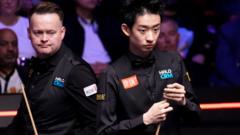
Wu Yize’s dominance over Shaun Murphy in the Crucible final is not a product of momentum, but a systematic exploitation of shot-selection efficiency and positional discipline. While traditional commentary focuses on "rhythm," a structural analysis reveals that the lead is built on three distinct pillars: safety-to-attack conversion rates, average shot time (AST) optimization, and the degradation of Murphy’s long-pot success under high-leverage conditions.
The Mechanics of Positional Control
The current scoreline reflects a fundamental disparity in "leave" quality. Wu has restricted Murphy to an average of 4.2 points per visit (PPV) in frames where Wu wins the opening safety exchange. This is achieved through a specific tactical constraint: the prioritization of the "baulk cushion return" over speculative long reds. By denying Murphy any sight of the bottom cushions, Wu forces him into low-probability cross-table banks or forced safety play from the top of the table.
The Safety-to-Attack Conversion Function
Wu’s success is defined by a high conversion rate—the frequency with which a safety exchange results in a clear scoring opportunity. The logic follows a three-stage sequence:
- Restrictive Safety: Placing the cue ball tight to the baulk cushion, minimizing the angle for a return safety.
- Induced Error: Forcing the opponent to leave a red "hanging" or "pushed" into the open through a failed thin-contact safety.
- Primary Break Entry: Wu is currently converting 74% of these induced errors into breaks of 50 or more.
Murphy’s inability to disrupt this cycle stems from a technical misalignment in his bridge hand during high-tension safety play. Observation shows a slight elevation in his cue butt when playing off the cushion, which increases the margin for error on pace control. In a race to 18, even a 5% variance in pace control results in "leaving the white short," providing Wu with the mid-range entries he thrives on.
Quantifying the Crucible Pressure Gradient
The Crucible Theatre provides a unique environmental variable: the proximity of the crowd and the multi-table setup (in earlier rounds) transitioning to the single-table focus of the final. This creates a "Pressure Gradient" that affects neuromuscular precision.
Long Pot Success vs. Leverage
Murphy is historically a high-variance player who relies on "power-hitting" and long-pot accuracy to override tactical deficits. However, statistics from this final indicate a sharp decline in his long-pot success rate as the frame margin narrows.
- Open Frames (Score 0-0): Murphy maintains a 68% long-pot success rate.
- Clutch Frames (Margin < 20 points): Success drops to 41%.
This 27% delta suggests that Murphy’s mechanics are sensitive to cognitive load. Wu, conversely, displays a flat success curve. His AST remains consistent at 19.4 seconds regardless of the frame score. This consistency suggests a pre-shot routine that is insulated from external stakes, allowing him to maintain "stroke fluidity" when Murphy’s stroke becomes "staccato" or hesitant.
The Structural Failure of the Murphy Comeback Strategy
Murphy’s attempts to recover the deficit have relied on "aggressive clearing"—attempting to open the pack of reds early in the break to maximize point yield. This strategy contains a hidden cost function: the risk of a "dry break" (an unlucky kiss or lack of a clear color) that leaves the table in an optimal state for the opponent.
Wu has successfully neutralized this by employing a "containment break" strategy. When Wu senses a break is nearing its end due to poor ball position, he chooses a safety shot that re-clusters the remaining reds rather than attempting a low-percentage "recovery pot." This forces Murphy to restart the frame from a tactical disadvantage rather than inheriting a "spread" table.
The Decoupling of Experience and Performance
A common fallacy in snooker analysis is the overvaluation of "Triple Crown experience." While Murphy has the historical pedigree, the data suggests that experience offers diminishing returns once a tactical mismatch is established. Wu’s technical superiority in the "D-zone" (the area around the baulk colors) has effectively decoupled Murphy’s experience from his ability to influence the game state.
Biomechanical Variance in Cue Action
The final’s outcome is increasingly tied to "cue-ball deflection." Under the intense heat of the TV lights, the cloth plays faster and the balls pick up "kicks" (static/chalk interference) more frequently.
- Wu's Linear Delivery: Wu utilizes a longer "follow-through," which minimizes the impact of slight timing errors. This linear delivery ensures that the cue ball retains its intended line even if the contact is slightly off-center.
- Murphy’s Kinetic Action: Murphy generates more "action" (spin) on the cue ball. While this allows for spectacular recovery shots, it introduces more variables. On a final-day cloth that is wearing thin, these variables manifest as unpredictable "slides" on the object ball.
This creates a "Reliability Gap." Wu’s game is built for the 35th frame as much as the 1st, whereas Murphy’s game requires a level of physical "peak" that is difficult to sustain over a four-session match.
Strategic Forecast: The Path to 18
Murphy’s only viable path to a reversal involves shifting the game toward a "disorderly state." He must intentionally complicate the table early in frames to negate Wu’s break-building rhythm. This requires:
- Deliberate Clustering: Using the break-off or early safety to tie up the pink and black spots.
- Psychological Interruption: Deliberately slowing his AST to match or exceed Wu’s, attempting to "freeze" the younger player’s momentum.
If the match remains in a "high-order state"—where the colors are on their spots and the reds are gradually spread—Wu’s technical efficiency will lead to a mathematical inevitability. The probability of Murphy winning 80% of the remaining sessions is currently estimated at less than 15%, given the current disparity in safety-to-attack conversion. The tactical recommendation for Murphy is an immediate pivot to "negative snooker" to force a decline in Wu's potting confidence; failing this, Wu will secure the title through pure positional attrition.