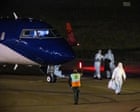
Public health officials love a good costume drama. The sight of Australians being paraded across a Dutch tarmac in full-body hazmat suits, goggles, and respirators isn't just an overreaction; it is a fundamental misunderstanding of viral pathology designed to soothe a terrified public rather than address a medical reality. The "Hantavirus Cruise" narrative has become a masterclass in bureaucratic panic. We are watching the medical equivalent of security theater, where the cost of the performance far outweighs the benefit of the protection.
The "lazy consensus" here is that more gear equals more safety. The media looks at a person in a white Tyvek suit and sees a professional containment strategy. I look at that same person and see a victim of administrative cowardice. These passengers are being treated like biological weapons when, in reality, they are victims of a specific, non-respiratory transmission chain that doesn't care about a plastic face shield on a pressurized plane.
The Transmission Myth Dismantling the Airborne Lie
Hantaviruses are not COVID-19. They are not the flu. They are not even particularly good at jumping from human to human. To treat a group of evacuees as if they are shedding an airborne plague is to ignore forty years of virology.
Hantavirus Pulmonary Syndrome (HPS) or Hemorrhagic Fever with Renal Syndrome (HFRS) is primarily a zoonotic issue. You get it from breathing in aerosolized droppings, urine, or saliva of infected rodents. You do not get it from sitting next to "Aussie Dave" in row 14 while he eats a bag of peanuts. While rare cases of human-to-human transmission have been documented with the Andes virus strain in South America, the strains typically associated with European rodent populations and maritime environments do not operate this way.
By forcing passengers into full PPE for a flight, authorities are signaling that the air itself is toxic. It isn't. This creates a "false positive" of fear. When we over-respond to low-risk scenarios, we deplete the public's psychological reserves for when a genuine respiratory threat emerges. We are crying wolf with N95 masks.
The Cruise Ship Crucible Why the Boat Was the Only Real Threat
The mistake wasn't how we got them off the ship; it was how we allowed the ship to become a Victorian-era pesthole in the first place. A cruise ship is a closed ecological system. If you have a rodent infestation on a vessel, you have a concentrated vector environment. The HVAC systems, the crawl spaces, and the food storage areas become the perfect breeding ground for the virus.
The real failure here is maritime hygiene, not aviation safety. The focus on the "secure plane" and the "specialized crew" is a distraction from the fact that a multi-million dollar vacation vessel failed basic sanitary protocols. I have consulted on logistics for high-risk transport, and the most dangerous part of any evacuation is the transition. Forcing elderly passengers into restrictive, heat-trapping gear for a long-haul flight back to Australia increases the risk of dehydration, syncope, and cardiovascular stress—all for a negligible reduction in a transmission risk that barely exists in a cabin environment.
Logistics of Fear vs. Logistics of Science
Let’s look at the "Secure Plane" protocol. The media reports this as a "specialized" aircraft. In technical terms, it’s a standard charter with the HEPA filters dialed up and a crew that’s been told they’re flying into a war zone.
- HEPA Filtration: Modern aircraft already cycle air through medical-grade HEPA filters every 2-3 minutes. These filters capture 99.97% of particles. The virus is already contained by the machinery of the plane itself.
- PPE Fatigue: Wearing a full gown and mask for 20+ hours is physically grueling. It leads to mistakes. A passenger adjusting a mask because they can’t breathe is more likely to touch their face and mucous membranes than a passenger who is comfortable and following standard hand-hygiene protocols.
- The "Clean" Zone Illusion: By creating a "dirty" plane, you centralize the anxiety. You treat the interior as a biohazard, which means the crew treats the passengers as "the infected." This erodes the quality of care and monitoring.
Imagine a scenario where we treated this with clinical logic instead of optics. You test the passengers. You isolate the symptomatic. You provide the asymptomatic with standard surgical masks (for peace of mind) and rigorous hand-sanitizing stations. You fly them home in comfort. The risk to the Australian public remains the same: virtually zero.
The Cost of the Performance
We are spending millions on this extraction. Every "secured" flight, every specialized hazmat cleaning crew, and every kilometer of plastic sheeting used to "wrap" the arrival gates comes out of a budget that should be spent on early detection and maritime regulation.
We’ve seen this before. In the early days of Ebola, the fear of the "invisible killer" led to similar overkill in areas where the risk was localized. We are repeating the error. We are prioritizing the image of safety over the mechanics of health.
If you are one of those Australians on that flight, the PPE isn't for you. It's for the cameras. It's to show the voters back home that the government is "doing something." But "doing something" is not the same as doing the right thing. The right thing would have been a quiet, medically-informed transport. Instead, we got a sci-fi movie.
The Wrong Questions We Keep Asking
People keep asking, "Are we safe from the cruise ship virus?" That is a flawed premise. You were never at risk from the passengers. You are at risk from the systemic failure of international maritime health standards that allows rodents to thrive in luxury environments.
Another common query: "Can Hantavirus start a new pandemic?" No. Its biology is too tied to its rodent host. It doesn't "want" to be in humans; we are accidental dead-ends for the virus. Treating it like the next global respiratory collapse is scientifically illiterate.
Stop looking at the hazmat suits. Start looking at the inspection reports of the ships. Stop applauding the "secure flight" and start questioning why we are wasting resources on a viral masquerade.
The suit isn't a shield. It’s a blindfold.