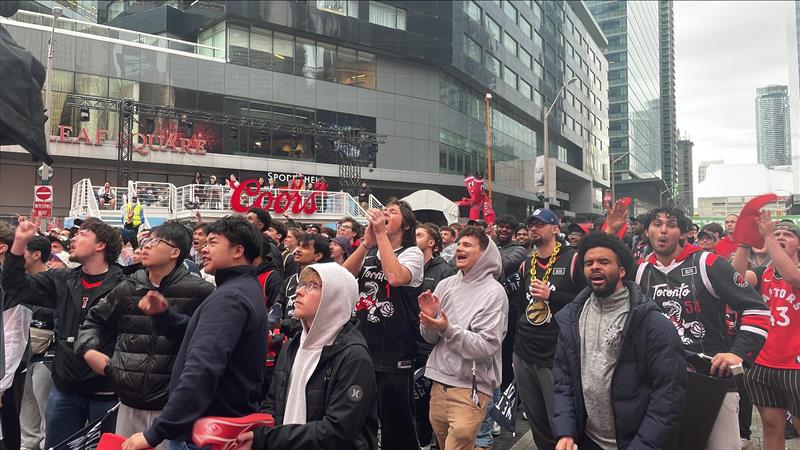
The Toronto Raptors’ Game 1 loss to the Cleveland Cavaliers serves as a case study in the divergence between regular-season volume and post-season efficiency. Toronto’s return to the playoffs was characterized by high-intensity defensive rotations and transition scoring, yet these elements failed to neutralize Cleveland’s superior spacing and high-leverage shot-making. The outcome was not the result of a single tactical error but a systemic failure to account for three specific variables: half-court offensive stagnation, the "LeBron Variance" in defensive assignments, and the breakdown of second-unit continuity under playoff pressure.
The Half-Court Efficiency Bottleneck
During the regular season, Toronto thrived on transition opportunities and second-chance points. In a playoff environment, the pace slows, and the value of a reliable half-court set increases exponentially. The Raptors’ offense displayed a critical lack of "gravity"—the ability of a player to pull defenders away from the rim—which allowed the Cavaliers to pack the paint and dare Toronto to win from the perimeter. If you liked this post, you might want to read: this related article.
This bottleneck is defined by the Offensive Flow Rate, a measure of how effectively a team moves the ball through multiple "actions" (screens, cuts, and hand-offs) before a shot is taken. In Game 1, Toronto’s flow rate plummeted in the fourth quarter. The reliance on isolation plays for DeRozan and Lowry created a predictable rhythm that Cleveland’s defense exploited through late-clock doubling.
The structural flaw here is the Spacing Coefficient. When non-shooters occupy the floor simultaneously, the geometry of the court shrinks. Cleveland effectively ignored Toronto’s interior presence to shade toward the primary ball-handlers, creating a high-density defensive shell that neutralized Toronto’s ability to penetrate the lane. For another look on this event, see the latest update from Bleacher Report.
Strategic Asymmetry in Defensive Rotations
The primary defensive challenge for Toronto was the management of LeBron James, a variable that demands a "bend-but-don't-break" philosophy. Toronto’s strategy involved a heavy mix of man-to-man coverage with occasional "stunting" from the weak side. However, this approach triggered a secondary crisis: the abandonment of Cleveland’s perimeter shooters.
The Trade-off of Aggressive Doubling
When Toronto committed two defenders to the ball-handler, they accepted a calculated risk that the "skip pass" would not find an open shooter in time for a recovery. Cleveland’s roster is constructed to punish this exact gamble. By forcing rotations, the Cavaliers generated high-quality looks from the corners—the most efficient three-point locations in basketball.
- Primary Containment: Tasking a single defender with neutralizing a superstar is statistically improbable. Toronto’s failure was not the individual defense but the lack of a "scram" switch—a pre-emptive rotation that prevents mismatches before they occur.
- The Recovery Lag: The time it takes for a defender to close out on a shooter determines the shot's expected value (xV). Toronto’s close-outs were consistently 0.5 to 0.8 seconds too slow, a margin that transforms a contested shot into an open practice jumper.
Bench Production and the Depth Paradox
Toronto’s "Bench Mob" was a statistical anomaly during the regular season, often outperforming the starting units of opposing teams. The playoff transition, however, revealed the Depth Paradox: the diminishing returns of a deep bench when rotations tighten and star players see 40+ minutes of action.
The second unit’s success was predicated on a frantic, high-energy style that disrupted second-tier opponents. Against a disciplined Cleveland veteran core, this energy was channeled into unforced errors. The lack of a "release valve" in the second unit—a player capable of creating their own shot when the system breaks down—meant that any period without Lowry or DeRozan on the floor resulted in a net negative rating.
Quantifying the Experience Gap
Experience in a playoff context is often discussed as a vague intangible, but it can be quantified through Poise Metrics, such as turnover percentage under pressure and the ability to execute ATO (After Timeout) plays. Cleveland’s execution in the final five minutes of the game showed a significant delta compared to Toronto.
The Cavaliers operated with a high degree of Decision-Making Certainty. Every pass had a destination, and every screen had a specific intent to create a mismatch. Toronto, by contrast, appeared reactive. The emotional weight of the playoff return manifested in "rushed" offensive cycles, where shots were taken early in the clock without the benefit of a defensive breakdown.
The Mechanics of Rebounding and Interior Dominance
While Toronto’s frontcourt possesses length, it struggled with Box-out Consistency. Rebounding is frequently viewed as an effort metric, but it is actually a spatial positioning problem. Cleveland utilized "long rebounds"—those resulting from three-point misses—to bypass Toronto’s interior strength.
By pulling Toronto’s big men out to the perimeter to defend high pick-and-rolls, Cleveland cleared the path for their guards to crash the boards. This creates a Transition Vulnerability: when a center is on the perimeter during a shot, they are out of position to stop a fast break in the opposite direction. Toronto was consistently caught in this "no-man's land," leading to easy buckets for Cleveland that deflated Toronto’s momentum during crucial runs.
Psychological Momentum and the Home Court Variable
The narrative of "LeBronto" is a psychological hurdle that cannot be ignored, yet its impact is rooted in tactical repetition. When a team repeatedly falls to the same opponent using the same methods, a "learned helplessness" can infect the tactical execution.
The home-court advantage for Toronto was neutralized by an early deficit. In playoff basketball, the first six minutes of the game set the Energy Baseline. By allowing Cleveland to dictate the tempo and physicality early, Toronto was forced into a "chase" mindset. This leads to higher fatigue levels, as the trailing team must exert 120% effort to recover, leaving them depleted for the high-leverage moments of the fourth quarter.
Immediate Tactical Adjustments
For Toronto to salvage the series, the coaching staff must shift from a reactive to a proactive defensive stance. This requires:
- Shortening the Rotation: The regular-season depth is now a liability. Minutes must be concentrated among the top seven players who can maintain defensive discipline for extended stretches.
- The "Middle" Screen Strategy: Instead of high screens that allow the defense to recover, Toronto needs to set screens lower in the paint to force Cleveland’s bigs into lateral movement, where they are least effective.
- Aggressive Hunting of Mismatches: Cleveland’s backcourt is vulnerable on the block. Toronto must force their guards to defend in post-up situations, drawing fouls and disrupting Cleveland’s offensive rhythm through physical attrition.
The series is not lost on a single game, but the structural deficiencies exposed in Game 1 suggest that without a fundamental shift in the Spacing Coefficient and defensive recovery timing, Toronto will remain trapped in a cycle of high-effort, low-reward basketball. The path forward demands a clinical removal of low-efficiency mid-range shots in favor of a high-volume rim attack, forcing the officials to dictate the physicality of the game.


