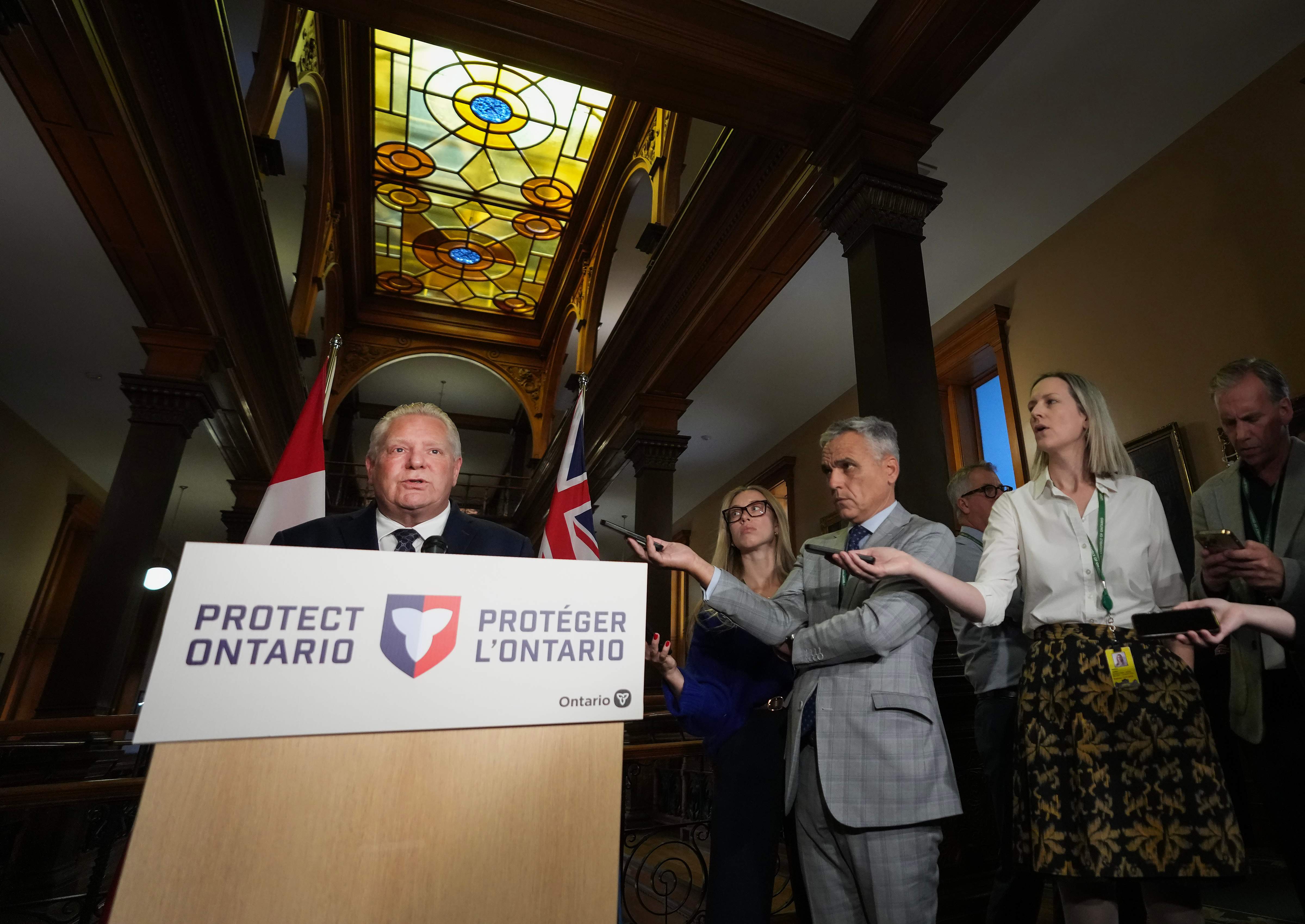
Political capital functions as a finite reserve, depleted by friction and replenished by transparency. When Ontario Premier Doug Ford addresses the press regarding the intersection of private travel logistics and internal polling inquiries, he is not merely defending a schedule; he is managing a crisis of institutional credibility. The current friction stems from a failure to align executive actions with the expectations of public accountability. This analysis deconstructs the mechanics of this controversy, examining the logistical optics of private aviation and the strategic utility of partisan polling within a taxpayer-funded framework.
The Logistics of Executive Mobility and the Optics of Separation
The use of private aviation by public officials is rarely a matter of simple transportation. It is a calculation of efficiency versus optics. For a high-level executive, time is a non-renewable resource, and the use of private craft is often justified through the lens of operational security and the ability to conduct sensitive business in transit. However, in the public sector, this efficiency creates a "Perception Gap"—a measurable distance between the lifestyle of the representative and the lived reality of the represented.
The Friction Points of Private Aviation
- The Cost-Benefit Asymmetry: While a private flight might save four hours of travel time, the political cost of that saved time is often disproportionately high. If the flight is gifted or subsidized by stakeholders, it introduces a "Dependency Variable" that suggests a conflict of interest, regardless of whether a quid pro quo exists.
- Regulatory Compliance vs. Moral Hazard: Following the letter of the law regarding travel disclosure does not insulate a leader from the moral hazard of perceived elitism. When the public perceives a leader as physically separated from the infrastructure they manage (e.g., public transit or commercial airports), it erodes the "Shared Experience" necessary for populist messaging.
The mechanism at work here is the Proximity Principle. A leader's authority is tied to their perceived proximity to the challenges faced by their constituents. Private jets serve as a physical and symbolic barrier to that proximity, creating a vacuum that opposition narratives quickly fill.
The Strategic Architecture of Internal Polling
The second pillar of the current controversy involves the use of polling data. In modern governance, polling is the "Market Research" of policy. It allows an administration to test the viability of a proposal before deployment. The tension arises when the line between governing (understanding public needs) and campaigning (securing partisan advantage) becomes blurred.
Categorizing the Polling Function
To analyze the Ford administration's use of data, we must categorize polling into three distinct functional buckets:
- Policy Feedback Loops: Legitimate data collection used to determine if a specific program (e.g., healthcare expansion or infrastructure spending) is meeting the needs of the population.
- Narrative Optimization: Data used to determine which words or phrases resonate best with the public to sell a pre-determined policy.
- Partisan Survivalism: Data used to identify wedge issues or assess the favorability of the leader against specific opponents.
The controversy intensifies when taxpayer resources are funneled into the third category. From a data-driven perspective, the "Misallocation Risk" occurs when the civil service—which is designed to be non-partisan—is used to gather intelligence that serves only the political survival of the incumbent party.
The Mechanism of the News Conference as a De-escalation Tool
A news conference is a high-stakes information exchange. For an embattled leader, it serves as a "Pressure Release Valve." The objective is not necessarily to provide new information, but to regain control over the narrative flow.
The Strategy of Controlled Disclosure
The Ford administration's approach typically follows a pattern of incremental admission. By holding a news conference, the executive branch attempts to:
- Exhaust the News Cycle: By answering questions in a marathon session, they aim to reach a point of "Audience Fatigue," where the public loses interest in the repetitive nature of the inquiry.
- Pivot to Economic Fundamentals: The strategy often involves acknowledging the "distraction" of travel or polling and immediately pivoting to "The Big Three" metrics: job growth, housing starts, and infrastructure investment.
- Assert Executive Vitality: Appearing before the press is a signal of strength. It suggests that the leader is not "hiding," even if the answers provided are obfuscated or incomplete.
This creates a Stall Maneuver. By providing just enough detail to satisfy legal requirements, the administration prevents the "Friction" from reaching a critical mass that would require a formal inquiry or a resignation.
The Cost Function of Institutional Secrecy
Every withheld document or refused answer carries a "Hidden Interest Rate." While secrecy may provide short-term tactical advantages by preventing the opposition from gaining ammunition, it builds long-term institutional debt.
The Debt Accumulation Process
- Phase 1: Erosion of Neutrality: When the public begins to view government data (polling) as a partisan weapon, the credibility of all government data—including economic reports and health statistics—decreases.
- Phase 2: Increased Oversight Friction: In response to opacity, legislative and judicial bodies often implement more stringent oversight. This increases the "Administrative Load" on the government, making it slower and more expensive to operate.
- Phase 3: The Credibility Cliff: Eventually, the gap between official statements and public perception becomes so wide that the administration loses its ability to lead during a genuine crisis.
The current situation with Ford represents a late-stage Phase 1 or early-stage Phase 2 scenario. The persistence of questions regarding private jets and polling indicates that the "Interest Rate" on previous secrets has become unsustainable.
Quantifying the Political Fallout
To measure the impact of these controversies, analysts look at the Trust Delta. This is the difference between the government’s approval rating on "Service Delivery" (the ability to build roads/hospitals) and its rating on "Ethical Conduct."
When the Trust Delta is narrow, an administration can survive individual scandals. When the Delta is wide—meaning the public likes the results but dislikes the methods—the government becomes vulnerable to a "Character Narrative." In Ford’s case, the insistence on focusing on "getting things built" is a deliberate attempt to keep the public’s attention on Service Delivery to compensate for the Ethical Conduct deficit.
The Variable of Timing
The impact of these revelations is non-linear. Information released two years before an election is "Discounted" by the electorate. Information released six months before an election is "Compounded." The administration’s current strategy is to absorb the hit now, betting that the "Recency Bias" of the voters will prioritize new infrastructure projects over year-old travel logs by the time the next ballot is cast.
The Strategic Path Forward
To resolve the current deadlock and stabilize the institutional reserve of political capital, a shift from defensive posturing to structural transparency is required. This involves three specific tactical adjustments:
- Establishment of a "Travel Clarity Protocol": Instead of reacting to leaks, the administration should proactively publish travel logs and flight manifests within 48 hours of any non-commercial flight. This eliminates the "Discovery Reward" for investigative journalists.
- Bifurcation of Polling Resources: A clear, audited firewall must be established between the Premier’s Office (partisan) and the Cabinet Office (non-partisan). All taxpayer-funded polling must be made public by default after a 90-day cooling period to ensure it is being used for policy development rather than campaign strategy.
- Direct Engagement with the Logistics Gap: Rather than dismissing concerns about private jets as "political games," the administration should provide a detailed "Time-Value Analysis" for each trip. Quantifying the hours saved and the specific meetings enabled would shift the debate from a moral one to an operational one.
The persistence of the "polling questions" and the "private jet" narrative is a symptom of an information asymmetry. Until the Ford administration provides the data necessary to bridge this gap, the friction will continue to degrade the efficiency of their legislative agenda. The ultimate play is not to win the news conference, but to render the news conference unnecessary through systemic disclosure.