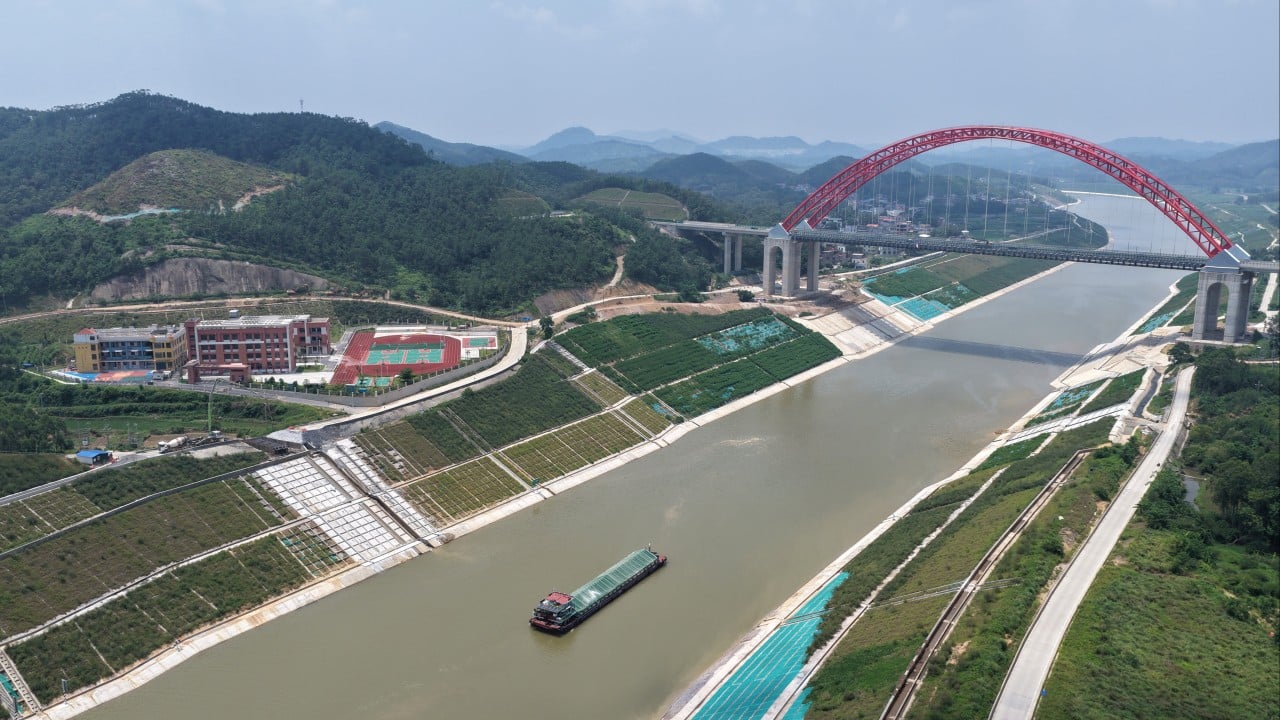
Geopolitical shifts rarely announce themselves with a gunshot. More often, they arrive with the steady mechanical roar of dredging vessels carving a new artery through the earth. The completion of the Pinglu Canal project in southern China represents a monumental engineering feat, yet the true story lies far beyond cubic meters of excavated soil or concrete locks. This 134-kilometer waterway reengineers the economic geography of the Pearl River Delta, directly altering how goods move from China's southwestern industrial heartlands toward the Beibu Gulf and international shipping lanes.
For decades, the standard economic trajectory for cargo originating in provinces like Guangxi relied entirely on navigating eastward along the Xijiang River system toward Guangzhou or Hong Kong before finding open water. That route is long, congested, and politically tethered to established municipal trade hubs. By slashing the transport distance to the sea by more than five hundred kilometers, the Pinglu Canal provides a direct maritime exit strategy for a region that has historically lagged behind coastal manufacturing powerhouses. The canal allows heavy freighters to bypass congested transit bottlenecks, fundamentally cutting logistics costs for heavy machinery, minerals, and manufactured goods.
While state media highlights export efficiency and regional integration, the quieter reality involves a calculated redistribution of economic gravity. Hong Kong, long accustomed to acting as the primary financial and logistical tollbooth for southern mainland commerce, faces an evolving landscape. The announcement of Hong Kong's first comprehensive five-year economic blueprint arrives at a moment when the city is actively repositioning its identity. It is no longer just a passive entrepôt for mainland trade. Instead, policymakers are attempting to anchor the territory as an innovation cluster, a green finance capital, and a high-value professional services hub that can survive the decentralization of physical freight.
The divergence between these two regional developments tells a larger story about infrastructure as an instrument of statecraft. Beijing is systematically decentralizing maritime dependence, ensuring that alternative corridors exist outside traditional, historically sensitive ports. When cargo can flow seamlessly from Nanning down to the Beibu Gulf and out toward Southeast Asian markets without touching traditional delta checkpoints, the entire commercial map of the region redraws itself.
Logistics executives and supply chain analysts have spent months modeling the cost-per-ton advantages of the new waterway. Early projections suggest savings that will incentivize regional manufacturers to relocate inland factories closer to the canal terminals, chasing lower land and labor costs while retaining rapid access to international shipping routes. Yet, every grand infrastructure project inherits complex externalities. Environmental management along the canal basin requires relentless oversight to prevent ecological degradation of local river ecosystems, and the long-term maintenance of locks on this scale demands continuous technological investment.
Simultaneously, Hong Kong's strategic planning pivots toward integration with the broader Greater Bay Area, attempting to merge its legal and financial architecture with neighboring tech hubs like Shenzhen. This is not merely an exercise in municipal administration; it is an economic defense mechanism. As physical trade routes multiply and modernize elsewhere in the province, a city built on trade intermediation must invent new forms of value.
The transformation of southern trade corridors serves as a stark reminder that physical geography is never permanent. Governments alter it with explosives and cement to serve macroeconomic goals, forcing every surrounding market to adapt or obsolesce. The concrete is dry, the locks are filling, and the race to capture the next era of Asian commerce has officially entered a faster lane.