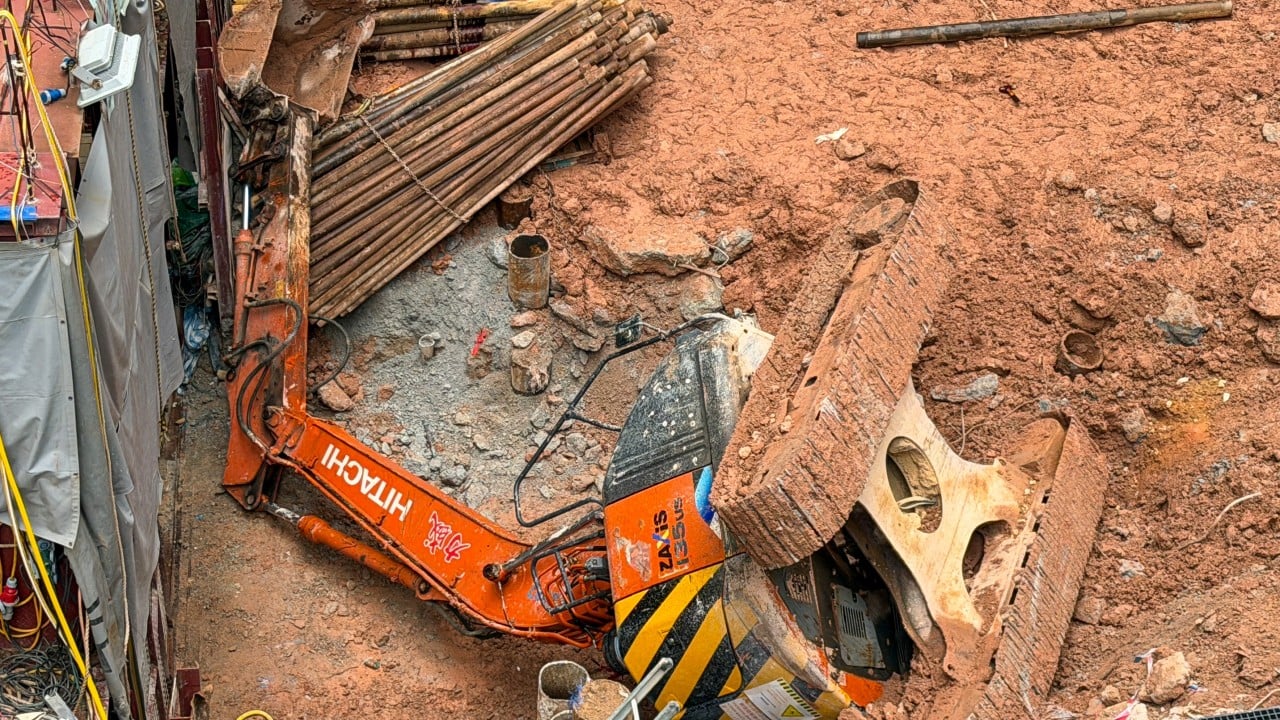
Industrial asset management and site safety protocols fail when mechanical limits intersect with unstable environmental variables. The fatal overturn of a tracked excavator on an inclined urban construction site in Ho Man Tin, Hong Kong, isolates a recurring systemic vulnerability: the miscalculation of structural load thresholds and dynamic ground-bearing capacity.
When heavy machinery operates near its physical thresholds, safety cannot rely on static assumptions. Preventing catastrophic mechanical failure requires a deep understanding of soil mechanics, structural leverage, and operational dynamics.
The Core Triad of Excavator Stability
To understand equipment overturn, operations must be analyzed through a strict mechanical framework. Tracked excavators maintain equilibrium by balancing a counterweight against the combined load of the front attachment, arm, boom, and payload. This balance relies on three distinct variables:
- The Center of Gravity Migration Vector: As the boom extends, elevates, or swings, the machine's global center of gravity shifts dynamically. If this vector moves beyond the outer edge of the tracks, tipping becomes mathematically inevitable.
- The Ground-Bearing Capacity Threshold: Tracked vehicles distribute their weight across a designated surface area to minimize ground pressure. When ground-bearing capacity drops below the pressure exerted by the tracks, the supporting soil shears, destabilizing the machine's platform.
- The Slope Gradient Variable: Operating on an incline reduces the lateral stability margin. The angle of the terrain shifts the baseline center of gravity closer to the lower track edge, reducing the amount of force needed to tip the machine.
                  [Center of Gravity]
                         │
                         ▼
             _________[Machine]_________
            /                           \
           /                             \
     [Track A]                         [Track B]
  (Compacted Soil)                 (Saturated/Loose Soil)
         │                                 │
         ▼                                 ▼
   Stable Support                   Shear Failure / Sinking
The incident in Ho Man Tin involved an excavator lifting heavy iron poles on an inclined surface. This operation triggered a cascade of failures across all three stability variables.
Environmental Saturation and Shear Stress
The structural failure of the ground surface is rarely a sudden event. It is usually the result of changes in the environment, particularly rainfall.
Preceding precipitation alters the shear strength of urban soils. When water fills the spaces between soil particles, it increases pore water pressure. This forces the soil particles apart, drastically reducing the friction between them.
$$\tau = c + (\sigma - u) \tan\phi$$
In this soil mechanics equation, an increase in pore water pressure ($u$) directly reduces the effective stress ($\sigma - u$), lowering the total shear strength ($\tau$). When an excavator moves onto saturated soil, the ground cannot support the weight, causing the track on the lower side of the slope to sink. This sudden shift tilts the machine, moving its center of gravity past the point of recovery.
Rigging Anomalies and Dynamic Load Multiplication
Using an excavator as a crane for long objects like iron poles introduces complex dynamic forces. Unlike a dedicated crane, an excavator lacks a loose-reeved hoist cable that keeps loads perfectly vertical.
EXCAVATOR LIFTING (Rigid/Fixed Hook)     CRANE LIFTING (Loose-Reeved Cable)
          [Boom Tip]                                [Boom Tip]
              │                                         │
              ▼ (Rigid Connection)                      │ (Flexible Cable)
         [Iron Pole]                                    ▼
    (Swinging creates dynamic                     [Iron Pole]
     lateral force vectors)                  (Load remains vertical;
                                              less lateral transfer)
When an excavator swings a load horizontally, the load tends to move outward due to centrifugal force. This increases the load radius and shifts the center of gravity further away from the machine.
If the iron poles catch on an obstruction or swing unevenly, they create sudden lateral forces. Because the connection between the boom and the load is rigid, these forces transfer directly back to the excavator's chassis, increasing the risk of an overturn.
The Failure of Spatial Zoning and Proximity Controls
A critical safety breakdown in heavy equipment operations is allowing personnel to work within the machine's maximum operating radius. In a controlled environment, the space around a lifting operation is divided into strict safety zones:
- The Exclusion Zone: The absolute physical reach of the excavator boom and its payload, plus a five-meter safety buffer. No personnel are permitted in this zone while the machine is active.
- The Spotter Matrix: Dedicated safety personnel positioned outside the exclusion zone with direct radio contact to the operator, tasked with monitoring ground conditions and blind spots.
When a machine tips over and strikes a worker, it proves that the exclusion zone was not maintained. Workers often enter these hazard zones due to compressed project schedules or a lack of clear physical barriers. This places personnel directly in the path of falling equipment or unconstrained payloads.
Operational Blueprints for High-Risk Excavation
To eliminate rollover risks on complex or inclined construction sites, project managers must transition from basic rule compliance to data-driven safety systems.
Digital Ground Verification
Contractors must use portable dynamic cone penetrometers to verify actual ground-bearing capacity at specific operational spots after rain events. Relying on historical site data or visual inspections is insufficient. If soil strength falls below the machine's maximum track pressure under full load, operators must use heavy steel mats to distribute the weight safely.
Live Load-Moment Monitoring
Excavators used for lifting should be equipped with retrofitted Load Moment Indicators (LMI). These systems use sensors on the hydraulic cylinders to measure actual pressures and boom angles in real time. The system provides an early warning as the machine approaches its stability limit, automatically cutting off functions that could worsen the tilt.
Mandatory Physical Exclusion Barriers
Exclusion zones must be enforced using high-visibility physical barriers rather than relying on verbal warnings. Ground personnel should wear wearable proximity tags that trigger an audible alarm in the cabin and log a safety violation if a worker enters the machine's operating radius.
Project managers must recognize that heavy equipment stability changes constantly with environmental conditions. Safety protocols must be as dynamic as the physics governing the machinery.