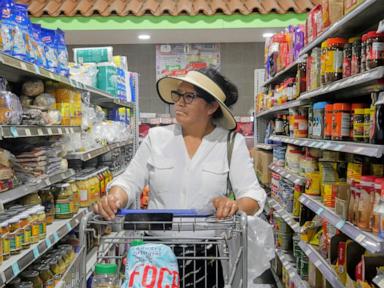
The cart is not heavy. That is the first deception.
It holds a half-gallon of whole milk, a bruised plastic clamshell of strawberries, two loose yellow onions, a pound of ground chuck wrapped in pink butcher paper, and a box of generic cereal. Nothing extravagant. No imported cheeses, no artisanal sourdough, no pre-marinated cuts meant to save time on a Tuesday night. Just the baseline ballast required to keep a small household anchored through another week. Discover more on a similar topic: this related article.
At the register, the cashier moves with the practiced, terrifying speed of a machine. Beep. Beep. Beep. The red laser slices across the barcodes, translating plastic and cardboard into an accumulating tally.
Then comes the number. Additional analysis by MarketWatch delves into comparable perspectives on this issue.
It is always twenty percent higher than the mental math whispered just three minutes ago while staring down an aisle of fluorescent lights. Twenty percent. A quiet tax levied against the act of staying alive.
We are told the storm has passed. For months, the headlines have grown softer. Inflation is cooling. The Federal Reserve has lowered its voice from a panic to a murmur. Gas prices have retreated from their jagged peaks, sliding down highway pylons like melting wax. The macroeconomic dials are turning back toward normal. Economists point to stabilizing indices and moderated consumer price indexes with the calm reassurance of meteorologists tracking a hurricane as it downgrades to a tropical storm.
Yet, the grocery bag remains light while the wallet feels entirely hollow.
To understand why, we have to look past the comforting spreadsheets of Wall Street and stare directly into a phenomenon known to economists by a strangely poetic name, though the reality of it is anything but artful.
They call it the rockets and feathers effect.
Prices shoot upward like rockets when trouble hits. A drought in the Midwest, a disruption in shipping lanes, a spike in global energy costs—and overnight, the cost of flour, milk, and eggs leaps vertically. The justification is immediate, urgent, and broadcast across every news network. Costs are up. Margins are squeezed. Everyone understands.
Gravity, however, behaves differently for the descent. When fuel prices drop, when supply chains unclog, when inflation cools to a respectable baseline, prices drift downward with the lazy, agonizing hesitation of a feather falling through still air. Sometimes, they do not fall at all. They simply settle into their new, inflated altitude, hardening into place like wet cement.
Consider a hypothetical household, the Millers. Sarah and David. Both work, both commute, both watch their bank accounts with the tense vigilance of air traffic controllers. Two years ago, their weekly grocery haul hovered comfortably around one hundred dollars. When inflation surged, that same cart crept to one hundred and forty dollars. Now, with inflation cooling to a manageable two or three percent, Sarah waits for the drop. She waits for the receipt to slide back down to one hundred and ten, or even one hundred and twenty.
It never does.
The cooling rate of inflation does not mean prices are falling. It merely means they are climbing off a cliff at fifty miles per hour instead of eighty. The damage is cumulative. The baseline has shifted, and the ground beneath working families has permanently dropped an inch.
Why does this happen? The answer is not found in malice, exactly, but in the cold, mechanical incentives of modern corporate logistics.
Imagine a sprawling food conglomerate that spans from the Iowa cornfields to the central distribution warehouse in Ohio. When diesel prices spiked, this corporation adjusted its prices upward to protect its profit margins. Consumers paid the toll because eating is not an optional luxury. But when diesel prices eventually fell back to earth, did the corporation pass those savings on to Sarah at the checkout counter?
Rarely.
Instead, corporate leadership faces a different kind of pressure: the relentless, unyielding demand of shareholders for quarterly growth. If a company proved during the crisis that consumers were willing to pay four dollars and fifty cents for a carton of eggs, lowering that price back to three dollars and fifty cents is treated as corporate treason. It is an admission of surrendered revenue.
So, the extra dollar sticks. It gets absorbed into the machinery, padded into executive bonuses, or smoothed over by clever corporate rebranding. The market has a long memory for pain and a short memory for relief.
This asymmetry creates a profound emotional fracture in daily life.
We are living through a strange psychological dissonance. The television tells us the economy is resilient, that jobs are plentiful, that the monster of inflation has been caged. Yet, every single time we walk down the cereal aisle, we are gaslit by a price tag.
We begin to bargain with ourselves. Do we buy the name-brand detergent or the generic soap that smells faintly of industrial solvent? Do we skip the fresh produce this week and rely on canned beans? Do we quietly drop the strawberries back into the refrigerated bin when the total gets too high, pretending we didn't really want them anyway?
This is the invisible tax of the feathers. It strips away the small, dignified choices that make ordinary life feel manageable. It forces constant, exhausting micro-calculations over items that should never require a budget summit.
Economists talk about sticky prices as if they are abstract mathematical anomalies. They are not. They are friction points where human endurance rubs against corporate inertia.
When prices rise like rockets, they exploit our immediate vulnerability. When they fall like feathers, they exploit our exhaustion. By the time a price might theoretically correct itself, we have already adapted. We have absorbed the blow. We have cut somewhere else—canceling a subscription, delaying a car repair, skipping a dentist appointment—to make room for the new normal. The market registers this adaptation not as strain, but as acceptance.
And so the cart rolls forward.
The cashier hands over the long slip of thermal paper. Sarah folds it carefully, without looking at the itemized breakdown, and tucks it deep into her coat pocket. Outside, the parking lot hums with the sound of idling engines and distant traffic. The air is crisp, carrying the undeniable scent of autumn, but the weight in her hands feels entirely separate from the season.
The storm may have passed. The weather reports may be clearing. But down here on the asphalt, in the long shadow of the grocery store, we are still paying for the wind.