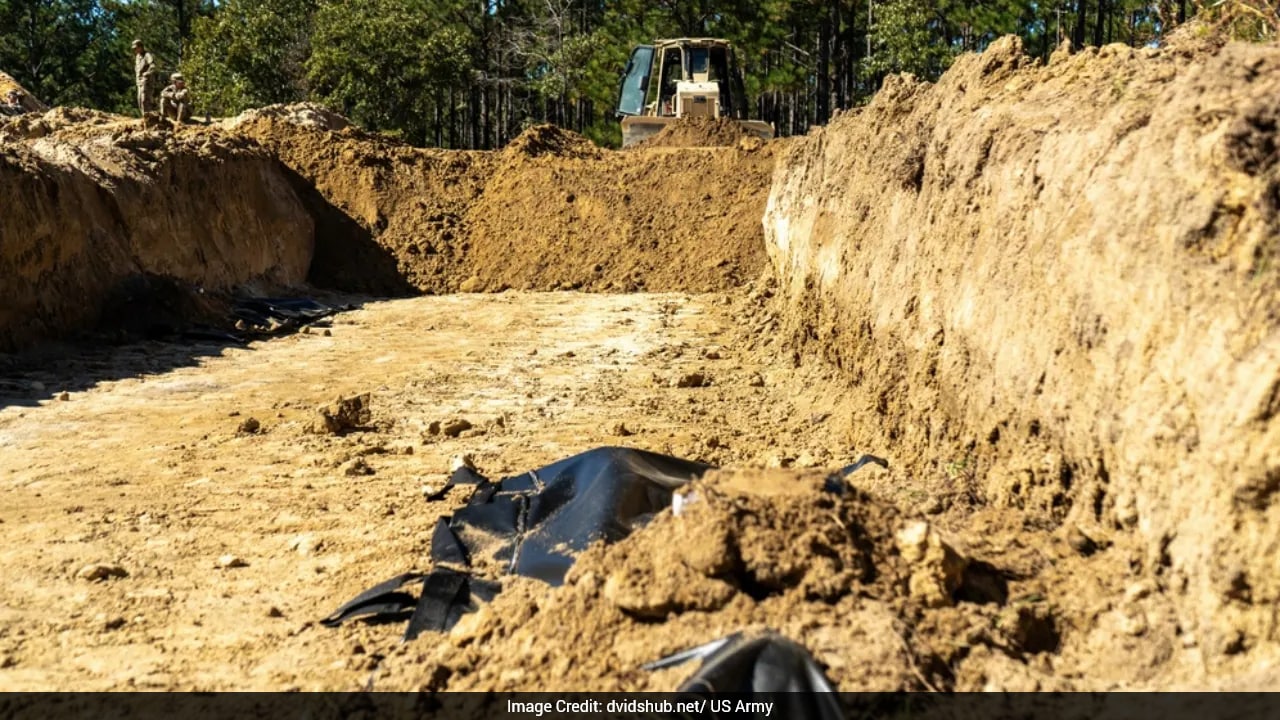
Social media exploded in late October 2026 with headlines claiming the Pentagon was digging mass graves for an imminent war with Iran. The photos were real, taken at Fort Bragg, North Carolina, showing heavy bulldozers carving long dirt trenches in the sand. Yet almost every viral post got the story backward.
The US Army mass burials exercise—officially called Phase II of Operation Dragon Covenant—wasn't a secret preparation for a single looming conflict. It was a long-overdue engineering and mortuary affairs test aimed at fixing a broken military manual that hadn't been field-tested since the Korean War. If you want to understand why American soldiers spent October 2026 practicing temporary battlefield interment, you need to look at military logistics rather than internet panic.
Why the Pentagon Resumed Mass Burial Training After 70 Years
For more than two decades in Iraq and Afghanistan, the US military operated with unchallenged air superiority. When a service member died in combat, helicopters or cargo planes could usually evacuate their remains within hours, routing them through mortuary affairs channels to Dover Air Force Base and home to their families.
That luxury disappears in a high-intensity war against a peer or near-peer adversary. Airspace gets contested. Runways get cratered. Supply lines stretch thin across thousands of miles.
Military planners realized years ago that if major combat broke out today, evacuation flights could be grounded for days or weeks. Without a tested system to temporarily inter the dead on the battlefield, units would be forced to improvise under fire. Improvisation in mortuary affairs leads to lost remains, damaged forensic evidence, and families never getting their loved ones back.
- Contested air and sea lanes mean cargo aircraft won't always reach forward operating bases.
- Mass casualty rates in conventional artillery and drone warfare can quickly overwhelm portable refrigeration units.
- Positive control and preservation require strict mapping, cataloging, and soil management so forensic teams can exhume and repatriate every soldier once fighting stops.
Honestly, the real scandal isn't that the Army ran this drill. It's that nobody ran it for over seventy years while doctrine gathered dust on a shelf.
Inside Operation Dragon Covenant at Fort Bragg
In October 2026, troops from the 3rd Corps Sustainment Command, the 20th Engineer Brigade, and roughly 130 Unit Ministry Team personnel converged near the St. Mere Eglise Drop Zone at Fort Bragg. Their mission was blunt: figure out if the Army's written rules for temporary battlefield burials actually worked in real dirt.
They didn't use real human remains. Instead, engineers placed simulated skeletal models and sealed water containers inside standard burial bags to test whether heavy earthmoving equipment would crush them during backfilling.
The Engineering Math Behind the 2,400-Casualty Headline
Many news outlets ran breathless headlines claiming the US Army practiced burying 2,400 soldiers in a single day. That number came from a planning calculation, not the actual number of simulated bodies placed in the ground at Fort Bragg.
Earlier exploratory trials using standard backhoes had gone poorly, averaging three hours to dig a single trench holding just ten remains. During Phase II of Operation Dragon Covenant, horizontal construction engineers from the 27th Engineer Battalion switched to D6 bulldozers. That single equipment change cut the excavation and backfill time for a 20-remains trench down to an average of one hour and 15 minutes.
Based on that one-hour-and-15-minute benchmark, Army planners calculated what a full engineer company—equipped with eight D6 bulldozers and four High Mobility Engineer Excavators—could accomplish during 24 hours of continuous, around-the-clock operations. The theoretical ceiling came out to 2,400 remains.
Where the Old Army Doctrine Failed
The most revealing part of the Fort Bragg exercise wasn't the headline number. It was discovering that the existing Army manual was physically unworkable.
Written doctrine called for digging five parallel trenches—holding 100 casualties total, with ten laid on each side—separated by seven-foot corridors. When soldiers put D6 bulldozers on the ground, they immediately hit a problem. Seven feet was two feet too narrow for a bulldozer's tracks to maneuver without driving directly over the burial zone.
Engineers had to rewrite the spatial layout on the fly. They widened the trench to 15 feet and left a nine-foot pillar of undisturbed soil between each row. That nine-foot buffer gave the bulldozer a stable center corridor to drive along while casting dirt inward.
Operators also had to master a delicate mechanical trick: keeping the heavy steel blade 18 inches above the ground during backfilling. Instead of pushing dirt down with mechanical force, they let displaced soil fall naturally by gravity. When teams later exhumed the test trenches, the sealed water containers and skeletal models were completely intact.
1st Lt. Connor Thompson, an engineer officer with the 27th Engineer Battalion, pointed out that dry sand in North Carolina behaves nothing like frozen earth, thick clay, or mud. Getting operators actual stick time gave the Army hard data instead of dangerous assumptions.
Is the US Army Mass Burials Drill Linked to Iran
Whenever military logistics make the news during a period of Middle East tension, pundits immediately connect the dots to Tehran. Headlines framed Operation Dragon Covenant as direct proof that Washington was bracing for massive American casualties in a renewed Iran conflict.
Let's look at the actual facts. Neither the 3rd Corps Sustainment Command nor the Department of Defense tied Operation Dragon Covenant to Iran. In fact, multi-phase military exercises of this scale take months or years of bureaucratic scheduling, environmental permitting, and unit coordination before a single bulldozer blade touches dirt.
At the same time, it's naïve to pretend geopolitics plays zero role in why the Pentagon is suddenly obsessed with large-scale combat operations. Whether planners are gaming out scenarios in the Middle East, Eastern Europe, or the Indo-Pacific, the underlying problem is identical. Modern warfare against state adversaries involves ballistic missiles, dense air defenses, and drone swarms that can sever evacuation routes on day one.
Temporary Interment vs Permanent Mass Graves
The phrase "mass grave" carries dark historical baggage, conjuring images of war crimes and anonymous pits. In US military doctrine, temporary battlefield interment is the exact opposite.
Every detail of the Fort Bragg exercise revolved around accountability and future repatriation. Temporary interment is strictly an emergency measure used when tactical conditions make immediate evacuation impossible.
- Exact GPS coordinates and trench diagrams are recorded for every single set of remains.
- Chaplains and Unit Ministry Teams conduct religious rites and blessings at the trench site before backfilling begins.
- Preventive medicine specialists monitor soil depth and drainage to prevent contamination and preserve remains.
- Dedicated recovery teams return once the front line moves or airspace opens, exhuming the temporary plots so every soldier is identified and returned home.
The Army plans to expand this testing in Phase III of Operation Dragon Covenant in spring 2027, adding security elements, field medical facilities, and full mortuary affairs collection points to stress-test the entire chain from battlefield death to repatriation.
How to Read Military Exercise News Without Falling for Clickbait
When viral defense stories hit your feed, a few simple checks will separate genuine strategic shifts from sensationalism:
- Check the primary source on DVIDS. The Defense Visual Information Distribution Service publishes the official unit press releases, unedited photos, and exact exercise names behind almost every viral military story. Reading the original release takes two minutes and strips away partisan spin.
- Distinguish capability math from actual events. Defense reporting frequently confuses theoretical capacity—like what an eight-bulldozer company could dig in 24 hours—with what actually happened during a training afternoon.
- Look at doctrine timelines. When the US military tests procedures last used in the 1950s, it reflects a broad institutional shift toward peer-conflict readiness rather than a secret countdown to a specific invasion.
Pay attention to the logistics, ignore the doomsday framing, and always verify the primary source before sharing defense headlines. For a clear look at the actual footage and breakdown from Fort Bragg, watch Army holds mass grave training for Fort Bragg soldiers, which shows the engineering drill and explains why military planners revived these procedures.