The debate over the United States southern border has completely changed. For years, the conversation centered around a simple physical barrier of concrete and steel. Today, the focus has shifted entirely. The federal government is pouring massive resources into a high-tech dragnet that monitors the desert using computer software.
Congress handed down $46 billion to finish this project. Now, the administration is moving fast. Customs and Border Protection is setting up miles of steel fencing alongside cameras, radars, and autonomous towers. They call it a smart wall.
Many people think the project is just about a physical fence. That is a mistake. The real operation relies on data gathering and automated surveillance.
Tracking the Reality of the 46 Billion Dollar Project
The sheer scale of this funding is hard to comprehend. The money comes via the One Big Beautiful Bill Act. It gives the administration the financial power to ink massive contracts with private defense firms.
The build rate is moving fast. Right now, workers are putting up 6 miles of barrier every single week. Since the president returned to office, crews have added 74 miles of new structures as of mid-June 2026. Homeland Security Secretary Markwayne Mullin stated that a massive chunk of this initial phase will wrap up by this time next year.
It helps to look at the numbers across the entire span of the border.
- Total border length is roughly 2,000 miles.
- No physical fence is planned for 535 miles because the rugged mountain terrain acts as a natural barrier.
- Steel bollard structures stand between 18 and 30 feet tall depending on the location.
- Floating cylinder buoys measuring 12 to 15 feet long line key parts of the Rio Grande in Texas.
The strategy does not just apply to empty spaces. The agency is going back to hundreds of miles of older fencing built years ago. They are installing new lights, grading patrol roads, and adding sensors to old steel poles.
The Software and Sensors Inside the Surveillance Network
The physical fence only exists to slow people down. The real tracking happens through the air and underground. Customs and Border Protection Commissioner Rodney Scott testified that the technology maximizes the efficiency of actual border agents. Instead of sitting in front of computer screens, agents wait for the system to tell them exactly where to go.
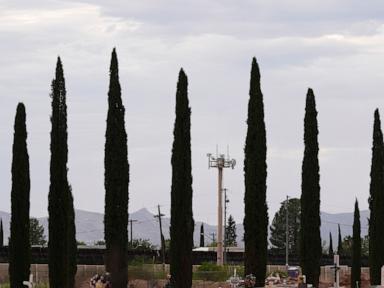
Fixed towers stand along the high ridges of the desert. These towers possess video, infrared night vision, and radar capabilities that can scan out to a range of 8 miles. Many of these units are mounted directly onto the beds of pickup trucks. Agents park them on ridges to change surveillance zones instantly.
Artificial intelligence drives the new hardware. The towers do not just record video for humans to watch later. The built-in software actively scans the environment, flags movement, and determines if a shape is an animal or a human being. Once it detects a person, it beams an alert straight to a field agent's handheld device.
This is not the first time Washington tried this. Back in 2011, under the Obama administration, Homeland Security Secretary Janet Napolitano canceled a virtual wall project. That plan collapsed because it ran way over budget and suffered from constant technical glitches. The current administration believes software has advanced enough to avoid those past failures.
Local Resistance and the Cost of Continuous Watching
Not everyone wants an automated surveillance network in their backyard. Civil liberties groups and border residents are raising alarms about the long-term impact of these tools.
Dave Maass from the Electronic Frontier Foundation points out that the heavy tech presence turns quiet towns into hostile environments for citizens and migrants alike. Landowners are finding hidden cameras tucked into the brush on their private property. A quarter-mile away from residential homes, massive metal towers stand over the riverbanks.
The issues extend to the local environment too. In the Big Bend region of Texas, famous for its completely dark night skies, locals are fighting the installation of high-intensity stadium lighting. Clara Benson of the No Big Bend Wall coalition notes that these massive light banks will ruin the pristine dark skies that draw tourism to the region.
Financial watchdogs are also skeptical. Organizations like Taxpayers for Common Sense question whether the government is spending this cash wisely. Border crossings have dropped significantly over the past year due to strict policy shifts, meaning the government is spending tens of billions of dollars on automated tracking at a time when actual migration numbers are at historic lows.
How to Track Local Border Impacts
If you live near the southern border or want to monitor how this money affects your region, you can take specific steps to stay informed.
- Review the official Customs and Border Protection interactive maps to see if active construction or tower installation is scheduled for your county.
- Check local county property records to find out if federal agencies have filed access easements or eminent domain notices for land near your community.
- Coordinate with local groups like the Southern Border Communities Coalition to track where new autonomous radar units are being deployed.