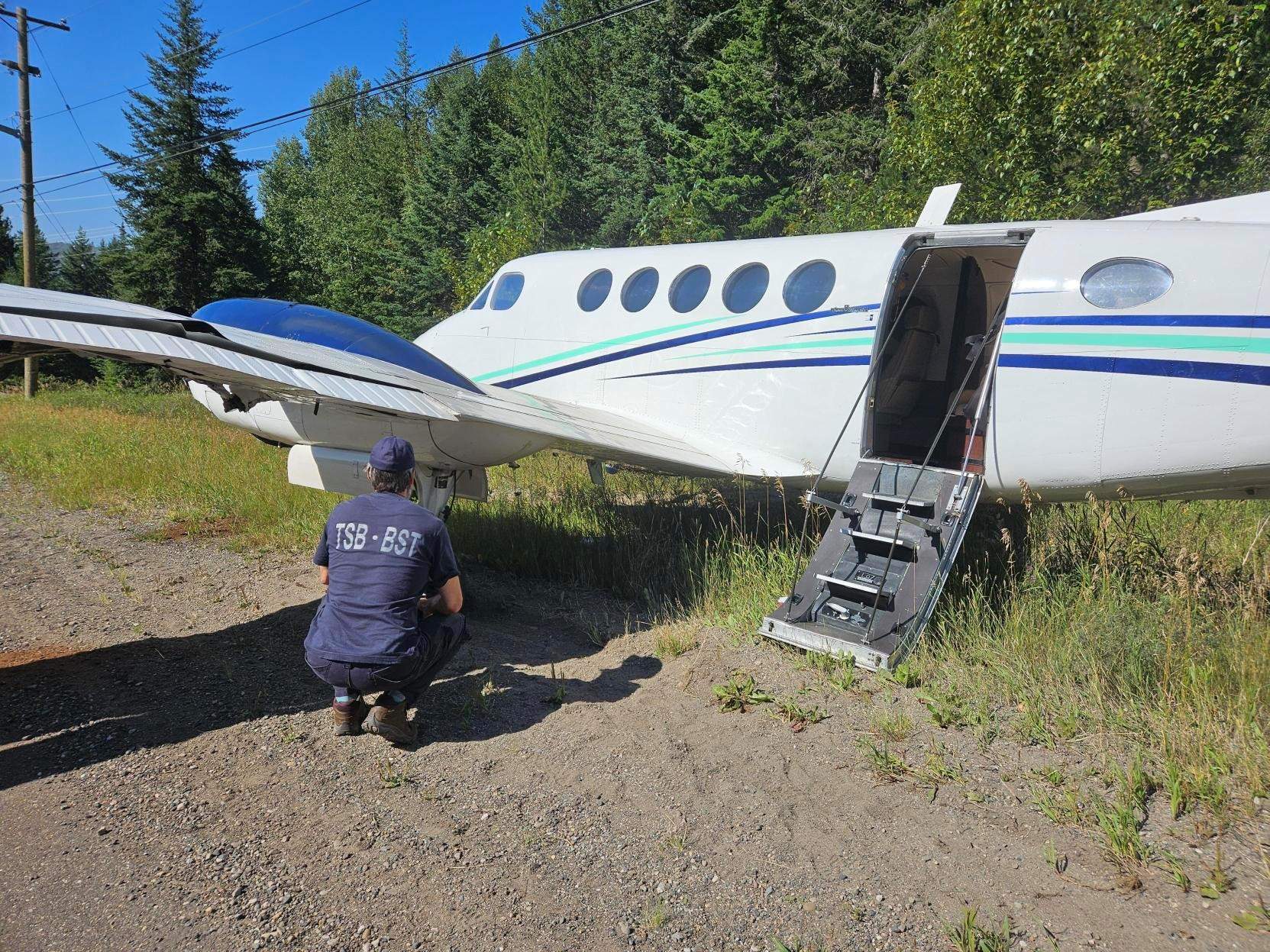
An aircraft doesn't just fall out of the sky because of bad luck. When a twin-engine Beech King Air 200 lost power on one engine over British Columbia, the resulting chaos on Foothills Boulevard turned a routine regional flight into a tragedy.
The Transportation Safety Board of Canada confirmed that the aircraft, registered as C-GEDV and operated by Sekani Air Ltd., departed Sturdee Airstrip at 1:25 p.m. heading for the Prince George Airport. Carrying two crew members and six passengers, the flight encountered severe mechanical failure en route. Instead of reaching the runway, the plane was forced into an emergency touchdown on a busy urban roadway, colliding with four vehicles and resulting in one fatality on the ground.
The Anatomy of a Twin Engine Failure
People assume twin-engine planes are foolproof. If one engine quits, you still have another, right?
In reality, flying on a single engine demands absolute precision. A Beech King Air 200 is a capable turboprop, but losing power mid-flight shifts the operational dynamics instantly. The remaining engine creates asymmetrical thrust, meaning the plane naturally wants to yaw and roll toward the dead engine. Pilots train rigorously for this exact scenario, yet executing a dead-stick or partial-power landing on a city street loaded with civilian traffic leaves zero margin for error.
The flight crew managed to bring the aircraft down without a single injury to the eight people on board. Everyone walked away from the fuselage. But the physical footprint of the landing zone tells a brutal story. Debris, broken glass, and mangled metal scarred Foothills Boulevard as the aircraft clipped vehicles trying to steer clear.
Examining the Aircraft History
Questions immediately arise about the machine itself. Aviation records show this specific airframe had previous mechanical trouble. Back in January 2024, the exact same King Air 200 was involved in an emergency incident near Kelowna where oxygen masks deployed at 20,000 feet, forcing a diversion.
Investigators from the TSB are looking into whether maintenance history or component wear played any role in the loss of engine power. However, aviation experts caution against jumping to conclusions before teardown analyses of the powerplants are complete. Mechanical failures can stem from fuel contamination, unexpected internal component fatigue, or environmental factors like bird ingestion.
The Reality of Urban Emergency Landings
Pilots are taught that when an engine fails and reaching a designated runway is impossible, you pick the safest clearing available. Usually, that means a field, a clear stretch of water, or, as a last resort, a straight stretch of highway.
Foothills Boulevard is a major arterial route connecting central Prince George to the northern neighborhoods. It's busy. It has power lines, light standards, and moving cars. When a pilot commits to landing a multi-ton turboprop on an asphalt road surrounded by urban infrastructure, the physics of stopping distance collide with civilian presence. Four vehicles were struck during the rollout, injuring motorists and bystanders, and tragically claiming one life on the ground. Paramedics assessed multiple other patients at the scene, transporting several to local hospitals in stable condition.
Federal investigators arrived on site rapidly to map the debris field, interview witnesses, and secure the flight data recorders. Complete TSB safety investigations take months, sometimes over a year, to piece together the sequence of pilot inputs, engine telemetry, and air traffic control communications.
For now, the focus remains on the systemic safety questions facing regional commercial operators in northern British Columbia, where rugged terrain and remote strips make mechanical reliability a matter of survival.